
In lithium-ion battery manufacturing, precise measurement during the coating process is critical. For engineers and quality managers working with lithium-ion battery electrodes, one of the most important parameters to monitor is the basis weight of anode and cathode coatings. Basis weight refers to the weight of the coating material applied to the foil or film substrate. This is typically measured in grams per square meter (g/m²).
Historically, krypton beta (Kr-85) gauges have been the standard for this application. However, advancements in x-ray technology have made older beta gauge technology obsolete.
If you’re still relying on beta gauges, here’s why it might be time to make the switch to x-ray measurement systems.

1. Higher Accuracy & Repeatability
X-ray offers higher measurement accuracy & repeatability compared to krypton (beta) gauges for basis weight measurement. While beta particles scatter in all directions from a decaying radioactive isotope, x-ray offers a much stronger & controlled signal. These advantages are crucial for:
- Detecting coating edge transitions
- Capturing detail in lane or patch coatings
- Reducing excessive signal averaging
- Maintaining measurement stability even with web flutter (up-and-down movement of the web as it passes through the gauge)
Krypton beta gauges suffer from a worse signal-to-noise ratio, requiring the measurement software to “smooth”, or average, the profile data. This makes it difficult to pinpoint critical variations in coating weight, especially in high-precision applications.
Germany-based CustomCells is one of many battery manufacturers that made the switch from beta to Scantech x-ray gauges. Watch their testimonial below to learn why.
2. ☢️ Safer & Non-Radioactive
Krypton beta gauges rely on Kr-85, a radioactive isotope with a half-life of 10.7 years. That brings a host of regulatory headaches:
- Strict licensing and compliance
- Cumbersome HSE (Health, Safety, and Environment) regulations
- Expensive end-of-life disposal logistics and costs
In contrast, x-ray sensors use a non-radioactive energy source by generating photons in an x-ray tube. This eliminates the need for isotope management while enhancing safety for operators. No specialized handling. No bureaucratic delays.

3. ⚡ Faster Operation for Real-Time Control
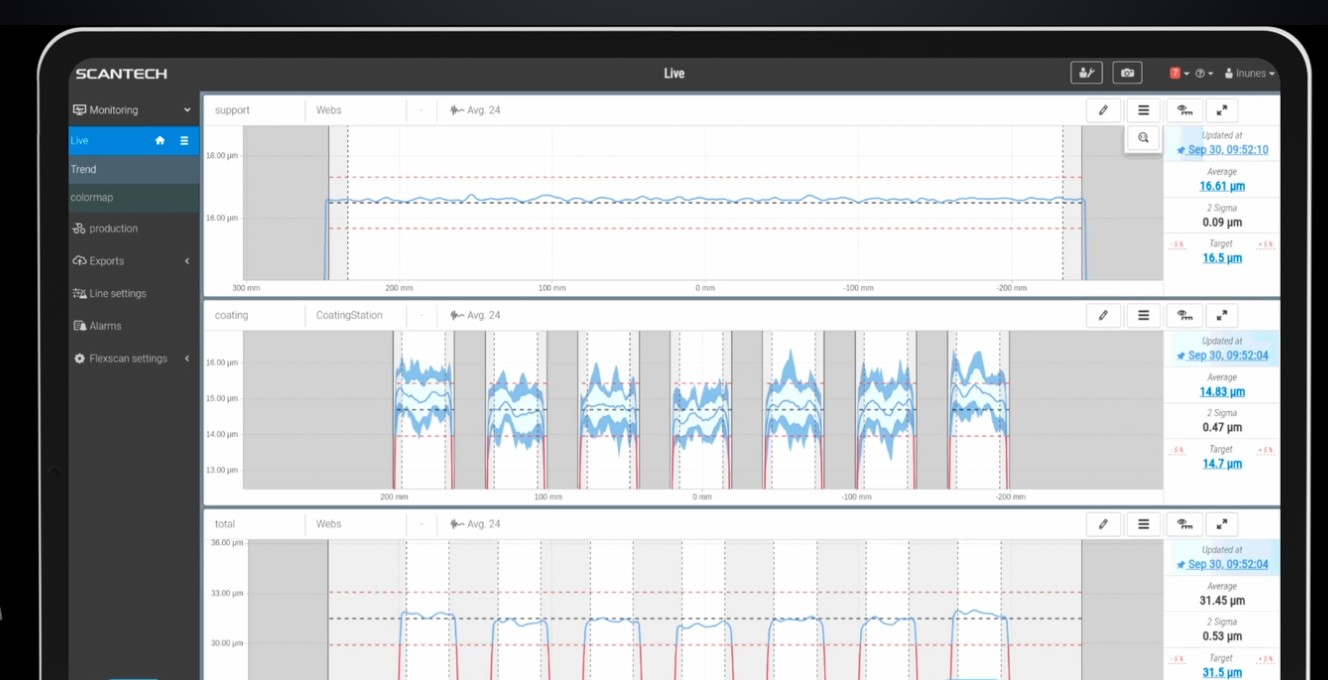
Real-time data is key for today’s precision coating lines. X-ray systems offer rapid standardization and strong detector response, making them ideal for continuous coating feedback.
Meanwhile, krypton beta gauges typically require longer standardization periods and more signal averaging, which slows responsiveness and reduces process visibility.
4. 💸 Lower Long-Term Operating Costs
Though both systems are offered at a similar price point, the long-term cost savings of x-ray systems are substantial. Consider the hidden costs of beta gauges:
- Ongoing compliance and licensing fees
- Source decay leading to poor measurement quality
- Eventual radioactive source disposal (thousands of dollars)
X-ray systems eliminate these burdens entirely, delivering lower total cost of ownership and better ROI.
Final Takeaway
For anode and cathode coating lines, x-ray measurement systems are the best choice for modern battery manufacturers. They deliver:
✅ Higher accuracy & repeatability
✅ Safer, non-radioactive operation
✅ Faster real-time feedback
✅ Lower operational overhead
If you’re evaluating measurement systems for basis weight control, x-ray is a clear winner. It’s not just a replacement for krypton beta gauges. It’s a competitive advantage.
Why Scantech Is the Leader in Battery Coating Measurements
Scantech is a global leader in non-contact measurement systems, and their x-ray technology is proven at the gigafactory scale. Their systems are trusted for high-throughput measurement and closed-loop coating line control. With over 7,000 systems installed worldwide, Scantech delivers:
- High-resolution basis weight measurement
- Fast response times for closed-loop control
- Long-term stability with minimal maintenance
- Auto calibration for coating composition changes
Whether you’re running wet slurry coatings or printed coatings, Scantech has proven expertise in battery electrode production environments.
📞 Take the Next Step
👉 Ready to add or upgrade your coating measurement system? Contact Gauge Advisor to learn about the best measurement solution for your battery coating application.

Founder, Gauge Advisor LLC
👉 Read this next: Engineer’s Guide: Web Gauging Technology for Extrusion and Coating Lines