
Resin Conveying Vacuum Pump Sizing Calculator
Estimate airflow and vacuum demand for your resin-conveying route, then use the result to discuss an ABS pump and conveying system with Gauge Advisor. Start with the material, peak rate, line size, distance, and lift.
- Build the operating pointScreen line airflow, route restriction, and material-loading demand together.
- See the starting pointIdentify an initial Tranquility or larger ABS pump range for manufacturer review.
- Continue with your dataCarry the inputs and result into an editable engineering-review request.
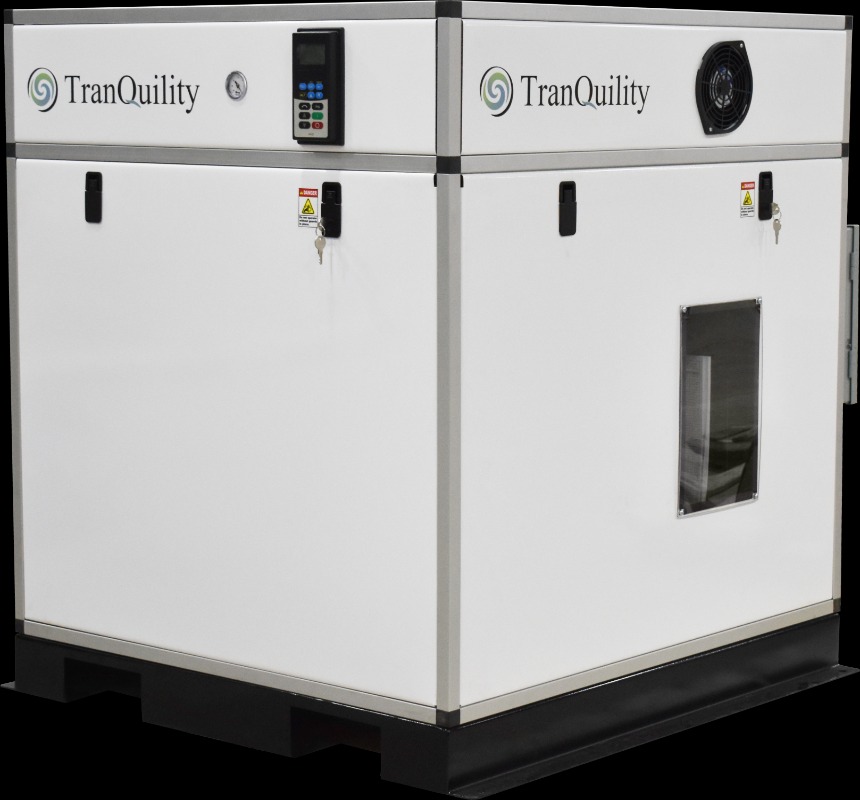
Control pickup velocity, the air speed that picks up and carries resin. Tranquility combines a twin-lobe positive-displacement blower, severe-duty motor, acoustic enclosure, and standard variable-frequency drive in 5–25 HP packages.
Estimate the most demanding conveying route
Use peak transfer rate—not average extruder or press consumption—and enter the longest or most restrictive route one pump must support. Shared central systems still require a sequencing and simultaneous-demand review.
Enter the design case
The example values below reproduce a common single-route planning case. Replace them with the actual worst-case route before using the result.
Calculator loading. If this message remains, confirm that JavaScript is allowed on this page.
Example values are loaded: 1,000 lb/hr through a 2.5 in ID line with 50 ft hard pipe, 10 ft flex hose, 15 ft lift, and five bends.
Pump demand starts with the line—and ends with the complete operating point
Horsepower alone does not describe a conveying system. Airflow, vacuum, material loading, and the hardware around the pump have to work together.
Line inside diameter
Diameter sets the air volume needed to reach a useful velocity. A small ID can be restrictive; a larger ID can require substantially more CFM.
Route restriction
Hard pipe, flex hose, vertical lift, bends, pickup geometry, receiver, and filtration all contribute to the vacuum operating point.
Peak material demand
Receiver fill rate can be much higher than average process consumption. Material density, shape, regrind, fines, and fillers change loading behavior.
System timing
A shared central system depends on sequence timing and simultaneous demand. One-route math cannot replace the plant-wide controls review.
Control pickup velocity, the air speed that picks up and carries resin
ABS Tranquility packages combine a severe-duty high-efficiency TEFC motor, twin-lobe positive-displacement blower, synchronous belt drive, acoustic enclosure, and standard VFD in published 5, 7.5, 10, 15, and 25 HP sizes.
The VFD lets the control system adjust pump speed from inlet-pressure feedback to manage programmed pickup velocity. That creates a practical path to reduce excessive velocity, angel hair, fines, material degradation, noise, and avoidable energy use where the complete system supports it.

A pump only works as well as the system around it
Gauge Advisor and ABS can turn the route screen into a coordinated receiver, pickup, filtration, sequencing, controls, and pump package—whether the project is new equipment or an existing resin-handling system service or retrofit.
Airflow, vacuum & velocity control
Select the blower at the operating point, then configure VFD, relief protection, electrical, enclosure, and service access.
View ABS Tranquility details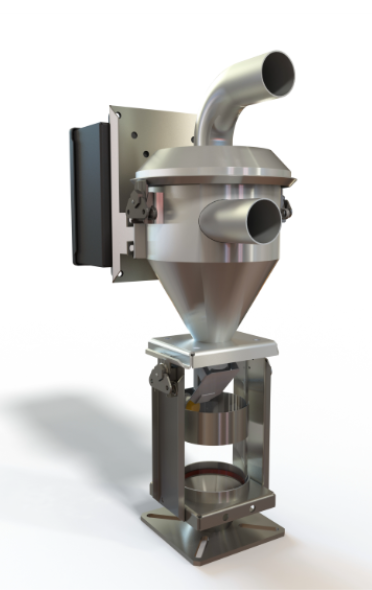
Receivers & pickup points
Receiver volume, fill cycle, pickup geometry, discharge hardware, and material demand determine the real transfer duty.
Explore resin conveying systems
Filtration & air management
Filter area, dust loading, fines, leaks, and maintenance condition directly affect restriction and long-term pump performance.
Review resin dust collection & air filtration
Sequencing, controls & data
Coordinate receiver demand, pump speed, alarms, proof-of-vacuum, plant communications, and scalable system expansion.
Explore resin controls & automationReview your pump estimate with ABS
Continue with your calculator inputs and results in an editable application request. Add your current bottleneck or expansion goal. Gauge Advisor can review the setup with ABS, select the conveying equipment and provide a quotation for the confirmed pump, receiver, filtration and controls scope.
Connect pump demand to the rest of the resin-handling project
Choose the next tool for your project, from equipment selection to estimating potential savings.
How to use this preliminary estimate
The tool is designed to make the first application conversation more productive, while keeping final system design where it belongs: on the complete application and manufacturer performance curve.
Is this a final vacuum-pump selection?
No. It is a preliminary application screen. Final horsepower and blower selection require the complete CFM-and-vacuum operating point, blower performance curve, design margin, material behavior, pickup, receiver, filtration, route, altitude, electrical requirements, controls, duty cycle, and simultaneous demand.
Why can line diameter influence pump size more than throughput?
Line inside diameter determines the volume of air needed to reach a useful conveying velocity. Throughput still matters because it changes solids loading, capacity margin, and vacuum demand, but adding pounds per hour does not translate into an equal linear increase in CFM.
What is equivalent distance?
Equivalent distance is a planning way to combine straight hard pipe with added restriction from flex hose, vertical lift, and bends. This calculator uses 1.5 times flex-hose length, the entered lift, and 12 feet per 90-degree bend. Pickup, receiver, filtration, bend radius, and actual construction still require review.
How do flex hose and bends affect the estimate?
Flex hose and bends add turbulence and resistance, raising the estimated vacuum operating point and reducing practical route capacity. Short, smooth hard-pipe routes with properly designed long-sweep bends are generally easier to convey through than flex-heavy routes.
Why does vertical lift matter?
Vertical conveying adds static and dynamic demand and increases sensitivity to pickup condition, material fallback, slugging, and air leaks. A route with meaningful lift should be checked using the exact material, receiver, pickup, and blower curve.
What is different about an ABS Tranquility pump?
Tranquility is an enclosed 5–25 HP vacuum-pump family with a severe-duty high-efficiency TEFC motor, twin-lobe positive-displacement blower, synchronous belt drive, acoustic treatment, service-access features, and standard VFD. Allen-Bradley, Beckhoff, and custom control choices are published.
How can VFD velocity control reduce angel hair and material degradation?
ABS velocity control uses pump-inlet pressure feedback to adjust pump speed toward a programmed pickup velocity. Where the complete system allows, avoiding unnecessary speed can reduce pellet impacts, friction, angel hair, fines, noise, material degradation, and avoidable energy use.
Can ABS review flakes, regrind, powders, filled materials, or an existing system?
Yes. Those applications often depend on representative bulk density, particle shape and size, fines, moisture, pickup and separator design, filter loading, route details, and current equipment. The calculator flags these materials for application review rather than automatically ruling them out.
Engineering basis and limitations
This calculator is provided solely for preliminary informational, educational, and resin-conveying application-screening purposes. Airflow, vacuum, pressure-drop, line-air-velocity, layout-capacity, and pump-bracket outputs are theoretical estimates based on simplified pneumatic-conveying assumptions, representative apparent bulk densities, equivalent-distance factors, empirical derates, and user-entered inputs. They are not guaranteed performance values.
Actual performance can be affected by material size, shape, apparent bulk density, temperature, moisture, regrind, flakes, fines, dust, additives, fillers, pickup and receiver design, filter condition, air leaks, pipe material and ID, bend radius, flex construction, route, elevation, relief settings, blower curve, motor speed, electrical configuration, controls, duty cycle, ambient conditions, and simultaneous demand.
The CFM-to-HP bands are Gauge Advisor nominal planning brackets—not published ABS airflow ratings. Results are not a final design, guaranteed throughput, final pump or blower selection, utility requirement, safety review, binding quotation, engineering certification, warranty, or order code.
Gauge Advisor tool terms
© 2026 Gauge Advisor LLC. Gauge Advisor's original calculator source code, sizing workflow, explanatory content, interface, route visualization, and output presentation are protected by applicable law and the Gauge Advisor Terms of Use.
Advanced Blending Solutions, Tranquility, product-family names, specifications, trademarks, and manufacturer materials remain the property of Advanced Blending Solutions or their respective owners. Final equipment must be confirmed from current manufacturer literature and application review.
© 2026 Gauge Advisor LLC. Preliminary resin-conveying application tool.