
Updated March 10, 2026
When unloading a railcar or truck of plastic resin into your silos, it is easy to assume the amount listed on the invoice matches what you actually received. The reality is that even small discrepancies can cost your plant a lot of money over the course of a year.
That is why many processors are now installing inline weighing systems with gravimetric hoppers, load cells, and rotary airlocks. These systems are typically integrated into modern resin conveying and blending systems, allowing processors to verify incoming material before it enters silo storage. They give you a straightforward way to check every load before it goes into storage, so you know you are paying for the right amount of material.
Why Railcar Resin Verification Matters
For many plastics processors, raw material is the single largest operating cost. Even small discrepancies in incoming resin weight can quietly impact profitability over time.
Without a verification system, plants rely entirely on supplier documentation. By installing railcar weighing systems with gravimetric hoppers and load cells, processors gain independent confirmation of every shipment.
This simple verification step improves inventory accuracy, supports procurement discussions, and ensures plants only pay for the material they actually receive.
How a Railcar Weighing System Works
The concept is simple. Resin is conveyed from the railcar or truck into your silo through either vacuum conveyance or pressure conveyance. For vacuum conveying systems, correctly sizing the vacuum pump is critical for maintaining consistent material flow. Engineers can estimate system requirements using this vacuum pump sizing calculator. By placing gravimetric hoppers on load cells in the line, you can weigh the material as it flows through. A rotary airlock ensures consistent discharge and stable material flow through the weighing system. Depending on your setup, the hoppers tie into either a vacuum pump or a pressure pump.
To size the system correctly, we only need 5 pieces of information:
- Whether you use vacuum or pressure conveying
- The bulk density of your material
- Your flow rate in pounds per hour
- Existing conveyance distance from railcar to silo (feet)
- Conveying line diameter (inches)
With those details, the rest is straightforward.
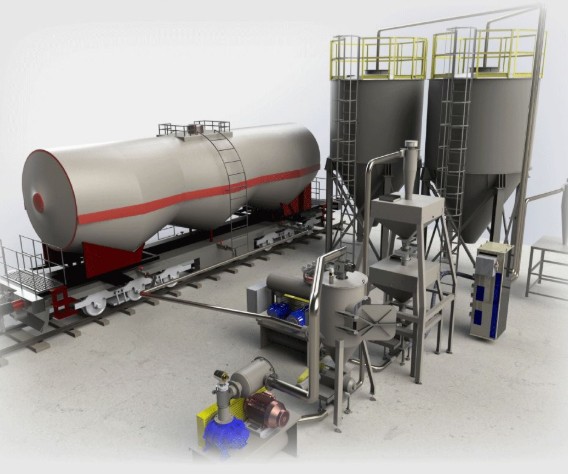
Rendering of a railcar unload system from Advanced Blending Solutions (ABS).
The ROI is Too Good to Ignore
Let’s put numbers on it. A typical railcar of polypropylene holds about 180,000 pounds. At $0.75 per pound, that shipment is worth $135,000.
Now imagine the weight is off by just 1 percent. That is 1,800 pounds of material, or $1,350, that you are paying for but not receiving. If you unload 30 railcars a year, that is more than $40,000 lost annually.
What if the error is 2 percent? That is $2,700 on a single railcar, or over $80,000 per year.
The payback on a railcar unload weighing system is often measured in months. In some cases, just catching one short load can cover the entire investment. If you’re evaluating a project like this, you can estimate the financial impact using the Resin Conveying & Blending ROI Calculator.
And this is not limited to plastics. Powders, chemicals, food ingredients, or any other high-value bulk material delivered by rail or truck can benefit. If it flows into a silo, it can be verified.

A set of Mobihoppers from Advanced Blending Solutions (ABS). These hoppers are outfitted with load cells and integrated into a railcar-to-silo pressure conveying system.
Protect Your Plant and Keep Suppliers Honest
Most resin suppliers do their best, but paperwork errors and loading mistakes happen. By weighing every railcar unload, you have proof of what you received. That protects your margins and strengthens your position in procurement discussions. It also removes uncertainty, giving your team confidence that the numbers in your system are accurate.
Gauge Advisor & Advanced Blending Solutions: Railcar Resin Weighing Systems
Advanced Blending Solutions (ABS) builds gravimetric hoppers, load cell systems, and material handling equipment in Michigan. Their team understands the unique requirements of plastics plants and has proven solutions for railcar weighing.
Gauge Advisor works directly with ABS and can help you set up the right system. To get started, all we need to know is your convey setup, the bulk density of your material, and your flow rate. Want an in-person audit? We’re happy to arrange an on-site visit!
Advanced Blending Solutions (ABS) is a Michigan-based designer of material handling, blending, desiccant drying, and controls for the plastics industry.
Let’s Review Your Resin Unloading System
If bulk resin is one of your largest operating costs, verifying incoming material is one of the fastest ROI projects you can implement.
Gauge Advisor works with plastics processors to evaluate railcar unloading systems, gravimetric weighing solutions, and resin conveying upgrades.
📄 Review your current railcar unloading process
📊 Estimate ROI from resin verification and weighing systems
🏭 Discuss integration with your existing conveying equipment
Gauge Advisor is an authorized sales and support partner for Advanced Blending Solutions, supporting manufacturers with equipment selection, application guidance, and system integration.
If you’re evaluating a railcar unloading system for your process, request application guidance using the form below.

 By: Matthew Baker
Founder, Gauge Advisor LLC
👉 Read these next:
Why Tranquility Industrial Vacuum Pumps Outperform Traditional Vacuum Pumps
Eliminating Angel Hair: How an Angel Hair Trap Enhances Plastics Manufacturing Efficiency