
Prepreg · Resin film · Continuous impregnation
Prepreg & Impregnation Basis Weight Measurement
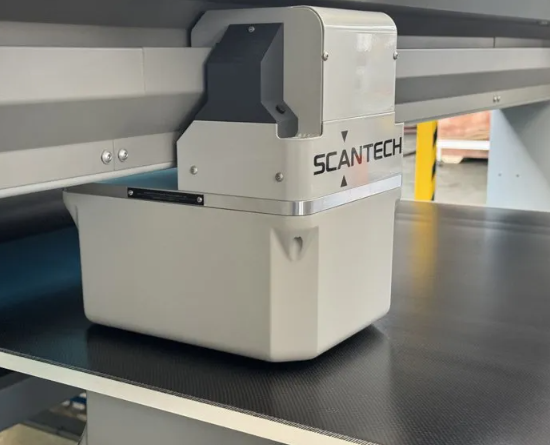
See resin application variation before the roll is finished. Scantech web gauging systems help evaluate total basis weight and net resin add-on on continuous composite and impregnation lines.
For carbon or glass reinforcement, resin film and carrier-based processes, the starting question is the same: which part of the material’s weight needs to be controlled?
Define the material contribution
Total prepreg weight is only the starting point.
Basis weight is mass per unit area. A transmission measurement responds to the combined material in the beam, so the reinforcement, resin and any carrier all matter.
| Required result | What it describes | What must be defined |
|---|---|---|
| Total basis weight | The mass per area of the measured web stack. | Which reinforcement, resin, liners and other constituents are present at that location. |
| Net resin add-on | The resin contribution after accounting for the other material contributions. | A reliable reinforcement or carrier baseline, the measurement condition and how positions are matched. |
| Resin mass fraction | The resin share of the defined dry prepreg mass, expressed as a percentage. | A validated net resin calculation and an agreed material and laboratory definition. |
| Physical thickness | The geometric thickness of the specified structure. | A suitable thickness method; any conversion from mass requires an appropriate density and material model. |
Swipe to see all columns.
Separate the resin from the reinforcement baseline. A steady total basis weight can hide resin variation if the incoming fiber or fabric weight also changes.
Net add-on & resin content
Make the calculation match your material.
For a defined dry prepreg made of reinforcement and resin, net resin add-on is the dry prepreg basis weight minus the dry reinforcement basis weight. Resin mass fraction is that net resin add-on divided by the dry prepreg basis weight.
Carriers, liners, retained volatiles and other constituents must be excluded or accounted for. Retained volatiles are substances that can evaporate but are still present at the measurement stage. Agree on the calculation definition and reference method before using the result to accept production.
When does the baseline need its own scanner?
If reinforcement or carrier variation is significant relative to the resin tolerance, an upstream measurement can provide the baseline for a downstream net result.
Same Spot can coordinate scan paths so the calculation compares corresponding web positions. Travel time, speed changes and alignment are part of that setup.
Choose the measurement location
Three useful starting points for an impregnation line.
Resin film on a carrier
Evaluate the coated carrier against a reliable carrier baseline. Define whether the target is wet pickup or the dried resin film.
Before and after impregnation
Compare the incoming reinforcement with the processed web when net resin add-on is the priority.
Finished prepreg verification
Follow total basis weight in the agreed final condition. Add a reliable reinforcement baseline if resin percentage is required.

Wet pickup and final resin content describe different conditions.
A measurement before drying includes the liquid formulation. A post-dryer measurement describes the material at that later stage and may still include residual volatiles. Use the measurement location that supports the process decision, with laboratory checks for properties such as volatile content, how fully the resin wets the reinforcement (wet-out), and cure behavior.
FLEXSCAN profiles & records
Turn cross-web variation into a clearer operating picture.
Use live profiles and trends to distinguish a persistent cross-web pattern from a changing average. Set up recipes, targets and alarms for the measurements and material condition your system provides.

Follow the profile
Review edge-to-edge variation and successive scans against the operating limits for the product.
Support repeatable setups
Use defined product recipes and clear alarm targets to help operators respond consistently.
Plan the production record
Specify roll views and reports, with TREX for deeper retrieval and organization when included.
View a representative roll report

Measurement & line integration
Fit the gauging system to the material and the machine.
Start with the reinforcement, resin formulation, carriers and expected ranges. Representative samples and the plant’s reference method help establish the measurement approach before selecting the frame and installation details.
Scantech O-frame platforms, including ULO3, provide scanning options for coated-web applications. Web width, access, environment and available space determine the appropriate fit.
Explore complete web gauging systems →Connect the reading to the right response.
A profile can guide an operator or feed a machine interface. Optional automatic correction requires a compatible coating actuator and a commissioned strategy, such as an agreed applicator-gap, roll-speed or feed-pump adjustment.

Web handling belongs in the review too. FMS web tension load cells and amplifiers provide a separate force measurement for the transport and tension-control system.
Watch the overview
Scantech measurement systems in operation
See scanning systems in a continuous-web production setting. This manufacturer video features extrusion applications.

Plan the project
Related solutions and practical calculation tools.
Review the measurement stations and web-handling requirements as one line project.
Check unit conversions using material assumptions appropriate to the result.
Use your resin costs, throughput and achievable reduction in over-application.
Explore variation against tolerances using representative data from a defined measurement method.
Planning to replace a beta gauge?
Evaluate the X-ray response of your reinforcement, resin and carriers alongside the installation, controls and reporting requirements.
Further reading: X-ray transmission web gauging · Scantech coating-system brochure.
Common questions
Prepreg measurement FAQ.
Can one scanner measure resin content?
The gauge responds to the combined material in the beam. Resin percentage needs a reliable reinforcement and carrier baseline, a defined material condition and a validated calculation. A nominal baseline is useful only when its variation is small enough for the required result.
When are two measurement stations useful?
When variation in the incoming reinforcement or carrier needs to be separated from the applied resin. Registered before-and-after measurements can support net add-on calculations.
Should measurement be before or after drying?
Before drying can support wet-pickup feedback. After drying supports evaluation in the defined later material condition. Some processes benefit from both.
Does correct basis weight prove complete impregnation?
No. Basis weight does not establish internal wet-out, tack, flow, cure state or mechanical performance. Continue the appropriate material and laboratory checks for those properties.
Can X-ray replace our existing beta gauge?
Potentially. Review representative material samples, required results, installation space, controls and reporting before selecting the replacement system.
Application review
Let’s review your resin application process.
Send the material construction and the production question you need to answer. I’ll help define the measurement scope and coordinate evaluation with Scantech.
Helpful details to send
- Reinforcement, resin formulation, carriers and liners
- Total basis weight and resin add-on ranges and tolerances
- Wet or dry targets and the laboratory reference method
- Web width, speed, line drawing and available scanner positions
- Representative samples and your control and reporting requirements
A drawing, sample description or current gauge specification is a useful starting point.