Technology Guide for Engineers Evaluating X-Ray Web Gauging Systems
X-ray transmission web gauging is an online measurement method used to measure basis weight, coating weight, and in some cases thickness by analyzing how low-energy X-rays are attenuated as they pass through a moving web. It is widely used on film, sheet, coating, battery, lamination, foil, paper, and other continuous web processes where cross-direction profile control matters.
For many engineers, the most important distinction is this: X-ray transmission fundamentally measures mass per unit area. It does not directly measure physical thickness the way an optical gauge does. Thickness can be inferred only when the material system has a stable and known composition or density relationship.
This page explains how X-ray transmission web gauging works, why it is often superior to older beta and gamma web gauges, how it compares with infrared and laser measurement, where it fits best, and why technologies such as those developed by Scantech are often chosen for high-resolution basis weight and profile control applications.
The relationship between transmitted X-ray intensity, material composition, and thickness is governed by well-known attenuation coefficients that vary with photon energy and atomic number. Reference values for these interactions are documented in the X-Ray Data Booklet published by Lawrence Berkeley National Laboratory, a widely used reference for X-ray material interaction data.
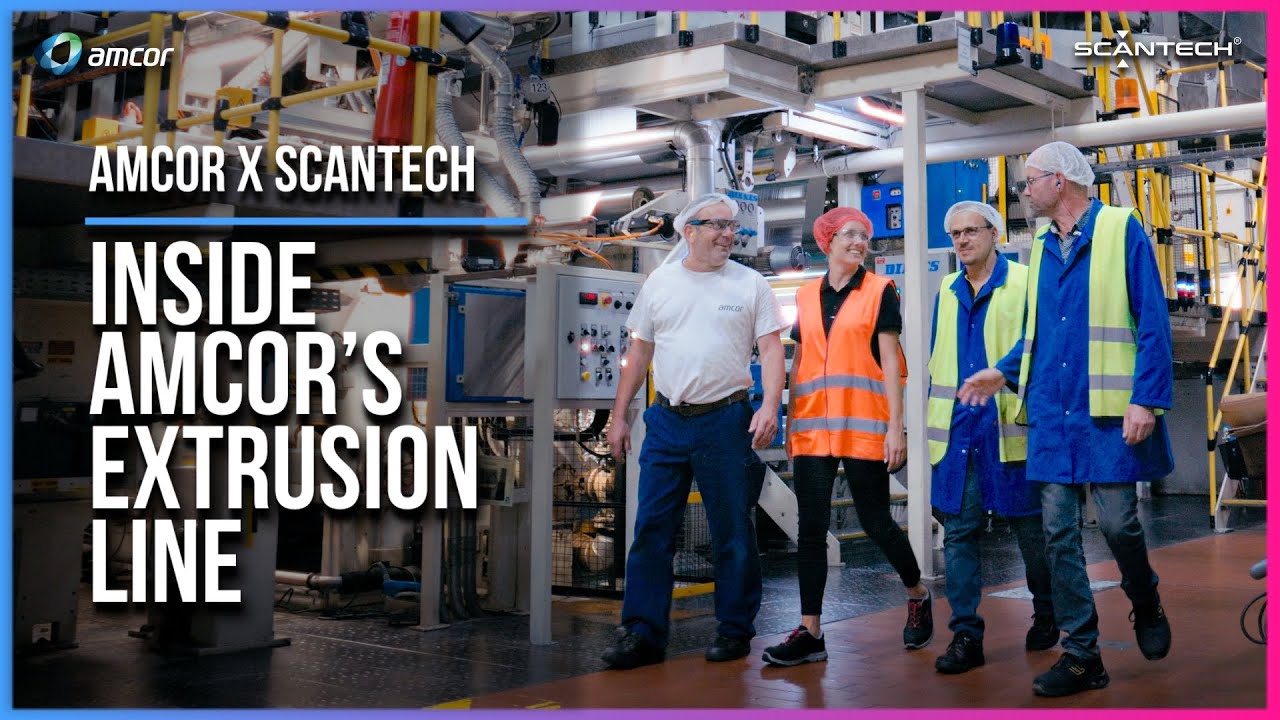
This short video helps visualize how a scanning X-ray gauge measures basis weight and profile variation across a moving web and supports process control on film and sheet extrusion lines.
On continuous film, sheet, coating, and battery lines, average thickness is only part of the story. The real production challenge is usually profile control across the width of the web. Cross-direction variation drives scrap, poor roll quality, coating non-uniformity, converting issues, and inconsistent downstream performance.
Web gauges reveal how the product varies across the width so operators can detect thick spots, thin spots, edge shape issues, and die-related profile problems.
Accurate, fast response profile data improves manual or automatic control of die bolts, coating heads, line speed, and other process variables.
Better measurement allows engineers to reduce giveaway, tighten targets, and shorten startup time without losing confidence in product quality.
Profile graphs, trends, alarms, and roll reports make it easier to understand what happened during production and prove process capability.
This is where X-ray transmission web gauging becomes so valuable. It gives manufacturers continuous, high-resolution measurement of basis weight or coating weight across the web and turns that information into actionable process control.
X-ray transmission web gauging is an online measurement method that uses low-energy X-rays to measure how much material is present in a moving web. As the X-ray beam passes through the product, some of the energy is absorbed and some reaches the detector. The amount of attenuation is directly related to the mass per unit area of the material in the measurement path.
In practical terms, that means X-ray transmission gauges are fundamentally mass-based measurement systems. They are especially useful for measuring basis weight, coating weight, and mass distribution across a web. If the composition and density of the product are stable, the same signal can also be correlated to thickness. But the primary physics is still mass per unit area, not direct geometric thickness.
This distinction matters because it explains why X-ray web gauges are often excellent on coated products, battery electrodes, filled films, and other applications where weight distribution is the real control variable. It also explains why optical thickness gauges may still be the better choice on foams, recycled-content film, or products with significant density variation.
In modern systems, the sensor is mounted on a scanning frame that moves across the web, creating a cross-direction profile. That profile can then be displayed, trended, used for alarms, exported for reporting, and tied into manual or automatic process control.
At a high level, X-ray transmission web gauging works through a straightforward sequence:
This is why X-ray transmission is so effective for web gauging. It does not rely on occasional spot checks. It produces continuous process data that can be used for profile visualization, trend analysis, alarms, roll reports, and closed-loop process control.
In many production lines, the scanner is also connected to control systems for die bolts, coating stations, or line speed. That allows measurement to move beyond observation and become part of the process improvement loop.
X-ray transmission measures how much material is in the beam path. That is why it is naturally suited to basis weight and coating weight control and why thickness only becomes a valid output when density and composition are stable.
Engineers often search for terms like x-ray thickness measurement, but the cleaner technical description is usually x-ray basis weight measurement or x-ray coating weight measurement. The X-ray signal is directly linked to absorbed mass. Thickness is a derived result that becomes reliable only when the material density relationship is predictable.
That means X-ray transmission is often an excellent choice when:
By contrast, if density varies significantly because of foam structure, recycled content, voided film, or changing composition, an optical thickness gauge may be more appropriate.
| X-Ray Transmission | Optical Thickness Gauge |
| Directly measures mass per area | Directly measures geometric thickness |
| Excellent for basis weight and coating weight | Excellent for true physical thickness |
| Thickness valid when density is stable | Less dependent on density stability |
| Strong fit for coated webs and weight control | Strong fit for foams, recycled content, and variable density products |
One of the most misunderstood topics in web gauging is response time. Faster response is not just a spec-sheet bragging point. It directly affects how accurately the scanner reproduces the real profile as it moves across the web. If response time is too slow relative to scan speed, peaks and valleys are flattened and the measured profile no longer matches the real profile.
In practical process-control terms, that means slower response reduces your ability to detect streaks, edge changes, narrow defects, or true bolt-related variation. It also slows the effectiveness of die control because the control system is reacting to a blurred version of the actual web profile rather than the real one.
Modern X-ray scanners can support fast response while maintaining usable signal stability. Older beta and gamma systems often cannot because reducing their response time increases statistical noise too much. That is why X-ray transmission has such a major advantage in high-resolution web profile applications.
For most industrial scanning conditions, the practical engineering goal is not an extreme response number for marketing purposes. It is a fast enough response to reproduce the real profile accurately while still maintaining acceptable measurement stability.
X-ray transmission and legacy nuclear gauges do not behave the same way in real production. X-ray offers better practical response, stronger streak and edge detection, and avoids the operational burden of isotope-based sources.
Not all online web measurement technologies solve the same problem. Engineers evaluating a web gauging system need to match the measurement physics to the product and the control objective.
X-ray transmission is often preferred when the goal is precise basis weight or coating weight measurement with fast profile response, low flutter sensitivity, strong edge detection, and no isotope handling burden. Beta and gamma systems were important historically, but they carry source management issues and often have weaker practical response for high-resolution profile control.
| Technology | Best Known For |
| X-Ray Transmission | High-precision basis weight or coating weight measurement, strong profile control, non-isotope operation |
| Beta | Legacy isotope basis weight measurement with slower practical response and source management burden |
| Gamma | Older low-resolution isotope gauging, often weakest profile fidelity in demanding applications |
| Infrared | Good for selected calibrated material systems, but sensitive to composition and recipe changes |
| Laser & Confocal | Direct optical thickness measurement, especially valuable when density is inconsistent |
In many real plants, the best solution is not a simplistic technology ranking. It is selecting the right sensor physics for the specific product. That is why some manufacturers use X-ray alone, some use laser or confocal alone, and some combine X-ray and laser or confocal to understand both mass and true thickness.
A scanning X-ray gauge becomes much more valuable when it is tied into die control, machine direction control, alarms, and software that helps operators act on the profile rather than just observe it.
The reason web gauges create such strong ROI is not just that they measure the product. It is that they create a feedback loop. A high-resolution cross-direction profile helps the operator or control system understand which part of the process is causing the variation and where to make the correction.
On extrusion lines, that often means die bolt control and machine direction control. On coating lines, it may mean controlling the coating process based on substrate, wet, and dry measurements. On battery lines, it may mean understanding coating distribution, coating add-on, and profile stability before and after critical process steps.
A modern web gauging system is not just a sensor on a frame. The software matters because it turns raw measurements into usable process information. Engineers need to see live cross-direction profiles, machine-direction trends, alarms, statistics, target comparisons, and report history in a way that helps them make decisions quickly.
This is also where long-term process value is created. Good software supports recipe handling, roll-by-roll traceability, exportable data, quality reports, operator dashboards, and optional integration into plant-wide systems. For many facilities, those workflow benefits become just as important as the sensor physics.
In other words, the best X-ray web gauging system is not just the one with a strong detector. It is the one that helps your operators and engineers use the measurement effectively every shift.
X-ray transmission web gauging fits a wide range of continuous web processes. On Gauge Advisor, the most relevant categories include:
Inline measurement and control for cast film, blown film, biaxially oriented film including BOPP and BOPET, sheet extrusion, and other flat-web polymer processes.
Continuous web-based coating measurement where add-on weight, profile uniformity, and process control matter.
Substrate, wet coating, dry coating, and density-related workflows on anode and cathode production lines.
Applications where basis weight, coating add-on, density correlation, and profile control drive product quality.
Any continuous process where weight uniformity, profile resolution, fast control response, or additive distribution is more important than occasional lab sampling.
Advanced coating lines may use multiple scanners to compare substrate, wet coating, dry coating, and downstream results. That allows engineers to see where variation is entering the process rather than only where it ends up.
Related reading: why X-ray is the superior choice for anode and cathode coating measurementFor cast film, sheet, and blown film applications, Scantech also highlights the ability to measure filler or additive loading, including CaCO3, TiO2, and BaSO4. That is important on breathable films, white films, barrier structures, and other formulations where additive distribution directly affects cost and product performance.
In those cases, the gauge is not only helping with cross-direction uniformity. It can also help the plant understand blend consistency, additive usage, and how formulation changes show up across the web.
One of the advantages called out in the extrusion literature is scanner flexibility. The cast and sheet platform is presented as covering web widths from about 0.5 meters up to 11.5 meters, which already covers a broad range of cast film and sheet lines.
For very wide orientation applications such as BOPP and BOPET, Scantech also supports large-format scanner architectures. If you want to state widths up to 15 meters on this page, I would keep that language tied to specific BOPP/BOPET projects and confirm the exact maximum width with the latest factory quotation or product documentation.
On blown film lines, Scantech notes that the scanning frame can be configured for either vertical or horizontal film passline. That matters because plant layouts are not all the same, especially on retrofit jobs where available structure, tower access, or downstream handling may drive the scanner orientation.
The blown film literature also emphasizes measuring on the layflat rather than the bubble for faster feedback and control action, along with bubble twist angle compensation and the ability to map the measured profile back to air ring or die zones.
Battery manufacturing highlights one of the strongest use cases for X-ray transmission because coating weight and mass distribution are often more important than simple geometric thickness alone. On lithium-ion electrode lines, multiple scanners can be installed along the process to measure the aluminum or copper foil substrate, the wet coating immediately after application, and the dry coating after the drying ovens. Using synchronized same-spot measurement, the system tracks the exact same location on the moving web as it passes through each scanner. This allows engineers to directly compare foil weight, wet coating add-on, and final dry coating mass, providing a clear view of coating uniformity, drying behavior, and overall process stability.
On anode and cathode coating lines, engineers are typically most concerned with coating add-on, mass loading, distribution, and consistency across the web. X-ray transmission directly addresses this mass-based control problem by measuring coating basis weight and visualizing the cross-direction profile while also enabling upstream versus downstream comparisons. For true physical thickness, which is often more important after the calendering process, a combined confocal and X-ray gauge can be installed to measure thickness, basis weight, and density simultaneously.
Related tool: coating weight, thickness & density converterThis video shows how multiple synchronized measurement stations can be used on lithium-ion electrode lines to compare foil, wet coating, and dry coating conditions through the process.
Scantech is a strong example of a supplier focused on high-resolution X-ray transmission web gauging with scanning platforms, process integration, software dashboards, and automatic control options for continuous production lines.
Good X-ray web gauging is not only about detector performance. It is also about how clearly the system shows the profile, trends, alarms, and control status so operators can respond quickly and consistently.
Visit ScantechX-ray transmission web gauging is powerful, but it is not universal. The right fit depends on the product, the process, and the real control objective. That is why serious suppliers qualify the material system rather than pretending one sensor physics solves everything.
If density varies significantly, thickness inferred from X-ray may no longer represent true geometric thickness accurately.
X-ray gauges are not magic boxes. Reliable measurement depends on correct material setup, calibration workflow, and process understanding.
When true physical thickness is the main target and density is inconsistent, laser or other optical methods may be the better answer.
That does not weaken the technology. It simply means engineers should evaluate X-ray transmission the same way they evaluate any serious measurement system: by reviewing material composition, density stability, thickness or basis weight target, line speed, scan resolution needs, and control goals before choosing the final architecture.
X-ray transmission web gauging is an online measurement method that uses low-energy X-rays passing through a moving web to determine how much material is present in the beam path. It is widely used for basis weight, coating weight, and related profile control.
The system sends a low-energy X-ray beam through the web, measures how much signal reaches the detector, and converts the resulting attenuation into a calibrated measurement. A scanning frame moves the sensor across the web to create a cross-direction profile.
Fundamentally, X-ray transmission measures mass per unit area. That makes it a natural fit for basis weight and coating weight measurement. Thickness can be derived only when density and composition are sufficiently stable.
It can be used for thickness measurement when the product density is known and consistent enough that mass per area can be correlated reliably to physical thickness. If density changes significantly, the derived thickness becomes less meaningful.
X-ray transmission usually offers better practical response time, stronger streak and edge detection, lower sensitivity to flutter, and avoids isotope replacement, disposal, and signal decay issues that come with legacy beta and gamma systems.
Response time determines how well the scanner reproduces the real profile as it moves across the web. If response is too slow, narrow variations are smoothed out and the measured profile no longer matches the actual profile, which weakens process control.
X-ray transmission directly measures mass per area, while laser gauges directly measure geometric thickness. X-ray is often better for basis weight and coating weight control. Laser is often better when density is inconsistent and true physical thickness is the priority.
Good fits often include film and sheet extrusion, blown film, BOPP and BOPET lines, coating lines, battery electrode coating, lamination, foil, paper, nonwoven, and other web processes where basis weight, coating weight, or additive distribution matters.
Yes. One of the biggest benefits of a scanning X-ray gauge is that it can feed profile data into manual or automatic control strategies such as die bolt adjustment, machine direction control, and process alarms. For biaxially oriented film, X-ray transmission is often the preferred measurement technology because basis weight can be directly correlated to film stretch through the orientation process. It is especially valuable on tenter-frame lines, where it provides excellent edge resolution in the areas where the clips grip the film.
Live profiles, trends, alarms, reports, statistics, recipe handling, exportable data, and intuitive operator workflow all matter because measurement value depends on how effectively the plant can act on the information.
In some extrusion applications, yes. Systems can be configured to help measure filler or additive-related content such as CaCO3, TiO2, and BaSO4, which is valuable on breathable, white, filled, and specialty film structures where additive distribution affects both cost and product properties.
It may not be the best fit when true physical thickness is the main goal and density varies enough to break the mass-to-thickness correlation. In those cases, laser or other optical thickness methods may be more appropriate.
Estimate the financial impact of installing an online web gauging system on film and sheet extrusion processes.
Convert between coating weight, thickness, and density when evaluating whether a mass-based X-ray output can be correlated to thickness.
Review process capability when profile variation, consistency, and long-term production control are central to the discussion.
See how measurement and control upgrades can affect scrap, startup, and process efficiency on production lines.
Explore the decision factors behind selecting the right online measurement technology for web coating applications.
Learn when online profile measurement becomes valuable enough to justify investment on flat-web extrusion lines.
Gauge Advisor represents Scantech for advanced web gauging applications in selected territories and supports manufacturers evaluating X-ray transmission measurement for film, sheet, coating, battery, and other continuous web processes. Scantech is a strong example of modern non-isotope X-ray web gauging with high-resolution scanning, process integration, control-oriented software, and extrusion-specific options such as filler measurement, blown film layflat mapping, and large-format scanner platforms.
Send your product type, whether the real target is thickness or basis weight, the composition and density stability, your approximate width and line speed, the tolerance you are trying to hold, and whether you need manual visibility only or automatic profile control. We can help you assess whether X-ray transmission web gauging is the right fit and what system architecture makes sense for your application.