Updated August 2, 2026
Battery electrode coating is not one measurement. A production line may need to separate foil contribution, wet coating, dry coating basis weight, physical thickness, effective density, lane geometry, and visible defects. Low-energy x-ray is a strong basis-weight platform, but it measures photon attenuation. When coating composition or effective density changes, an x-ray-only calibration can shift, so Scantech can add an independent differential-pressure correction channel. When the requirement is physical thickness, Scantech offers confocal measurement, including a confocal-only station after calendering or a combined architecture. For a line that needs thickness, corrected basis weight, and density, the most complete path can combine confocal, x-ray, and differential-pressure signals. Confocal performance depends on a very steady, flutter-free web span, and Scantech can incorporate stabilizing rollers when the passline needs help.

What must the online measurement prove?
Basis weight, thickness, and density answer different questions. Select the closest objective before choosing the sensor or deciding whether a legacy beta system is adequate.
Anode or cathode coating basis weight
X-ray transmission is a strong starting signal when the line needs coating mass per unit area across lanes and across the web. The coating and substrate must be represented by the calibration model, and substrate contribution must be separated by a known foil value or a registered upstream measurement.
Auto-calibrated low-energy x-ray attenuation translated into coating basis weight.
Recipe range, foil contribution, lane edges, wet or dry state, dynamic repeatability, and laboratory correlation.
Physical thickness, density, porosity, chemistry, adhesion, or electrochemical performance.
Battery coating quality often requires mass and geometry
Battery coating and calendering studies treat coating thickness, mass loading, and porosity as separate physical properties because each can change with coating, drying, and pressing conditions.[8] A useful online architecture preserves those distinctions.
The aluminum, copper, polymer, membrane, or other substrate contribution must be known or measured before coating add-on can be isolated reliably.
Usually reported in g/m². It is the coating mass distributed over area after the substrate contribution and the defined wet or dry state are accounted for.
Thickness describes the geometric build. Scantech confocal measurement can provide this signal independently of basis weight when the web is held in a steady, flutter-free span.
Density requires corrected coating basis weight and confocal physical thickness in compatible units. Porosity requires an additional solid-density reference and a validated model.
Effective coating density, g/cm³ = corrected coating basis weight, g/m² ÷ confocal coating thickness, µm
Porosity-related calculations require the appropriate solid-density reference and do not come from x-ray attenuation or confocal thickness alone.
Where measurement belongs from foil to slit electrode
Click each stage to see the measurement question, the likely Scantech architecture, and what the result can still change.
1. Foil or substrate: establish the baseline before coating
Copper and aluminum foil contribute strongly to the transmission signal. A substrate scanner or approved recipe value establishes the baseline that will later be deducted from the wet or dry coated web.
- Measure or document foil basis weight, thickness, alloy, lot, width, and edge condition.
- Use Same Spot registration when the same web position must be compared downstream.
- Add visual inspection when pinholes, scratches, wrinkles, contamination, or edge damage are separate reject modes.
Why x-ray alone can shift when coating composition or density changes
An x-ray gauge does not directly weigh the web. It measures how the web attenuates photons. NIST publishes mass attenuation coefficients by photon energy and by element, compound, or mixture, which is why the calibration relationship depends on the actual material system.[6][7]
For a tightly controlled coating recipe, the attenuation-to-basis-weight relationship can be very stable. The risk appears when the effective composition or density changes enough to move the calibration. Battery and specialized coatings can vary through active-material ratio, binder, conductive additive, solvent or moisture, solids content, ceramic fraction, catalyst loading, cure, drying, void structure, calender pressure, or recycled content.
See why x-ray produces a more orderly transmission signal than a beta source
This is an illustrative process graphic, not a literal particle-physics simulation. The point is to show why a radioactive beta source creates a broader, more condition-sensitive stream while an energized x-ray source can produce a tighter and more orderly transmission path into the detector.
A radioactive source decays continuously, brings licensing and source-accountability obligations, and can offer a less orderly transmission path for demanding modern coating applications.
An electronically generated x-ray beam can be tightly controlled, shut off electrically, and integrated with the broader Scantech platform for basis weight, differential-pressure correction, confocal thickness, density, and traceability.
Split view shows the broad beta-style scatter beside the tighter x-ray-style transmission path. Use the buttons above to isolate each analogy.
- Beta view: shows a wider, more diffuse signal path with more scatter before the detector.
- X-ray view: shows a tighter and more orderly transmission path through the coated web into the detector.
- Why it matters: the cleaner signal analogy supports why modern x-ray systems are often the stronger direction for battery and specialized coating lines, especially when combined with the right correction and thickness channels.
Where confocal thickness measurement fits after coating and calendering
Scantech publicly offers confocal measurement for dry coating thickness and battery calendering. The technology can be configured as a stand-alone thickness station, including after the calender, or combined with x-ray to calculate density from mass per area and physical thickness.[17][18][19]
Use this path when physical thickness is the primary online result and coating basis weight or density is not required at that station.
Two thickness stations can show how much compaction occurs across the web instead of inferring the change from roll gap or force alone.
The current HC3 starting architecture combines x-ray, differential-pressure correction, and confocal. Confocal provides physical thickness, x-ray provides the mass-sensitive signal, and the correction channel improves the qualified basis-weight relationship when composition or effective density varies.
X-ray versus beta gauges for coating measurement
Both technologies are transmission gauges. The source sits on one side of the web and the detector sits on the other, and the product attenuates the radiation between them. IAEA guidance notes that transmission gauges traditionally used beta or gamma sources, while electrically generated x-rays are increasingly common.[9]
| Decision area | Modern x-ray gauge | Legacy beta gauge | Application judgment |
|---|---|---|---|
Radiation source | Electronically generated photons while the tube is energized. The source stops producing radiation when power is removed. | A sealed isotope emits continuously and must remain shielded and controlled even when the process is stopped. | X-ray removes sealed-source ownership, but it is still ionizing radiation during operation and requires shielding, interlocks, surveys, maintenance, and applicable machine registration. |
Measurement physics | Photon attenuation with energy- and material-dependent calibration. Strong basis-weight platform that can be paired with differential-pressure correction and confocal thickness. | Beta attenuation with isotope, detector, air gap, product, and calibration-dependent behavior. Many installed systems remain capable in established ranges. | Do not buy from a generic claim that one radiation type is always more accurate. Prove repeatability, bias, response, edge behavior, recipe coverage, confocal passline stability, and correlation on the actual product. |
Source output over time | Tube output is controlled electrically and monitored through the system standardization and service strategy. Tubes and electronics remain lifecycle components. | Activity decreases predictably according to isotope half-life. Compensation can maintain calibration, but lower count rate can require more averaging, less responsiveness, or source service depending on the design. | Activity loss is not the same as immediate accuracy loss. Review the actual count-rate margin, averaging, source age, service history, and profile-time requirement. |
Regulatory ownership | Radiation-producing machine requirements vary by state and jurisdiction. Safety programs and equipment controls still apply. | Radioactive-material licensing or registration, source accountability, records, inventories, authorized transfer, and disposal can apply. | Obtain the site-specific requirements from the radiation-safety organization and regulator. Do not use this article as a licensing determination. |
Maintenance and end of life | Plan for tube, detector, electronics, cooling, interlocks, software, calibration, and service support. No sealed isotope must be returned or disposed. | Plan for shutter checks, source records, qualified service, shipping or transfer restrictions, source return, replacement, or disposal through an authorized path. | Use real vendor and site costs. A sealed-source program can be manageable, but it is rarely free. |
Best application fit | New battery, catalyst, ceramic, coated foil, and high-value coating lines needing basis weight, confocal thickness, corrected density, Same Spot, defect integration, traceability, and control. | Existing qualified lines where the source, license, service, spares, calibration, and eventual disposition remain acceptable. | For a new line or major modernization, Scantech can build the measurement stack around the actual measurands. For an existing stable line, replacement should be justified by risk, performance, support, and cost. |
Half-life changes count-rate margin, not the laws of metrology
Beta gauges have used several isotopes depending on the product range and original design. IAEA guidance lists Pm-147, Kr-85, and Sr-90/Y-90 among beta sources used in nuclear gauges.[9] The National Nuclear Data Center publishes the following approximate half-lives.[12]
After one half-life, approximately half of the original activity remains. Many historical coating gauges used Kr-85.
The shorter half-life makes source-age and service planning especially important where this isotope is used.
The long half-life slows activity loss, but source accountability and authorized disposition still remain lifecycle obligations.
NRC guidance for fixed gauges emphasizes receipt, inventory, transfer, disposal, shutter checks, and records. Leak-test requirements follow the applicable source and device registration, and should not be assumed identical for every isotope or gauge.[11]
Why Scantech is more than an x-ray head on a scanner
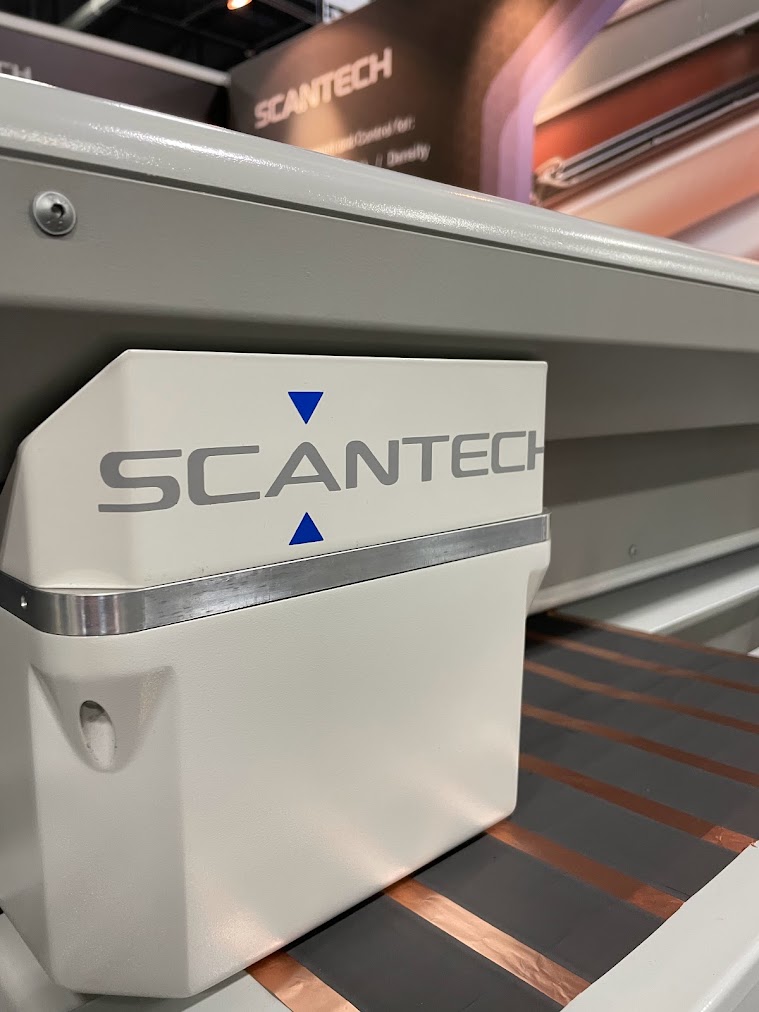
Scantech has developed low-energy x-ray measurement since 1992 and now supplies scanner mechanics, measurement channels, Flexscan software, Same Spot registration, visual inspection, data integration, control, sample testing, service, and spare-parts support as one platform.[1][3]
Foil, wet coating, dry coating, calendered electrode, slit lane, or specialized coated web.
X-ray for basis weight, differential pressure for composition-related correction, confocal for physical thickness, or a combined architecture for density.
Use Same Spot and line-speed data when substrate, wet, dry, or two-sided stations must refer to the same web location.
Flexscan organizes lane profiles, trends, alarms, roll reports, recipe data, and measurement quality.
Communicate the qualified signal to coating, drying, calender, or other compatible process controls.
Calibration, samples, spares, service, software, backups, training, and acceptance criteria remain part of the project.

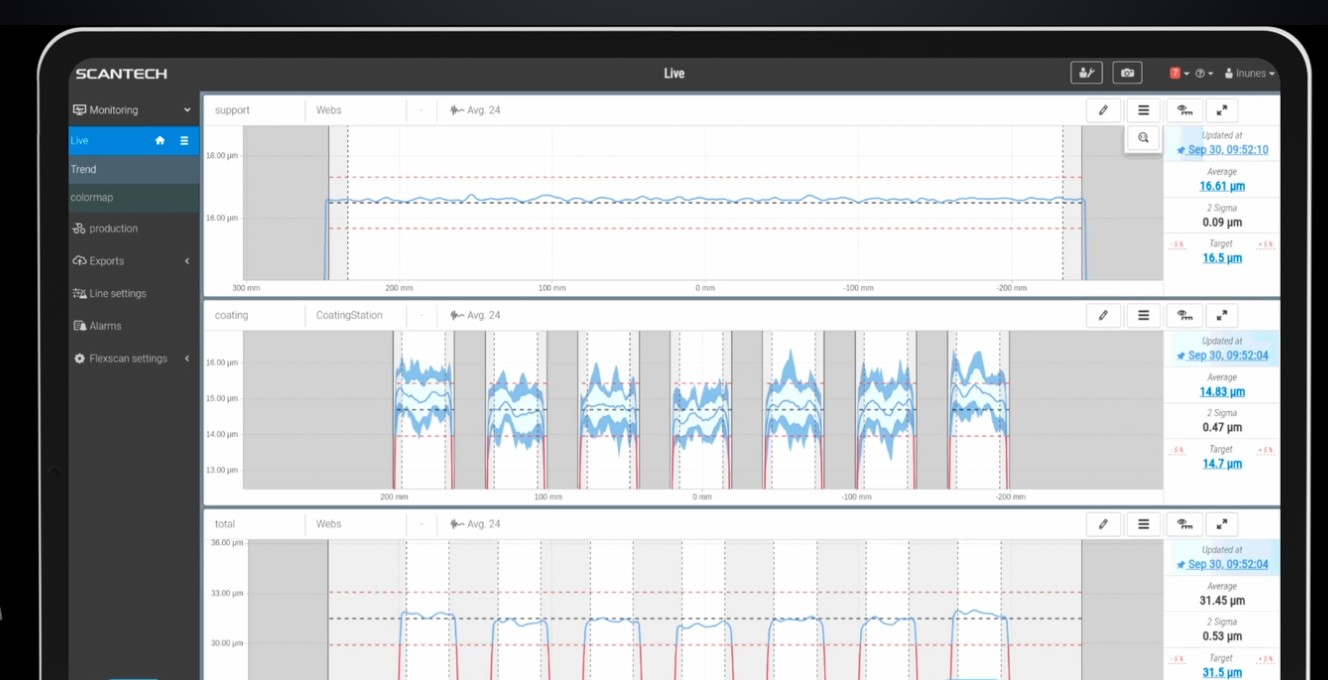
Scantech publishes wet and dry coating basis-weight measurement, lane-edge resolution, and application-dependent repeatability and absolute calibration capability.
Provides the independent correction input used when coating composition or effective density can shift the x-ray basis-weight relationship.
Provides physical thickness as a stand-alone post-calender result or as the geometric signal used with corrected x-ray basis weight to calculate density.
Connects foil, wet, dry, calendered, lane, and defect information to registered web positions and production records.
Build a preliminary Scantech coating measurement path
The tool identifies a practical starting architecture. Final selection requires line drawings, representative material, current factory application guidance, reference-method review, and a written FAT and SAT plan.
Estimate the ownership burden created by the radioactive beta source
Normal scanner maintenance is intentionally excluded because both beta and x-ray scanners require mechanical and electronic service. An electronically generated x-ray tube does not require an isotope-style source program. Enter only the incremental costs that are specific to the beta-gauge installation above the x-ray machine requirements, plus any source-event cost and any production downtime that occurs outside a planned shutdown.
Enter downtime only if the source work creates production loss outside a shutdown that was already planned. If multiple gauges are serviced during one outage, enter the outage time once.
Included: user-entered licensing and radiation-program cost, source-specific compliance, internal administration and training, annualized source exchange or disposition cost, and annualized event downtime. Excluded: normal scanner service, calibration, and mechanical or electronic maintenance common to both beta and x-ray systems; capital cost, installation, financing, any project-specific nonannual x-ray tube replacement, scanner performance, yield, scrap, quality escapes, taxes, and residual value. Source activity is a decay estimate, not an accuracy prediction.
Coating profile, visible defects, and slit-lane tension answer different questions
Scantech can combine coating measurement with visual inspection for streaks, missing coating, ceramic patterns, lane geometry, edge defects, and traceability. After coating or calendering, FMS segmented tension measurement can reveal whether individual slit lanes or cross-web zones carry unequal mechanical tension. Thickness, basis weight, density, appearance, and tension should remain separate signals until the process relationship is proven.


Answers where corrected basis weight, confocal physical thickness, or calculated density changes across the coated web.
Answers where visible defects, lane edges, overlaps, stripes, or traceability marks occur.
Answers how mechanical load is distributed across the parent web or individual slit lanes.
What should be proven in samples, FAT, SAT, and production trials
A scanner is not accepted because a static coupon looks repeatable. The measurement must work across the actual product range, web motion, lane pattern, process states, and quality decision.
Foil, wet basis weight, dry basis weight, confocal physical thickness, corrected density, coating add-on, defects, and lane geometry must have separate units and acceptance rules.
Include anode, cathode, ceramic, catalyst, filler, solvent, density, thickness, foil, color, lane, edge, and approved recipe extremes.
Use accepted laboratory methods and known sample positions. Document bias, repeatability, uncertainty, substrate subtraction, and density calculations.
Challenge normal and maximum speed, confocal stand-off, web flutter, stabilizing rollers, lane transitions, acceleration, threading, stops, recipe changes, calibration checks, and invalid-data states.
Confirm mapping, delay, actuator authority, alarms, manual mode, fail-safe behavior, OPC UA tags, roll reports, recipes, users, backups, and traceability.
Reporting x-ray attenuation as direct coating mass
The detector measures attenuation. Basis weight is a calibrated result that depends on source energy, material stack, recipe, substrate, detector, air gap, standardization, and the reference model.
Using one calibration for every anode, cathode, ceramic, and catalyst recipe
Composition, density, filler, solvent, solids, porosity, foil, and layer structure can change the signal relationship. Validate the complete approved recipe family and define when a new calibration or correction model is required.
Assuming basis weight proves physical thickness
Similar mass per area can produce different thickness when density or compaction changes. Use confocal measurement when physical thickness or calender compaction is the requirement.
Calling density a direct x-ray measurement
Density is calculated from corrected x-ray basis weight and confocal physical thickness. When composition or effective density changes the x-ray relationship, the differential-pressure correction channel belongs in the model. Porosity still needs an additional solid-density reference and qualified method.
Installing confocal measurement on a fluttering web
Confocal thickness depends on a controlled measurement gap. A visibly moving, vibrating, or steering web can turn passline motion into apparent thickness variation. Create an effectively flutter-free span and include Scantech stabilizing rollers when the application requires them.
Ignoring foil and substrate variation
The substrate is part of the transmission signal. Use an approved foil baseline or a registered upstream station when its variation is meaningful relative to the coating target.
Assuming source age alone proves a beta gauge is unacceptable
Calculate remaining activity, then review count rate, averaging, response, calibration, service history, source documentation, and actual performance. Source age is one lifecycle input, not a pass or fail result.
Calling x-ray non-radiological or maintenance free
X-ray equipment produces ionizing radiation while energized and requires shielding, interlocks, indicators, surveys, maintenance, and applicable regulatory controls. It also contains tubes, detectors, cooling, electronics, software, and moving scanner components that require lifecycle planning.
Adding closed-loop control before dynamic validation
Control requires a trusted signal, mapped actuator, known transport delay, adequate authority, stable tuning, interactions review, limits, manual mode, and defined behavior when the measurement becomes invalid.
Using profile data as proof of electrochemical performance
Online coating data supports process control and traceability. Cell performance also depends on chemistry, mixing, dispersion, drying, adhesion, calendering, porosity, assembly, electrolyte, formation, and many other controlled variables.
Application data to send before configuration
- Process and web stateFoil, single-sided or simultaneous coating, wet, dry, calendered, separator, catalyst, ceramic, slit lane, or final roll.
- Materials and recipesSubstrate, active material, binder, conductive additive, solvent, solids, filler, coating sides, and approved product-family extremes.
- Measurement targetsFoil, wet and dry basis weight, confocal physical thickness, corrected density, porosity-related output, lane geometry, defects, and traceability.
- Ranges and tolerancesMinimum, nominal, and maximum values by recipe, lane, edge region, side, and process state.
- Line geometryMeasured web width, C-frame or O-frame access, passline, opening, straight length, confocal stand-off, stabilizing-roller space, scanner location, oven, calender, slitter, guarding, heat, vibration, and clean or dry-room requirements.
- Production conditionsNormal and maximum speed, acceleration, measured or observed flutter, tension, steering, roller wrap, lane count, patch pattern, edge transitions, and web threading.
- Reference methodsLaboratory basis weight, micrometry, density model, foil certificate, cut sample, oven, balance, sample position, uncertainty, and correlation data.
- Control objectiveMonitor, alarm, report, coating control, dryer response, calender control, roll release, or plant-data integration.
- Legacy beta detailsIsotope, source age, activity records, device registration, license, service history, response, source event path, and eventual transfer or disposal plan.
- Samples and acceptanceRepresentative good, borderline, reject, density-variable, composition-variable, lane-edge, and difficult samples for laboratory and FAT work.
Related Gauge Advisor coating and web resources
X-ray and beta coating-gauge FAQs
Does x-ray measure coating basis weight directly?
No. The direct signal is photon attenuation. The system converts that signal into a calibrated basis-weight result using the qualified material, substrate, energy, geometry, and reference model.
Why can composition or density changes affect an x-ray result?
Photon attenuation depends on energy and material composition. A calibration built on one coating relationship can become biased when active-material ratio, filler, solvent, solids, void structure, density, or layer construction changes enough to leave the qualified model.
When is an x-ray-only system sufficient?
It can be the strongest and simplest architecture when the recipe family is stable, the substrate contribution is controlled, and the primary requirement is basis weight. Prove the complete approved range with samples and production correlation.
When should the differential-pressure channel be added?
Add it when composition or effective density can shift the x-ray attenuation-to-basis-weight relationship. It is the correction channel for the mass-sensitive x-ray result, not the physical-thickness measurement.
When is confocal-only measurement the best fit?
Confocal-only is a strong option when physical thickness is the primary requirement, especially after calendering. The web must be presented in a steady, effectively flutter-free span and correlated to the accepted reference method.
Can Scantech combine x-ray, differential pressure, and confocal?
Yes. In the complete architecture, x-ray provides the mass-sensitive signal, differential pressure corrects composition- or density-related x-ray variation, and confocal provides physical thickness. The combined model supports corrected basis weight and effective density.
What if the web flutters at the proposed confocal location?
Do not treat the confocal station as ready from the sensor specification alone. Scantech can incorporate stabilizing rollers to create a controlled measurement span, but roller contact, wrap, tension, surface cleanliness, coating sensitivity, access, and dry-room requirements must be reviewed.
Does the differential-pressure channel identify coating chemistry?
No. It supplies a correction input for the x-ray relationship. Chemistry, solids ratio, dispersion, moisture, cure, adhesion, and electrochemical performance require their own controls and tests.
Is x-ray completely free of radiation regulation?
No. The system produces ionizing radiation while energized. It requires engineered shielding, interlocks, indicators, surveys, maintenance, training, and the applicable radiation-machine registration or site requirements. The key lifecycle difference is that no sealed radioactive isotope remains active when the tube is powered off.
Does a beta gauge automatically become inaccurate as the source ages?
No. Source activity decreases predictably, and a capable system can compensate through calibration. The practical question is whether the remaining count rate supports the required precision, averaging, profile time, edge response, and control speed.
Which beta isotopes may appear in coating gauges?
Historical industrial gauges have used Kr-85, Pm-147, Sr-90/Y-90, and other sources depending on the original design and product range. Confirm the exact isotope, activity, model, registration, and source records for the installed device.
Can Scantech measure wet coating, dry coating, thickness, and density?
Yes, with an application-specific multi-station and multi-channel architecture. Scantech publishes substrate, wet and dry basis-weight, confocal thickness, density, visual-inspection, Same Spot, Flexscan, and OPC UA configurations for battery production. The exact sensor stack depends on composition stability, web condition, process stage, and accepted references.
Which Scantech scanner family fits each measurement stack?
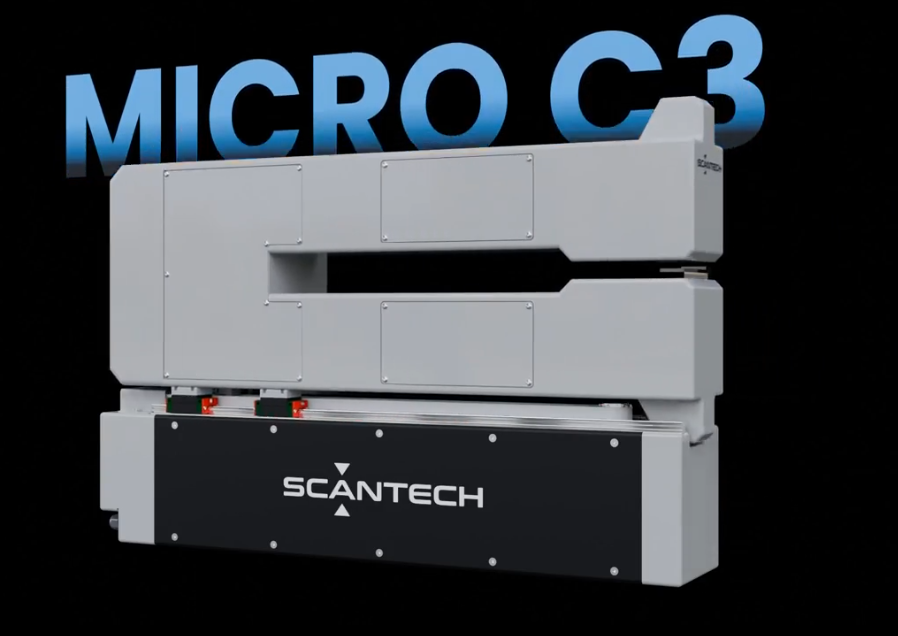
Current starting assignments are Micro C3 and Micro OF3 for x-ray-only measurement without the differential-pressure correction channel, with visual inspection available separately where required; LC3 and ULO3 for x-ray plus differential-pressure correction; and HC3 for x-ray plus differential-pressure correction plus confocal thickness. Width, opening, C-frame or O-frame access, environment, visual-inspection scope, and the approved quotation still govern the final model.
What should I send for a Scantech quotation?
Send the web construction, foil, coating chemistry family, wet and dry ranges, physical thickness, density targets, lane and edge pattern, width, speed, passline drawing, web-flutter condition, available stabilizing-roller space, environment, desired control, reference methods, existing beta information, and representative samples.
References and source notes
Open References and source notes to review the supporting sources.
Open technical references and source notes24 sources
Gauge Advisor is an authorized Scantech sales and applications support representative. Scantech product claims are identified as manufacturer information; independent sources support the attenuation physics, battery-process, radiation-safety, and isotope discussion. Final scanner and sensor configurations should be confirmed for the application.
- Scantech, Battery Industries Online Measurement and Control. Manufacturer architecture for foil, coating, calendering, separator film, multi-station measurement, Same Spot, Flexscan, OPC UA, density, visual inspection, and support.
- Scantech, Cathode Simultaneous Coating Line Measurements. Current public example of five-scanner Same Spot measurement, coating basis weight, thickness, density, visual inspection, Data Matrix Code, Flexscan, and OPC UA.
- Scantech, Company Presentation. Manufacturer history of low-energy x-ray development and current measurement markets.
- Scantech, Coating-Line Measurement. Current coating-line thickness, weight, density, control, Same Spot, and sample-testing context.
- Gauge Advisor, Anode and Cathode Coating Measurement Systems. Current application page for Scantech battery coating and calendering measurement.
- NIST, X-Ray Mass Attenuation Coefficients. Reference data and physics context for energy-dependent photon attenuation.
- NIST XCOM, Element, Compound, and Mixture Database. Demonstrates that attenuation calculations depend on elemental or mixture composition and photon energy.
- University of Warwick, Understanding the Effect of Coating-Drying Operating Variables on Electrode Physical and Electrochemical Properties. Peer-reviewed battery process study treating thickness, wet and dry mass loading, porosity, calendered thickness, and calendered porosity as separate properties.
- IAEA, Radiation Safety in the Use of Nuclear Gauges. Transmission-gauge principles, historical beta and gamma sources, increasing use of x-ray generators, source types, engineered controls, and safety-program context.
- IAEA, Technical Data on Nucleonic Gauges. Counting-rate, response, detector, source-intensity, and process-transient context for radiation-based industrial measurements.
- U.S. NRC, NUREG-1556 Volume 4, Fixed Gauges. Radioactive-material accountability, inventories, shutter checks, leak-test program, transfer, disposal, and recordkeeping guidance.
- National Nuclear Data Center, Nuclear Wallet Cards. Half-life data for Kr-85, Pm-147, and Sr-90.
- OSHA, Ionizing Radiation Background. Distinction between electronically generated x-rays that stop when powered off and radioactive material that continues to emit.
- OSHA, Ionizing Radiation Control and Prevention. Shielding, interlocks, indicators, training, and other controls for radiation-producing equipment.
- FMS, Frequently Asked Questions. Conventional and cross-web tension measurement context, including segmented tension profiling as a separate mechanical measurand.
- Gauge Advisor, Coating Weight, Thickness and Density Calculator. Unit relationships and visible assumptions for converting mass per area, thickness, and density.
- Scantech, HC3 Confocal C-Frame for Battery Lines. Current confocal and combined x-ray configuration, frame-width range, measuring distance, linearity, repeatability, spot size, and density architecture.
- Scantech, Cathode Single-Sided Coating Line Measurements. Current public use of confocal and x-ray for dry thickness, wet or dry basis weight, and dry density.
- Scantech, Cathode Calendering Line Measurements. Current public configurations for thickness after calendering, thickness before and after calendering, and thickness plus density after calendering.
- Scantech, Aluminium Foil Measurement. Public battery application page identifying the Micro OF3 with an x-ray sensor. The Micro OF3 product page publishes a 500 to 2000 mm product-width range.
- Scantech, Micro C3 Scanner. Public frame dimensions and product-width range of 400 to 1000 mm.
- Scantech, ULO3 Scanner. Public O-frame dimensions and product-width range of 500 to 3500 mm.
- Scantech, LC3 Scanner. Public C-frame dimensions and product-width range of 300 to 1200 mm.
- Current Scantech factory and application guidance supplied to Gauge Advisor, August 2026. Current starting assignments used in this article: Micro C3 and Micro OF3 for x-ray-only measurement without the differential-pressure correction channel; LC3 and ULO3 for x-ray plus differential-pressure correction; HC3 for x-ray plus differential-pressure correction plus confocal. Final configuration remains quotation- and application-specific.
Define the coating variables before replacing the gauge
Gauge Advisor is the authorized Scantech sales and applications support partner. I help battery, fuel-cell, catalyst, ceramic, coated-foil, and specialized roll-to-roll manufacturers evaluate, select, quote, integrate, and support Scantech x-ray, differential-pressure correction, confocal thickness, visual-inspection, Same Spot, Flexscan, and control systems.
The application review is provided in connection with Scantech equipment. Gauge Advisor is an equipment sales and applications support firm, not a standalone coating or radiation-safety consulting service. Send the web construction, coating family, wet and dry ranges, thickness and density targets, line drawing, speed, web-flutter condition, available roller space, reference methods, current beta-source details, and representative samples when available. I will respond within one business day, often within a few hours.
- X-ray, differential-pressure, and confocal architecture
- Foil, wet, dry, calender, and slitter station review
- Composition correction, thickness, and density strategy
- Confocal passline and stabilizing-roller review
- Legacy beta lifecycle and replacement planning
- Samples, quotations, integration, and ongoing support