
Updated May 11, 2026
If you’re running a film extrusion line, you’ve probably asked yourself: “What do we actually do with all this edge trim and scrap?” Edge trim recycling is a common challenge in blown film and cast film operations, where scrap generated during trimming and roll changes can quickly add up.
Whether it’s edge trim, off-spec rolls, or film web waste, tossing it costs you. And noisy, dusty shredders aren’t much better. But what if there was a quiet, compact, grinder-free way to turn that scrap into high-quality pellet feedstock that can be reintroduced into your resin conveying and blending system?
Modern systems for repelletizing plastic film scrap allow manufacturers to recover valuable resin directly inside the plant. That’s where the Sasquatch Film Trim Repelletizer from Advanced Blending Solutions (ABS) comes in.
The Challenge of Film Edge Trim Waste
Blown film and cast film extrusion lines continuously generate scrap during normal operation. Edge trim removed during slitting, startup scrap, and off-spec rolls are unavoidable in most film manufacturing processes.
Traditionally, many plants manage this scrap by:
- grinding film scrap using shredders or granulators
- transporting scrap offsite for recycling
- landfilling contaminated film waste
These approaches increase labor costs, generate plant dust, and often reduce the overall value of the recovered material.
Modern film scrap repelletizing systems allow manufacturers to recover this scrap directly within the plant and convert it back into usable resin pellets.
How Film Edge Trim Recycling Works
In a typical film extrusion plant, edge trim recycling follows a simple process:
- Edge trim collection – Trim removed during slitting is vacuum conveyed directly from the extrusion line.
- Scrap feeding – Off-spec rolls or loose film scrap can be fed into the repelletizer.
- Melting and filtration – The repelletizer melts the film scrap using a controlled extrusion process.
- Pelletizing – The molten polymer is converted into uniform pellets.
- Reintroduction into production – Pellets are returned to the resin conveying and blending system for reuse.
This closed-loop film recycling process allows manufacturers to recover valuable resin without transporting scrap offsite.
Engineered for Performance and Simplicity
This isn’t your typical film scrap pelletizing system. The Sasquatch was designed specifically for inline and offline plastic film scrap recycling, giving you a cleaner, quieter, and more efficient alternative to traditional shredding and repelletizing setups.
Features at a Glance:
- Melt Temperature Control – Four heater zones on the extruder barrel and improved screw geometry ensure consistent pellet quality.
- Enlarged Feed Entry – Reduces bridging risk, improving material flow even with lightweight film scrap.
- Grinder-free Design – Significantly minimizes plant dust and noise compared to conventional methods.
- Compact Footprint – Saves valuable floor space (6.5 sq/ft footprint) while providing throughput up to 110 lbs/hr.
- Low Maintenance and High Efficiency – Quick setup with easy access for cleaning. Power consumption rated at 0.1 kWh per lb of material.
- Dual Screen Changers – Reduce operational interruptions and improve pellet quality.
- Allen-Bradley User Interface – Seamlessly integrates with resin blenders, dryers, and vacuum pump PLCs, providing easy and efficient monitoring and operation.

The Advanced Blending Solutions Sasquatch Repelletizer pulling in a scrap film roll for pelletizing.
Bonus: Say Goodbye to Shredders
One key advantage of the Sasquatch system is that it eliminates the need for dusty & noisy film shredders or grinders . The unit reduces both noise levels and equipment maintenance by conveying edge trim directly into its integrated extruder. Finished rolls of scrap film can be automatically fed into the side mouth of the repelletizer. No pre-processing required.
It’s a cleaner, safer system that keeps your plant running smoothly and keeps OSHA happy.
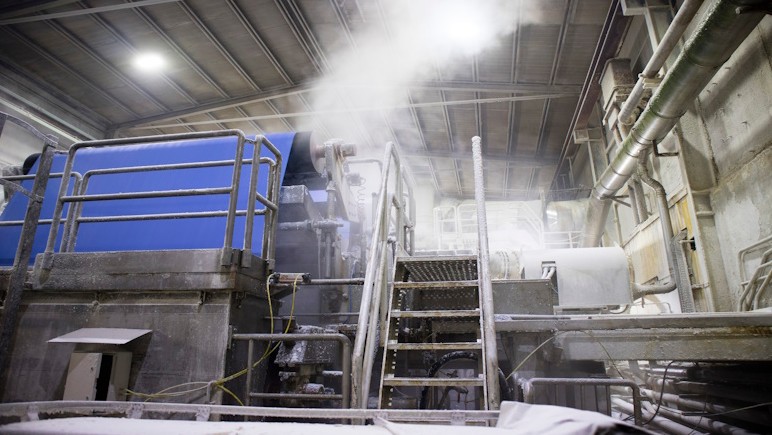
Get rid of combustible resin dust in your plant by entirely eliminating the film grinding process and switching to the Sasquatch Repelletizer. Image source: Getty Images
A True Closed-Loop Recycling System
The Sasquatch supports closed-loop recycling, turning film waste directly back into usable pellets ready to re-enter the extrusion process. That means:
- Less waste transported offsite
- Reduced labor & raw material costs
- Greater control over resin blend and quality
- Quieter operations
- Safer working environment
By recovering in-line trim and offline scrap in a single, integrated system, process engineers can close the loop without compromising efficiency or quality.
Considering the rising cost of resin, film scrap recovery systems often deliver ROI in months rather than years. Process engineers evaluating scrap recovery can estimate potential savings using the Resin Conveying & Blending ROI Calculator.
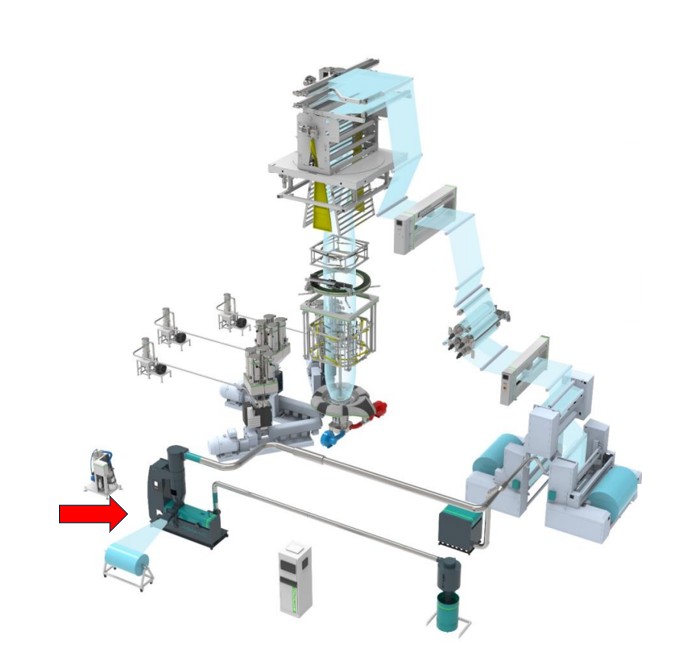
Sasquatch Repelletizer (red arrow) in a blown film process: edge trim is vacuum conveyed into the top and scrap rolls are fed into the side. Film is melted, pelletized, and re-conveyed to the blender in a closed-loop system.
Improve Your Film Scrap Recycling Process
Many film extrusion plants are quietly improving profitability by closing the loop on edge trim recycling. Systems like the Sasquatch film scrap repelletizer allow processors to convert trim and off-spec material back into reusable pellets with minimal operator intervention.
Gauge Advisor works with film and sheet extrusion processors to evaluate recycling opportunities and determine whether repelletizing systems make sense for their operation.
📩 Reach out to start the conversation:
📄 Review your edge trim handling and recycling process
📊 Estimate ROI from film scrap repelletizing
🏭 Discuss integration with your existing extrusion line
Gauge Advisor is an authorized sales and support partner for Advanced Blending Solutions, supporting manufacturers with equipment selection, application guidance, and system integration.

 By: Matthew Baker
Founder, Gauge Advisor LLC
Read these next:
Blenders and Thickness Gauges: The Real Profit Drivers in Film Extrusion and Which Ones to Use
How to Weigh Resin Coming Off a Railcar (and Why It Matters for Your Bottom Line)