
Updated May 11, 2026
In plastic film & sheet extrusion, the difference between average and exceptional process performance lies in how well you measure and control what you’re making. Two systems stand out as the most critical for film extrusion process control and consistent high-capability performance on the extrusion line: resin blenders and the thickness gauges.
Together, these technologies form the heartbeat of your line. And when you’re running best-in-class extrusion processes, you’re not just producing film. You’re producing quality product. Moreover, the material and labor savings are astronomical whether you are making performance films or grocery bags. A return on investment (ROI) is immediate!
What Is Film Extrusion Process Control?
Film extrusion process control refers to the systems used to monitor and stabilize critical production variables such as resin dosing, melt pressure, film thickness, and line speed. When these variables are tightly controlled, extrusion lines produce more consistent film with less variation and less material waste.
Two of the most important technologies supporting film extrusion process control are continuous gravimetric blenders and real-time thickness measurement systems. Together, they allow operators and engineers to control the process from the moment resin enters the extruder to the moment finished film is wound.
Modern extrusion plants rely on these systems to improve CpK, reduce scrap, and run closer to target thickness without risking off-spec product.
Gravimetric Blending: Why Continuous Beats Batch
It all starts at the hopper. Gravimetric blending systems control your product at the very beginning: right at the resin feed. Modern extrusion plants increasingly rely on integrated resin conveying and blending systems to ensure precise dosing of base resin, regrind, and additives before material even enters the extruder. But not all blenders are created equal. Many extrusion lines still rely on batch blending systems, which operate by mixing weighed quantities in a cycle, then discharging the entire batch before starting the next. These are inferior to quality and consistency of continuous loss-in-weight gravimetric blenders.
🚫 Batch blending drawbacks:
- Material segregation between batches leads to inconsistent resin ratios
- Dead time between batches introduces flow variation
- Harder to detect short-term process disturbances
- Time & labor consuming clean-out & changeover
✅ Continuous gravimetric blending advantages:
- Real-time metering of individual components ensures constant flow and uniform mix
- No batch-to-batch shift, which reduces fluctuations in extrusion pressure and output
- Improved feed consistency tightens standard deviation: directly boosting CpK and PpK
- Fast Changeover: Clean-out takes several minutes (20 seconds with auto clean-out) versus an hour on a batch system for multi-component lines; a big labor savings!
Because material dosing accuracy directly impacts resin usage and additive cost, many processors evaluate the financial impact before upgrading. You can estimate the potential savings using the Resin Conveying & Blending ROI Calculator.
However, there are certain applications where batch blending is a practical choice. When the process is low-throughput and doesn’t demand high dosing precision, a batch blender can be a cost-effective and sufficient solution.

Inside a Batch Blender (left) and a Continuous Gravimetric Blender (right). Different colors represent different resins. The Batch blender fails to mix resin evenly, resulting in uneven polymer distribution on a multi-layer film. Courtesy: Advanced Blending Solutions.
Thickness Gauges: Beyond Outdated Radioactive Technologies
Once your film is extruded, your next best opportunity to control quality is measuring it. Modern film and sheet thickness measurement systems provide real-time profile data that allows operators to maintain tight thickness tolerances across the web. The measurement market offers a few technologies: nuclear (radioactive gamma or beta), infrared, and x-ray systems to name a few. But not all are equal in terms of accuracy, safety, and adaptability.
⚖️ Commonplace Technologies:
- Nuclear (gamma and beta) rely on radioactive isotopes (like Americium or Krypton), which bring regulatory baggage and licensing headaches. Plus, aging sources = declining accuracy and expensive source disposals/replacements. Marginal accuracy and high measurement “noise”.
- Infrared is non-nuclear but struggles with thickness resolution and can be sensitive to environmental variables (like temperature and haze). Additionally, their sensor filter wheels are calibrated to the unique “DNA” of a specific polymer, meaning the gauge may become ineffective if you switch materials, making it a poor choice for future flexibility. That said, they do excel at identifying and distinguishing individual film layers.
- Others: Ultrasonic, laser, terahertz, and capacitance also have their limitations but are less common and application-specific.
✅ Why X-ray Wins:
- No radioactive sources offer simpler compliance and less red tape. Safer for operators and plant personnel.
- High accuracy (0.1 % or 0.03 µm) with excellent repeatability.
- Unaffected by colors or prints.
- Ideal for a range of materials and film & sheet thicknesses. Future-proof in the event of polymer blend changes.
- Fastest auto die bolt adjustment due to superior sensor signal strength, even on the thinnest biaxially oriented and battery separator films.
- The technology of choice for OEM line builders worldwide.
- Can be combined with additional sensors within the same head for supplemental measurements.
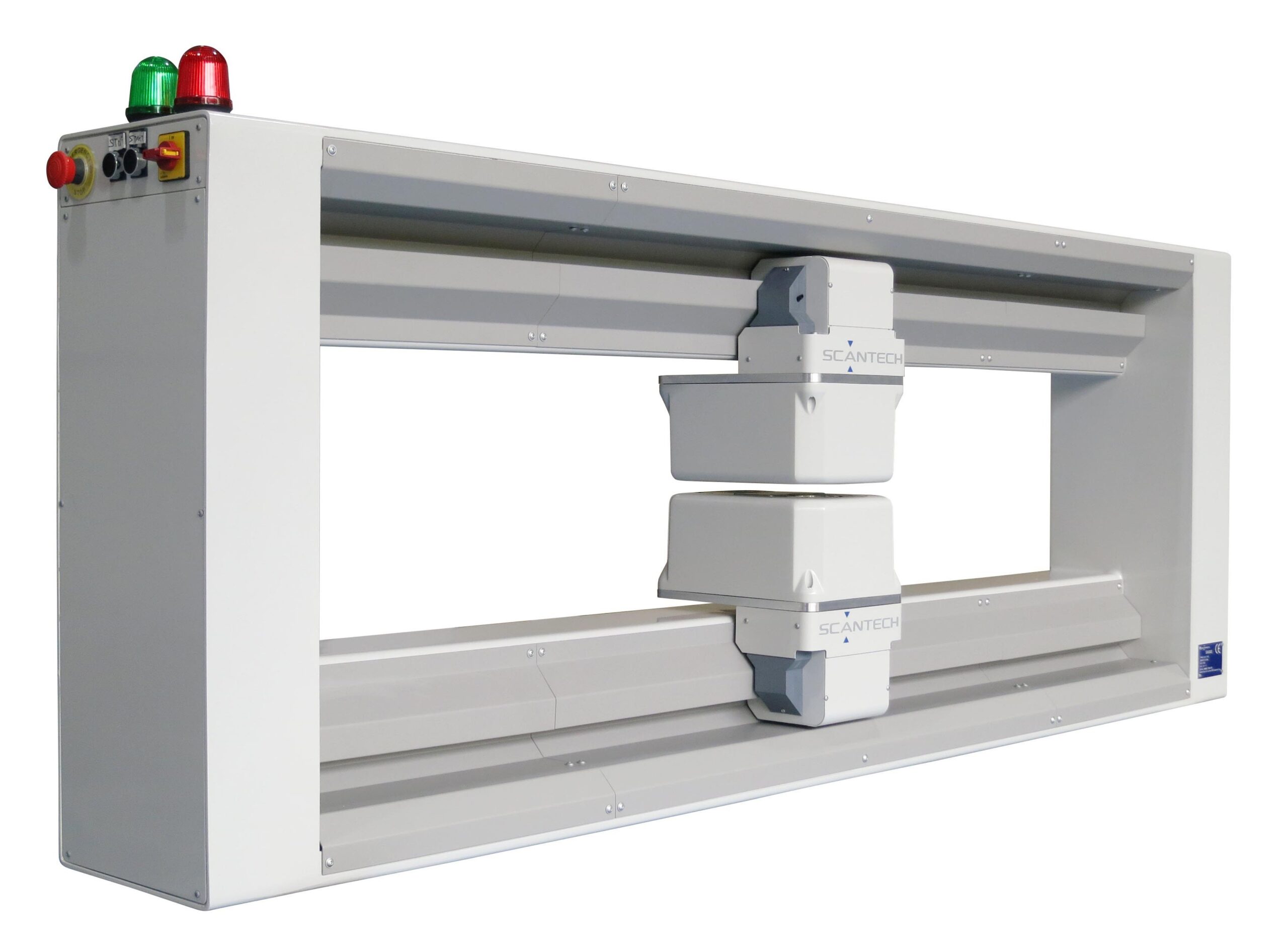
A Scantech ULO3 thickness web gauging system.
Why It Matters for CpK, PpK, and Profit
Let’s be honest: variability is expensive!
Every pound of resin that’s over your target thickness is money wasted. Even small improvements in thickness control can translate into significant material savings. Process engineers can estimate those savings using the Film Thickness Measurement ROI Calculator.
Every off-spec roll costs more than just scrap. It erodes customer trust. High-performing gravimetric blenders and thickness measurement systems reduce variation where it matters most: at the start and end of the process window.
When these systems are running optimally:
- CpK rises because variation shrinks around your target
- PpK rises because you hit your target consistently over time
- You reduce giveaway, scrap, downtime, and rework
- And perhaps most importantly, you deliver better film, faster
Engineers often quantify this improvement using process capability metrics. You can estimate your process capability using this CpK / PpK process capability calculator.

BLENDER: The efficiency of a continuous gravimetric blender enables polymer blend or additive distribution to center around the nominal target. Y-axis is lbs/hr and X-axis is time over the course of one hour.

THICKNESS GAUGE: High precision from an x-ray gauge with automatic die bolt control enable a near-perfect film thickness profile on this roll report.
A Focus on Suppliers: Advanced Blending Solutions and Scantech
Where does an engineer begin looking for these types of advanced systems? The answer often starts with suppliers that specialize in extrusion process control technologies. Michigan-based Advanced Blending Solutions offers among the highest regarded continuous gravimetric blenders on the market.
Maryland-based Scantech Americas, Inc. offers superior film measurement systems with over 7,000 systems installed worldwide. Both companies offer robust data tracking, which is a huge win for traceability and quality assurance. They also interface with other extrusion process equipment for complete thickness & blend control. Above all, both companies offer excellent customer service and support; a rare feat in today’s industrial equipment market.
Improving Film Extrusion Process Control
Investing in continuous gravimetric blenders and thickness measurement systems isn’t just about modernizing your line. It’s about optimizing it. These technologies act as the control pillars of your extrusion process, locking in quality from pellet to final film profile.
When blending accuracy improves and thickness variation decreases, CpK and PpK rise naturally. That means less resin giveaway, fewer off-spec rolls, and a more stable production process overall.
Have you ever stopped to calculate what outdated equipment and unnecessary manual labor are really costing your plant?
Take the Next Step
📄 Request detailed technical specs
📬 Send resin or film samples for evaluation & testing
Gauge Advisor is the authorized sales and support partner for Scantech & Advanced Blending Solutions supporting manufacturers with equipment selection, process optimization, and system integration.

 By: Matthew Baker
Founder, Gauge Advisor LLC
👉 Read these next:
Film Extrusion: The ROI of Smart Equipment Upgrades
Why Scantech Leads the Way in Film & Sheet Extrusion Measurement Systems
Extrusion Melt Pumps: How MAAG Pumps Improve Output and Product Consistency