
Updated May 11, 2026
Whether you’re manufacturing medical tubing or food-grade film, you rely on precise and repeatable measurement systems to ensure your product stays within spec.
Two terms come up constantly in measurement discussions:
✅ Accuracy – Is your measurement correct?
✅ Repeatability – Is your measurement consistent?
Understanding the difference, and why repeatability is the foundation for any trustworthy measurement system, is critical for plastics manufacturers.
Accuracy vs Repeatability: The Simple Difference
Accuracy describes how close a measurement is to the true value. Repeatability describes how consistent a measurement is when the same part is measured multiple times.
In manufacturing measurement systems, repeatability is often more important than accuracy because a consistent gauge can always be calibrated, while an inconsistent gauge cannot be trusted for process control.
Are you confused about the difference between accuracy and repeatability?
How Exactly do Repeatability and Accuracy Connect?
Accuracy
Accuracy describes how close a measurement result is to the true or reference value.
Example:
Your gauge says the film thickness is 100 μm, and the true thickness is 100 μm. That’s accurate.
However, gauge accuracy can drift due to:
- Environmental changes (temperature, humidity)
- Mechanical wear
- Calibration errors
- Operator technique
✅ That’s why accuracy depends on maintaining good calibration and controlling conditions. Engineers often verify gauge accuracy using precision calibration pins. Our Calibration Pin Selector Tool helps determine the proper pin size when verifying laser micrometer accuracy.
Repeatability
Repeatability describes how consistent a measurement system is when measuring the same feature repeatedly.
Example:
You measure the same point on the tubing 5 times and get 0.394”, 0.394”, 0.393”, 0.394”, 0.394” OD (outside diameter in inches).
✅ High repeatability means low measurement variation.
If you get 0.392”, 0.397”, 0.391”, 0.396”, 0.395” (inch) on the same point, your gauge is not repeatable.
Why Focus on Repeatability First?
You can fix accuracy with calibration if your gauge is repeatable. But you can’t fix a gauge that is inconsistent.
- Good repeatability ensures that the gauge variation is low. Any changes you see reflect real process changes.
- Poor repeatability means you can’t tell if variation is in the product or just noise from the measurement system.
✅ In short: Repeatability is the foundation. Accuracy is built on top.
Examples in Plastics Manufacturing
Example 1: Tubing Extrusion
You’re running a medical tubing line with an in-line laser micrometer for diameter & ultrasonic sensors for wall thickness:
✅ Good repeatability
- The gauge consistently reports 0.122” (inch) ±0.001” diameter and the ultrasonic measurement consistently reads 0.0345” (inch) ±0.0001” wall.
- You can confidently control the die and puller to stay in spec.
✅ Accuracy
- You calibrate the gauge against a certified standard pin.
- Even if the environment changes (temperature, humidity), you can re-calibrate to keep readings true.
❌ Poor repeatability
- Readings bounce from 0.115” (inch) to 0.125” (inch) even when the tube diameter isn’t changing.
- Operators can’t know if they’re in spec. This leads to unnecessary operator adjustments, scrap, and production downtime.
Learn more about these gauge technologies on our medical device measurement and inspection solutions page.

Plastic tubing measured with a LaserLinc triple-axis laser micrometer for precise, repeatable diameter control.
Example 2: Plastic Film Extrusion
You’re making blown film or cast film and using a non-contact scanner (e.g., x-ray or laser) to measure thickness:
✅ Good repeatability
- Scanner gives stable thickness readings (e.g., 100.1 μm, 100.0 μm, 100.2 μm).
- Process control system can confidently adjust chill rolls or die bolts.
✅ Accuracy
- You calibrate the scanner with a known film standard.
- Compensate for environmental effects like humidity, which can change density in some systems.
❌ Poor repeatability
- Scanner jumps between 98 μm and 104 μm after every scan on the same spot of the film.
- SPC charts become meaningless, and operators can’t tell if there’s a real gauge band variation or just bad measurement.
See our film and sheet extrusion thickness measurement solutions page for an overview of these measurement technologies.
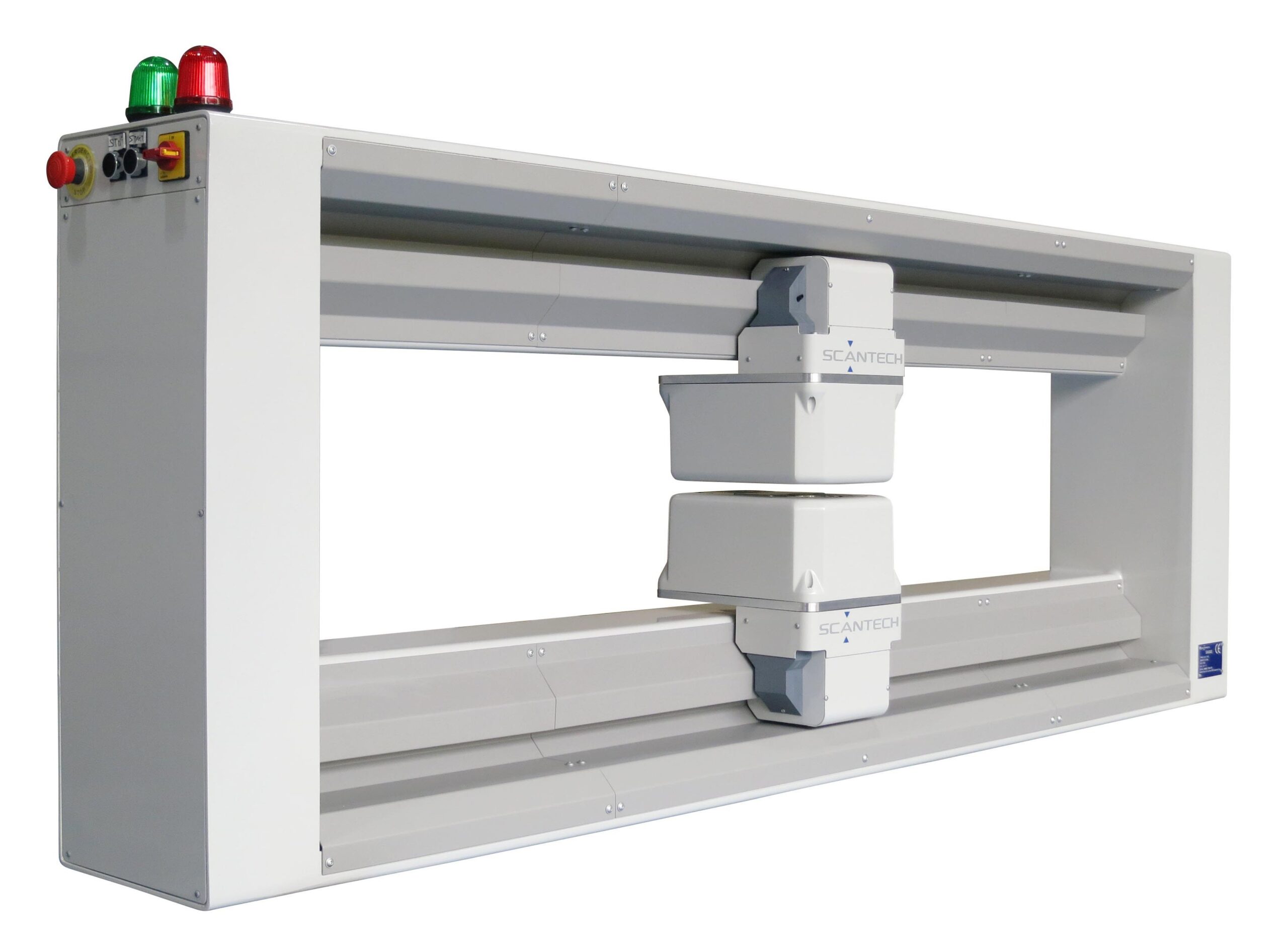
A Scantech ULO3 thickness web gauging system.
How Accuracy and Repeatability Work Together
✅ Repeatability first
- Proves your gauge is stable and consistent.
✅ Then accuracy
- Achieved through calibration.
- Adjusts for environmental conditions (temperature, humidity).
- Corrects for system drift over time.
If you have good repeatability, accuracy is easy to maintain.
If you have poor repeatability, accuracy can’t even be verified reliably.
Summary
Repeatability = Consistency. Accuracy = Correctness. You need consistency first.
Regardless of your manufacturing process, measurement repeatability ensures:
- Reliable process control
- Low scrap rates
- Confidence in quality data
Ready to Improve Your Measurement Process?
At Gauge Advisor, we help plastics manufacturers choose the right measurement systems for their processes.
✅ LaserLinc offers high-precision laser micrometers, ultrasonics, and defect detection for tubing, wire, and profiles: ideal for consistent, repeatable measurements.
✅ Scantech delivers world-class x-ray and multi-sensor scanning solutions for film extrusion & coating lines with excellent gauge repeatability and accuracy, even under the harshest environmental conditions.
👉 Gauge Advisor supports plastics manufacturers in California and across the Western United States with precision measurement systems for extrusion and coating processes.
We are the authorized sales and support partner for LaserLinc, Scantech, and AIM Systems, supporting manufacturers with equipment selection, process optimization, and system integration.
If you’re evaluating a measurement system for your process, request application guidance using the form below.

 By: Matthew Baker
Founder, Gauge Advisor LLC
👉 Read these next: Engineer’s Guide: Web Gauging Technology for Extrusion and Coating Lines
Acheiving Precision in Medical Tube Extrusion: Advanced Measurement Technologies