
Updated: May 11, 2026
Selecting the right web gauging technology for extrusion and roll-to-roll coating production lines is critical for maintaining product quality, improving process stability, and minimizing material waste.
Web gauging systems measure thickness or basis weight across the width of a moving web and provide real-time data used for process control. These systems are widely used in applications such as:
- Cast film and sheet extrusion
- Blown film production
- Nonwoven materials
- Adhesive and polymer coatings
- Lithium-ion battery anode and cathode coatings
- Fuel cell coatings
Engineers implementing inline measurement systems for extrusion or coating can explore available solutions on the film and sheet thickness measurement solutions page or the coating measurement solutions page.
This guide compares the six most common web gauging technologies used in extrusion and coating processes, explaining how each technology works and where it performs best.
Web Gauging Technologies Used in Extrusion and Coating Lines
1. Beta Transmission (Krypton-85, Strontium-90, Promethium-147)
Beta transmission gauges were one of the first technologies developed for measuring basis weight in continuous web processes, originally by Industrial Nucleonics in 1950. These systems measure radiation attenuation through the material to determine coating weight or film mass.
- Measurement: Basis weight (thickness inferred) invented for web processes in 1950
- Scanner Type: Rectangular (O-frame)
- Advantages:
- Mature technology with versatility across a broad measurement range
- Lower signal-to-noise ratio compared to gamma gauges
- Disadvantages:
- Relies on radioactive isotopes with varying half-lives
- Expensive source replacements & disposals
- Sensitive to web flutter (up and down movement)
- Optimal Applications: Today, beta gauges are increasingly replaced by modern non-radioactive technologies that provide stronger signals and lower long-term operating costs.
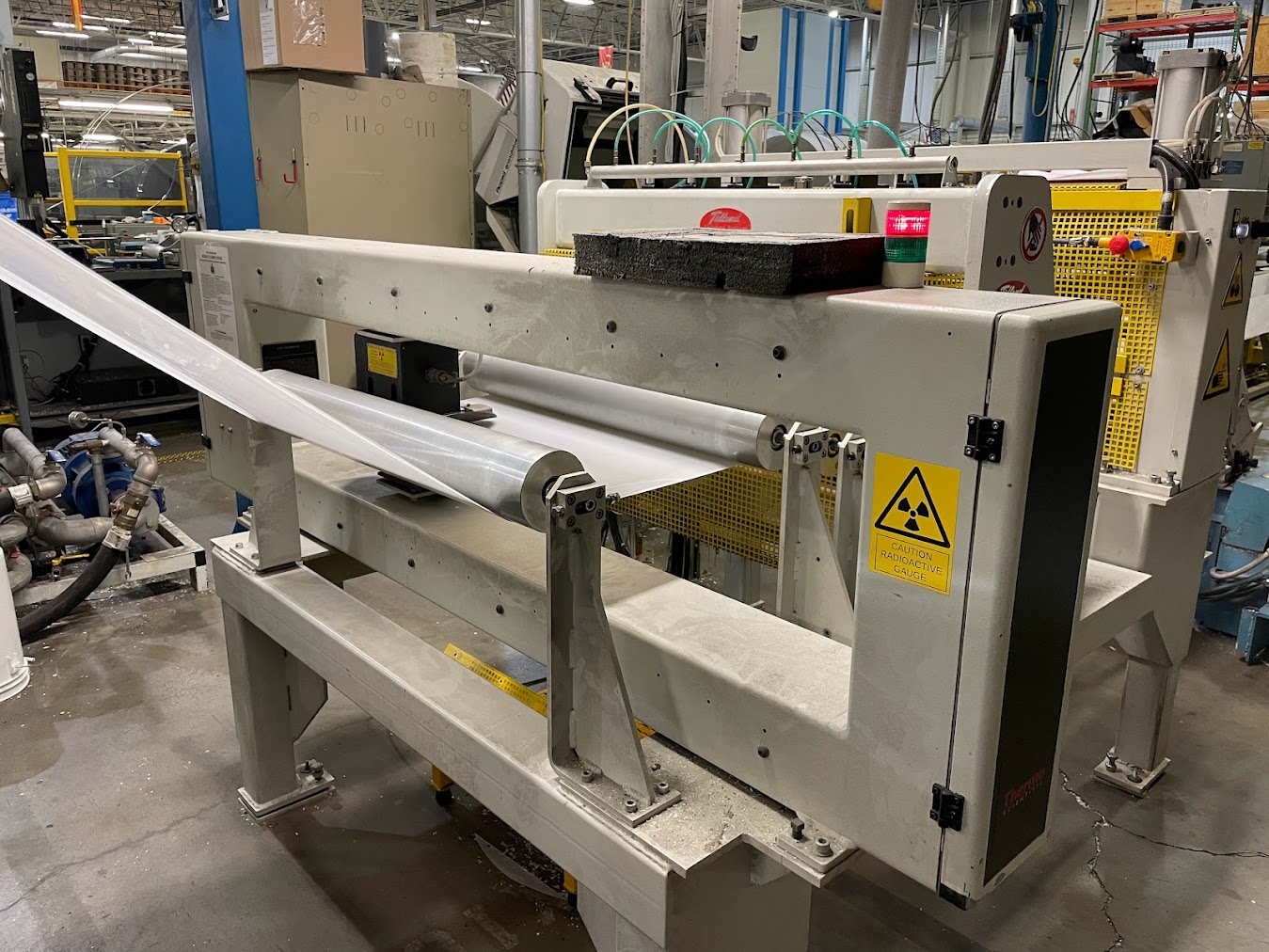
Measurement scanner with a Beta gauge traversing the web. Stabilizing rollers are placed before and after the scanner to prevent web flutter.
2. Gamma Backscatter (Americium-241)
Gamma backscatter gauges measure radiation reflected from the surface of the material rather than transmitted through it.
- Measurement: Basis weight (thickness inferred) invented for web processes in 1965.
- Scanner Type: Single Beam (I-frame)
- Advantages:
- Compact design suitable for tight spaces
- Relatively insensitive to composition variations
- Disadvantages:
- Very slow data acquisition compared to other sensors
- Film & sheet extrusion: slower auto die bolt adjustments
- High measurement “noise” levels requiring extensive data averaging
- Uses radioactive source with costly replacements every 15 years
- Sensitive to web flutter; requires close proximity to the sheet
- Optimal Applications: Gamma backscatter gauges are typically limited to very thick sheet extrusion applications, especially where recycled material contains heavy element additives.
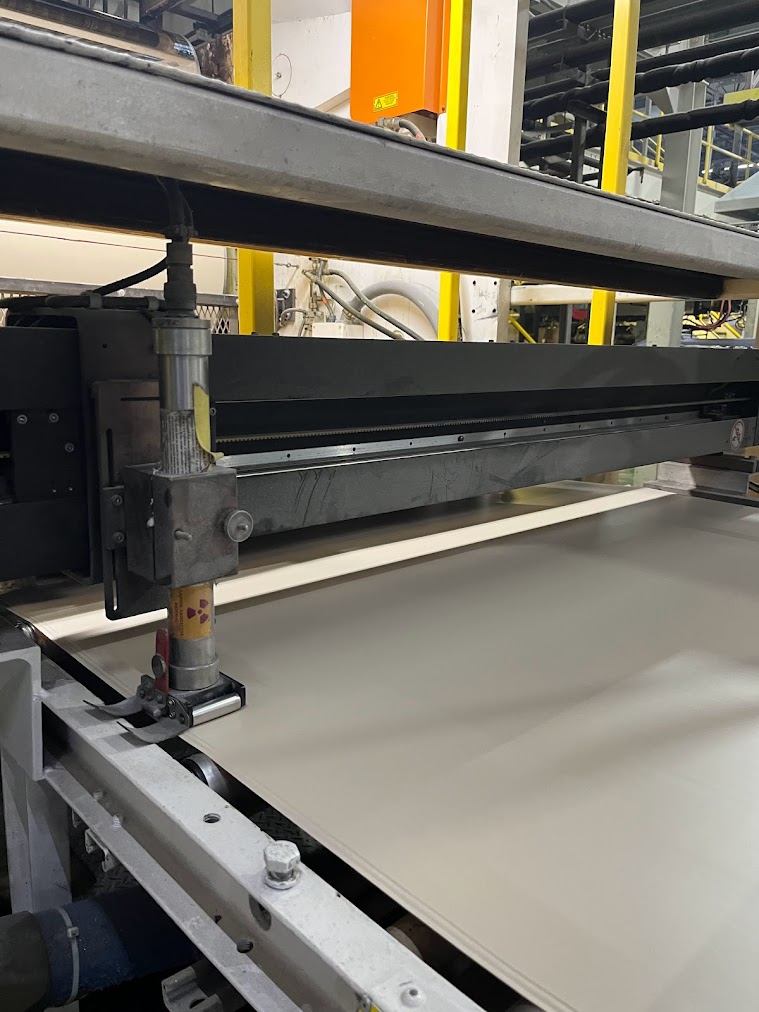
Measurement scanner with a cylindrical gamma backscatter sensor on a sheet extrusion line. The sensor requires close contact with the sheet to obtain a measurement.
3. Infrared Transmission or Backscatter
Infrared measurement systems analyze absorption bands associated with moisture or organic chemical groups.
- Measurement: Weight and thickness (inferred from moisture & organic components).
- Scanner Type: Rectangular (O-frame) for extruded film thickness; Single Beam (I-frame) for coatings
- Advantages:
- High accuracy and repeatability
- Non-radioactive
- Capable of distinguishing between layers within a film structure
- Disadvantages:
- Sensor’s filter wheel tailored to specific compositions (incompatible if different materials are run in the future)
- Highly sensitive to web pass-line angle
- The sensor struggles to accurately distinguish the coating layer from the underlying substrate.
- Not suitable for printed film or die-bolt control on biaxially oriented film
- Optimal Applications: Infrared systems are commonly used when measuring specific polymer layers, such as EVOH barrier layers in multilayer film structures.
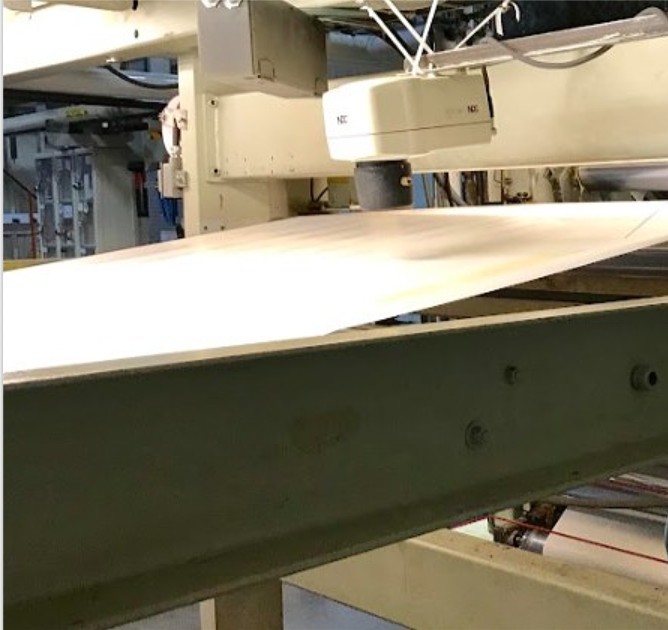
A fixed infrared sensor measuring coating weight on a prepreg line.
4. Ultrasonic Transmission
Ultrasonic gauges measure the time required for acoustic waves to pass through the material to determine thickness.
- Measurement: Thickness (basis weight inferred).
- Scanner Type: Rectangular (O-frame)
- Advantages:
- High accuracy and repeatability
- Non-radioactive
- Insensitive to composition changes
- Disadvantages:
- Signal drop-off near web edges, making precise edge adjustments for die bolt control impractical
- Optimal Applications: Ultrasonic gauges are often used as complementary sensors for calibration when material composition varies significantly.
5. Laser Triangulation and Laser Shadow
Laser measurement technologies determine thickness using optical distance measurements.
- Measurement: Thickness (cannot measure basis weight).
- Scanner Type: C-frame, Rectangular (O-frame), Single Beam (I-frame) with reference roll
- Advantages:
- High accuracy and repeatability
- Non-radioactive
- Insensitive to material composition
- Disadvantages:
- Requires maintenance to keep scanning track debris-free
- Shadow gauges need a metal reference roll, introducing an additional contact point on the web
- Laser Triangulation: high sensitivity to mechanical vibrations
- Laser Shadow: reference roll must remain clean of debris for proper measurement. Difficult in dusty environments.
- Optimal Applications: Laser technologies are often used for materials with random composition or density variation, such as foamed products where x-ray attenuation may change. An example is the Scantech SBF3 laser shadow scanner, which measures web thickness using a precision reference roll.
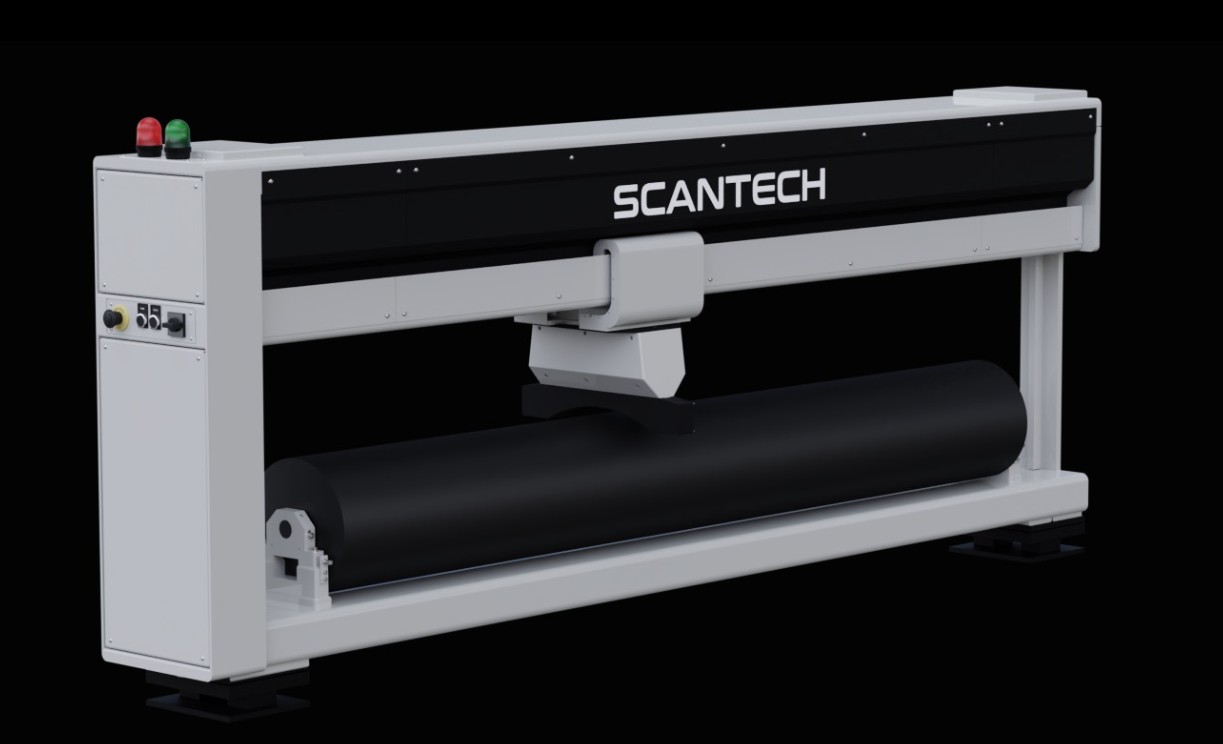
A Scantech SBF3 laser shadow measurement scanner. The web wraps over the steel reference roll and the sensor traverses the width to take a thickness measurement.
6. X-ray Transmission
X-ray transmission gauges measure the attenuation of x-ray photons as they pass through the web material.
Because x-ray photons travel in a well-defined beam path, these systems provide stronger signals and faster measurement response compared with many older radiation-based technologies.
Engineers evaluating measurement solutions should understand how x-ray transmission web gauging works in extrusion and coating environments.
- Measurement: Basis weight (thickness inferred).
- Scanner Type: Rectangular (O-frame)
- Advantages:
- Non-radioactive radiation source
- Confined radiation beam minimizes scattering
- Not influenced by web flutter
- Long life expectancy with sub-micron accuracy
- Disadvantages:
- Requires registration in most U.S. states due to x-ray radiation
- Sensitive to material composition changes in some applications
- Optimal Applications: Suitable for many film, sheet, coating, and battery applications. Engineers evaluating measurement technologies should understand how x-ray transmission web gauging works in extrusion and coating environments.
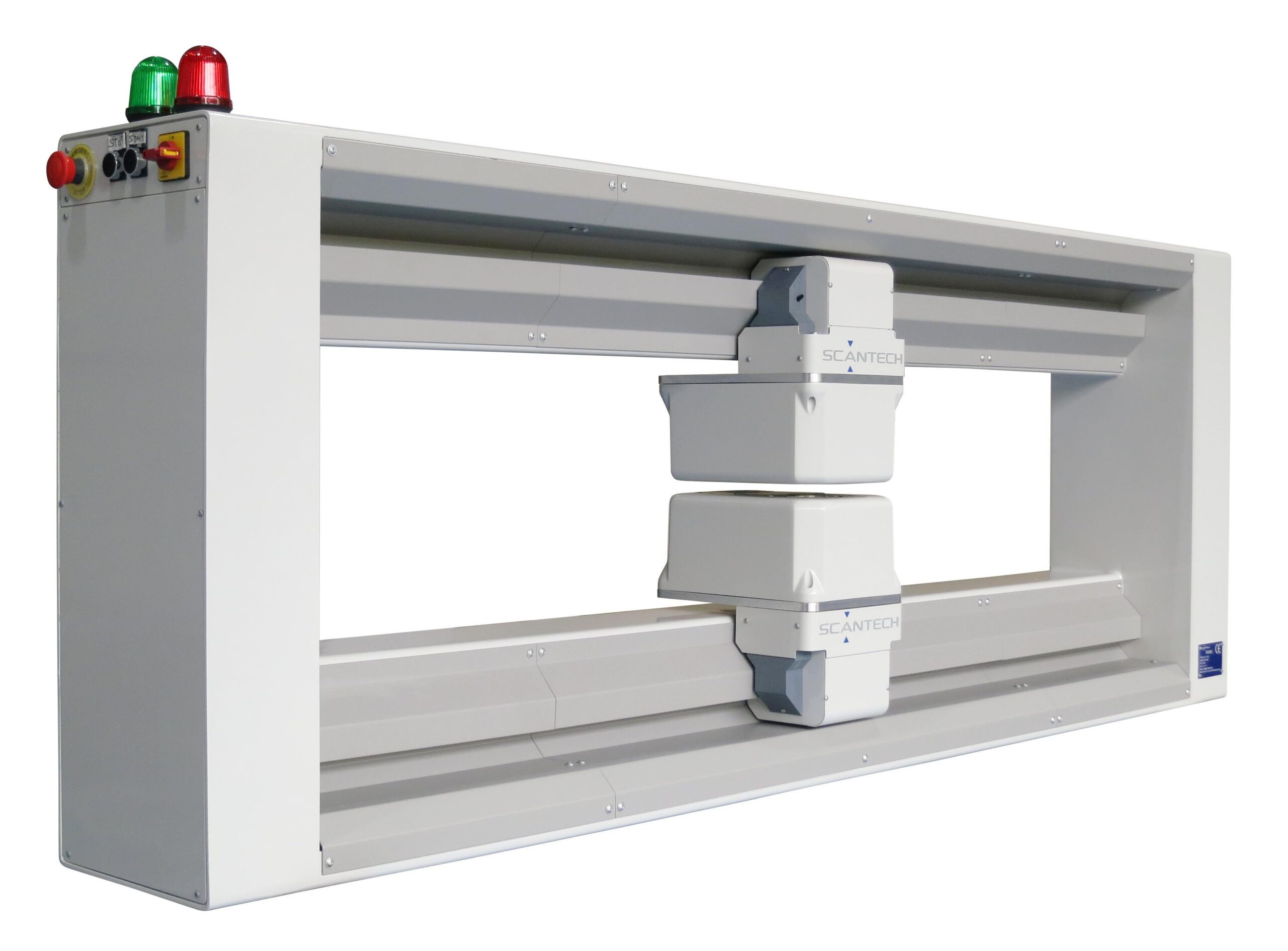
A widely used system is the ULO3 x-ray transmission scanner, which measures basis weight across the web during production.
When Multiple Measurement Technologies Are Required
While x-ray transmission gauges provide the most versatile solution for many extrusion and coating processes, certain advanced applications require additional measurement capabilities.
Battery electrode manufacturing is a good example. Engineers may need to measure:
- Coating basis weight
- Coating thickness
- Coating density
To address these requirements, some measurement systems combine multiple sensing technologies into a single scanner platform.
One example is the HC3 multi-sensor system from Scantech, which integrates:
- X-ray measurement for basis weight
- Confocal optical sensors for true thickness measurement
- Ultrasonic measurement for calibration
These systems are particularly useful for high-precision battery electrode coating processes.
For most extrusion and coating applications, however, standard x-ray transmission scanners remain the primary measurement technology, with other sensors used only when additional measurement parameters are required.
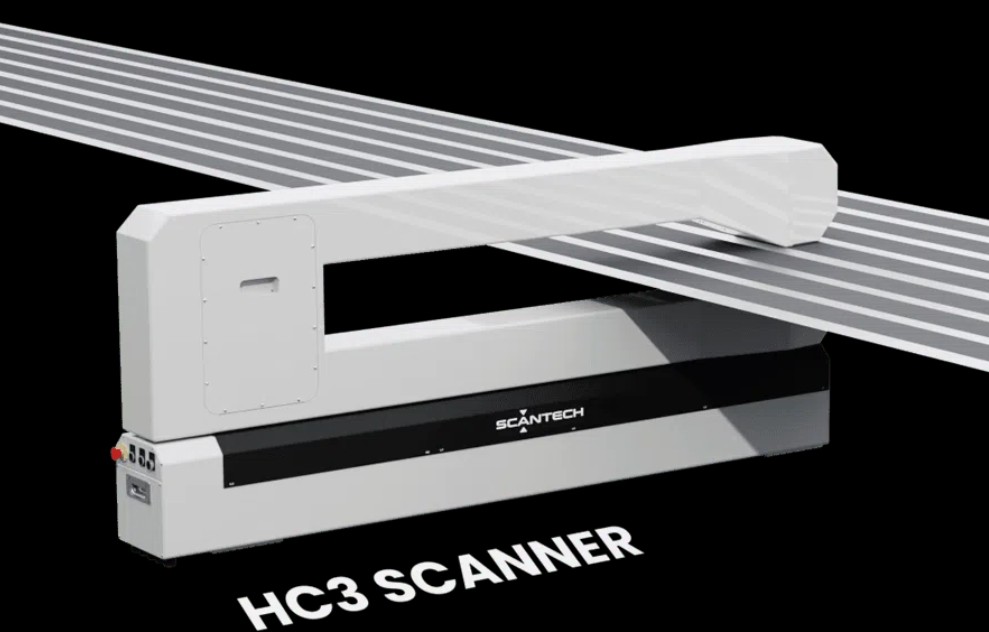
SCANTECH HC3 combined x-ray, confocal, and ultrasonic measurement system on a battery cathode coating line (rendering).
Selecting the Right Web Gauging Technology
No single measurement technology is ideal for every application. Selecting the best solution depends on several factors, including:
- Material composition
- Process stability
- Required measurement accuracy
- Line speed and web width
- Available installation space
For many extrusion and coating applications, x-ray transmission measurement provides the best balance of accuracy, reliability, and operational simplicity.
However, laser or ultrasonic sensors may be appropriate when material composition varies significantly, while multi-sensor systems may be required in advanced battery manufacturing.
Engineers evaluating measurement improvements can estimate process capability improvements using the Cpk and Ppk process capability calculator.
Manufacturers interested in material savings from improved thickness control can estimate potential ROI using:
Additional engineering tools are available in the Gauge Advisor Tools Hub, including calculators for coating weight, extrusion throughput, and material density.
Ready to Find the Right Web Gauging System for Your Line?
Selecting the right measurement technology is essential for enhancing product quality, minimizing waste, and ensuring maximum uptime. The ideal solution ultimately depends on your unique materials, processes, and space limitations.
Gauge Advisor supports film, sheet, and coating manufacturers across the Western United States with web gauging and inline thickness measurement systems. Learn more about our film and sheet extrusion measurement solutions in the Western United States.
We are the authorized sales partner for Scantech measurement and control systems supporting manufacturers with equipment selection, process optimization, and system integration..

 By: Matthew Baker
Founder, Gauge Advisor LLC
👉 Read these next:
Choosing the Right Gauging System for Film and Sheet Extrusion Lines: Key Considerations
Turn Scrap into Profit: Smart Repelletizing of Edge Trim and Off-Spec Rolls