
Updated May 11 2026
Profitability in plastics extrusion is directly linked to statistical process control (SPC). Whether you’re extruding film, sheet, or tubing, metrics are equally important. For an overview of measurement technologies used in extrusion processes, see our measurement and process control solutions page. Small deviations will lead to massive resin waste, higher customer rejects, and more manual labor. The outcome? Higher costs and lower profits.
But here’s the good news: mastering just four core statistics can significantly improve your quality control and bottom line.
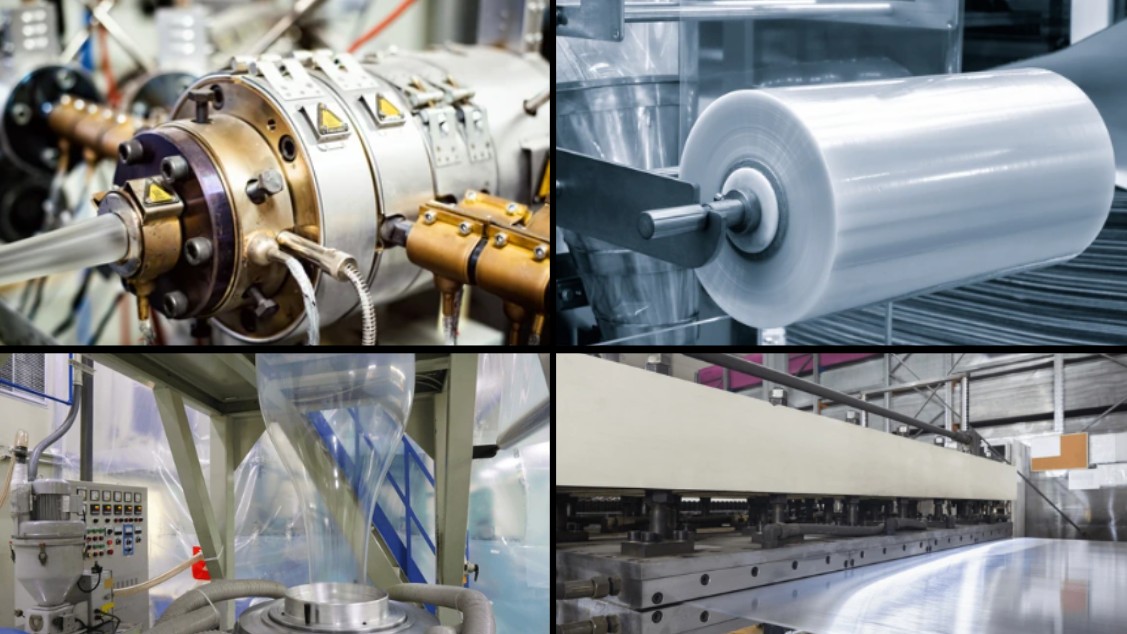
Metrics are important in a variety of plastics extrusion processes.
1️⃣ Average Thickness
If you only tracked one number, this would be it.
Think of average thickness (or average diameter & wall for round extrusions) as your resin spending meter. The thicker your product runs compared to your target, the more resin you’re giving away when it goes out the door.
Let’s say your spec is 50 µm, but you’re consistently running at 52 µm just to be safe. That extra 2 µm adds up quickly. Over time, this will cost tens of thousands of dollars in wasted resin across high-volume runs. Perhaps even more if expensive polymers or additives are part of the recipe. However, while averages are a straightforward statistic, they tell you nothing about how efficient your process is at achieving that number.
Takeaway: Dialing in your average thickness is the fastest way to cut material costs, but other statistics are needed to evaluate process efficiency. You can estimate potential resin savings using our ROI Calculators for plastics extrusion.
2️⃣ Standard Deviation: Your Process “Wobble”
If average thickness tells you where your process is, standard deviation tells you how much it moves.
Think of your extrusion line like driving a car on cruise control. A low standard deviation is like maintaining a constant speed on an open highway. A high standard deviation is like your speed constantly dropping due to traffic and then surging when you speed to make up for lost time.
That kind of fluctuation in your plastics extrusion line, whether caused by varying operator skill, defective machinery, or a reliance on manual processes, creates instability.
The result is sections of product that are either too thick or too thin, leading to quality and waste issues. These inconsistencies can cause problems in downstream processes like sealing, printing, or lamination. Even worse, they can result in product failure. Imagine the risk when you’re producing critical products like food-grade packaging film or precision tubing for vascular stents. There’s no room for error! Learn more about measurement systems used for these applications on our film and sheet measurement solutions page and our medical device measurement and inspection solutions page.
Smaller standard deviation equals tighter control and fewer quality issues.
And here’s the kicker: Standard deviation directly affects process capability metrics such as Cpk and Ppk. Reduce it, and your capability stats improve too. Engineers can evaluate these metrics using our CPK / PPK Process Capability Calculator.

A normal bell curve distribution. The average (mean) represents the central tendency of a dataset, while the standard deviation measures the spread or dispersion of values around that mean. A low standard deviation indicates data points are clustered closely around the average, whereas a high standard deviation suggests values are more spread out.
3️⃣ Cpk: The Process “Target Score”
Now we’re turning data into meaningful information.
Cpk (Process Capability Index) tells you how capable your process is at hitting your targets under ideal conditions.
Think of it like a game of darts. If you consistently hit close to the center bullseye with tight grouping, your Cpk is high. If your darts are all over the place, even if they’re still on the board, your Cpk drops.
This is the stat you use when you’re validating a new line or tuning your die and temperature zones.
Goal: Cpk ≥ 1.33 for capable, well-tuned lines.
4️⃣ Ppk: Your Real-World Performance
If Cpk is how well you shoot on a calm day, Ppk (Process Performance Index) is how you perform in wind, rain, or after a double shift.
Ppk includes all real-world variation such as material shifts, operator changes, and ambient temperature effects. It’s the most honest look at how your line performs over time.
Ppk tells your customers, auditors, and team if you’re really staying in spec.
And just like Cpk, a Ppk below 1.33 often means you’re wasting resin by running thick to avoid spec violations.
An explanation how Cpk and Ppk work in relation to process variation.
🔁 How They All Work Together
Here’s a quick breakdown of how these four stats connect:
| Statistic | What It Tells You | How It Helps You Save Resin |
|---|---|---|
| Average Thickness | Your material usage baseline | Run closer to target thickness |
| Standard Deviation | Process variation | Tighten control by identifying improvements |
| Cpk | Short-term process capability | Tune your line settings more precisely |
| Ppk | Long-term process performance | Measure true output under real-world conditions |
Want to Improve All Four Stats?
The fastest way to tighten these metrics is by using the right plastics extrusion equipment:
- Upstream: Continuous loss-in-weight gravimetric blenders ensure precise recipe delivery and reduce blend variability at the source. Melt pumps reduce fluctuations at the die. Consider suppliers like Advanced Blending Solutions and MAAG.
- Downstream: In-line thickness or basis weight gauges provide real-time data and closed-loop feedback so you don’t run thicker than needed. Consider suppliers such as Scantech for flat film & sheet thickness and LaserLinc for tubing diameter and wall thickness.
If you’re serious about resin savings and quality gains, these tools are your best investment. Even more benefits? Investing in these technologies will help save manual labor costs, time, and product waste. You will instantly realize higher profit.
📞 Take the Next Step
Whether you’re planning to improve line efficiency or just want to “talk shop”, reach out to start a conversation. After all, what are process variations really costing you?
Gauge Advisor supports plastics extrusion manufacturers in California and across the Western United States with precision measurement and process control solutions.
We are the authorized sales and support partner for Advanced Blending Solutions, MAAG, Scantech, LaserLinc and Force Measuring Systems (FMS). We support manufacturers with equipment selection, process optimization, and system integration.
If you’re evaluating equipment upgrades for your film, sheet, pipe, profile, or tubing extrusion line, request application guidance using the form below.

 By: Matthew Baker
Founder, Gauge Advisor LLC
👉 Read these next:
Blenders and Thickness Gauges: The Real Profit Drivers in Film Extrusion and Which Ones to Use
Acheiving Precision in Medical Tube Extrusion: Advanced Measurement Technologies
Extrusion Melt Pumps: How MAAG Pumps Improve Output and Product Consistency