
Updated May 11, 2026
Maintaining accurate wall thickness measurement during tube extrusion depends on one critical factor that is often overlooked: transducer alignment.
Ultrasonic measurement systems work by sending sound waves through the tube wall and measuring the returning signal. For the measurement to be accurate, the transducers must remain centered on the product as it passes through the cooling tank.
In reality, that is not always easy. Tubing can drift slightly during startup, move within the cooling trough, or change position as process conditions stabilize. When this happens, ultrasonic transducers may not be perfectly aligned with the tube. Even small shifts can affect measurement stability.
This is why centering the ultrasonic measurement assembly during startup has always been an important step in tube extrusion measurement.
If you want a deeper overview of measurement technologies used in catheter and medical tubing production, see our guide to medical-grade tube extrusion measurement technologies.
Now there is a new approach that simplifies this process.
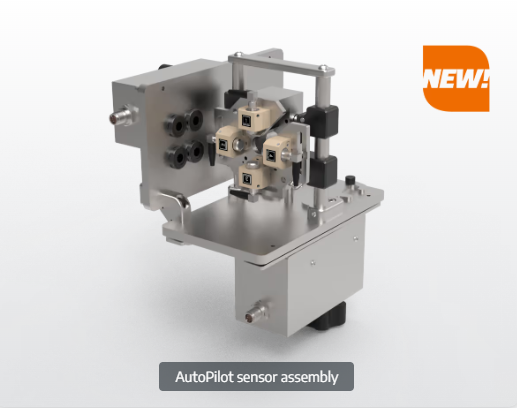
AutoPilot from LaserLinc automatically positions ultrasonic transducers to center them on the extruded tube during startup, allowing stable wall thickness measurement in less than a minute.
The Challenge with Manual Transducer Alignment
Many ultrasonic wall thickness systems rely on manual adjustments to position the transducers around the product.
Operators typically adjust knobs or rollers until the tube appears centered in the measurement field. On a busy extrusion line this process can take time, and results often depend on the operator’s experience.
Common issues include:
- Slow startup when centering the system
- Measurement drift while dialing in alignment
- Operator variability between shifts
- Frequent adjustments during process changes
Some competing systems attempt to solve this problem using clamshell contact assemblies that physically hold the tube in position.
While these systems can help with alignment, they introduce their own challenges. Contact components can cause product abrasion, require insert changes for different tube sizes, and add friction to the process.
Extrusion engineers often prefer roller-guided measurement systems because they support the product without dragging on it.
However, traditional roller-guided systems still require manual alignment.

Manual adjustment knobs on the roller-guided UltraGauge system from LaserLinc (shown) allow operators to manually center ultrasonic transducers on the tubing. Systems can be easily upgraded to the AutoPilot automatic centering assembly.
Automatic Transducer Centering with AutoPilot
To address this challenge, LaserLinc introduced AutoPilot, a motorized positioning system designed for UltraGauge ultrasonic measurement platforms.
AutoPilot automatically moves the transducer assembly so the tubing is centered in the measurement field during extrusion startup. The system uses motorized positioning to adjust the assembly until optimal alignment is achieved.
In most cases the system completes the centering process within about 45 seconds, allowing engineers to begin stable measurement quickly after line startup.
This reduces the time operators spend adjusting measurement systems and allows production to begin with reliable wall thickness data.
How AutoPilot Works During Startup
During extrusion startup, tubing position can change as the line stabilizes.
Instead of manually adjusting alignment knobs, AutoPilot automatically moves the through wall transducer assembly in both the X and Y directions to center the product within the ultrasonic measurement field.
The system uses motorized positioning and limit switches to control movement and prevent over travel while maintaining the same adjustment range as existing UltraGauge systems.
Once alignment is achieved, measurement begins with properly centered ultrasonic transducers.
This approach simplifies the setup process and allows operators to reach stable measurements much faster.
If you are selecting ultrasonic sensors for a tubing application, you may also find our UltraGauge transducer selector tool useful.
Adaptive Mode for Dynamic Processes
Some extrusion processes involve tubing that shifts position during production.
Examples include:
- very small diameter tubing
- soft polymer materials
- high line speeds
- unstable startup conditions
In these cases AutoPilot can be placed into Adaptive Mode.
When enabled, the system continues monitoring alignment and adjusts the transducer position as needed during extrusion. This allows the ultrasonic measurement system to remain centered even if the product moves within the cooling tank.
For extrusion engineers working with tight tolerances, this helps maintain measurement stability throughout the run.
Why Extrusion Engineers Like This Approach
Automatic alignment provides several practical advantages on the production floor.
Faster startup
AutoPilot reduces the time required to center ultrasonic transducers during run setup.
Lower scrap during startup
Stable measurements allow engineers to begin process control sooner.
Less operator dependency
The system removes the need for manual alignment adjustments and reduces operator variability.
Improved measurement consistency
Keeping the product centered ensures ultrasonic readings remain stable and repeatable.
Roller guide advantages without manual adjustment
The system maintains the benefits of roller guided fixturing without the drawbacks of clamshell contact systems.
For engineers evaluating whether measurement automation makes financial sense, you can estimate potential savings using our medical device gauging ROI calculator.
New LaserLinc technologies featured at MD&M West 2026. AutoPilot automatic transducer alignment is shown at 1:05 in this video.
Where This Technology Is Most Useful
Automatic transducer alignment is particularly valuable in industries where tight dimensional control is critical.
These include:
- medical tubing extrusion
- catheter manufacturing
- micro extrusion
- multilumen tubing
- high precision industrial tubing
If you want to explore how these systems fit into medical manufacturing environments, see our full overview of medical device measurement and inspection systems.
Ultrasonic measurement is often paired with laser diameter gauges to provide a complete picture of tubing geometry during extrusion.
The Bigger Trend in Extrusion Measurement
Extrusion measurement systems are evolving toward automation and reduced operator intervention.
Historically, many measurement tools required manual adjustment and significant operator experience. Newer systems focus on automation, faster setup, and more consistent measurement.
Automatic transducer alignment is a good example of this trend. By removing manual centering steps, extrusion lines can begin stable measurement more quickly and maintain measurement quality throughout the run.
You can explore additional engineering calculators and tools for extrusion and measurement applications in the Gauge Advisor Tools Hub.

Modern tubing extrusion lines often integrate complete measurement and process control automation to maintain tight dimensional tolerances. Courtesy of LaserLinc.
Final Thoughts
Accurate wall thickness measurement requires more than just a good ultrasonic sensor. The measurement system must remain properly aligned with the product during extrusion.
Manual alignment has traditionally been part of the setup process, but automated positioning systems like AutoPilot simplify this task significantly.
By automatically centering the transducers during startup and maintaining alignment during production when needed, extrusion engineers can spend less time adjusting measurement equipment and more time focusing on the process itself.
Gauge Advisor is the authorized sales and support partner for LaserLinc measurement systems in the Western United States, supporting customers with equipment selection, system integration, and technical application support.
If you’re evaluating ultrasonic measurement systems for tubing extrusion, request application guidance using the form below.

 By: Matthew Baker
Founder, Gauge Advisor LLC