
Protective coatings · Magnet components · Non-contact inspection
Rare Earth Magnet Coating Thickness Measurement
Check coating build without a probe touching the finish. For neodymium iron boron (NdFeB) and other magnet components, Gauge Advisor helps evaluate AIM photothermal measurement around the coating stack, part geometry and required result.
Start by defining what must be reported: total protective coating, an individual layer or thickness variation across selected regions.
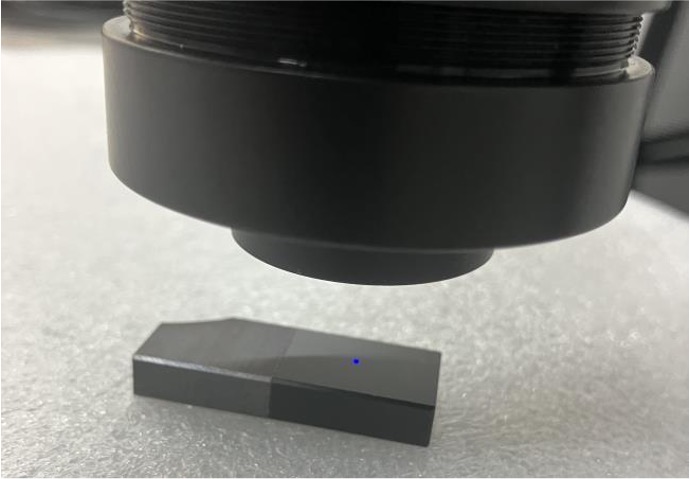
Define the coating requirement
Total build, individual layers or local variation?
| Required result | Why it matters | What to specify |
|---|---|---|
| Total protective coating | Checks the combined build against a defined coating requirement. | The full stack, total thickness range and accepted reference method. |
| An individual layer | A Ni/Cu/Ni stack contains different layers; a combined result may not answer a layer-specific requirement. | The named layer, surrounding materials and the uncertainty needed for that value. |
| Thickness by location | Reveals whether selected faces or regions differ. | Inspection locations, part presentation and whether point values or an area view is needed. |
Swipe to see all columns.
One multilayer stack can involve several inspection questions. Identify them before selecting the gauge. Separate Ni/Cu/Ni layer values need specific confirmation for the proposed method.
A different measurement principle
Read the coating’s thermal response.
AIM photothermal measurement applies controlled light and observes the resulting thermal response. Calibration relates that response to coating thickness.
The thickness signal does not rely on magnetic induction. That makes it an approach to evaluate when the coating and magnet combination is difficult for a conventional contact-gauge workflow.
Coating absorption, thermal contrast, surface finish and part presentation still influence the result. Test the actual component in its intended magnetized or unmagnetized state.
Explore photothermal measurement principles →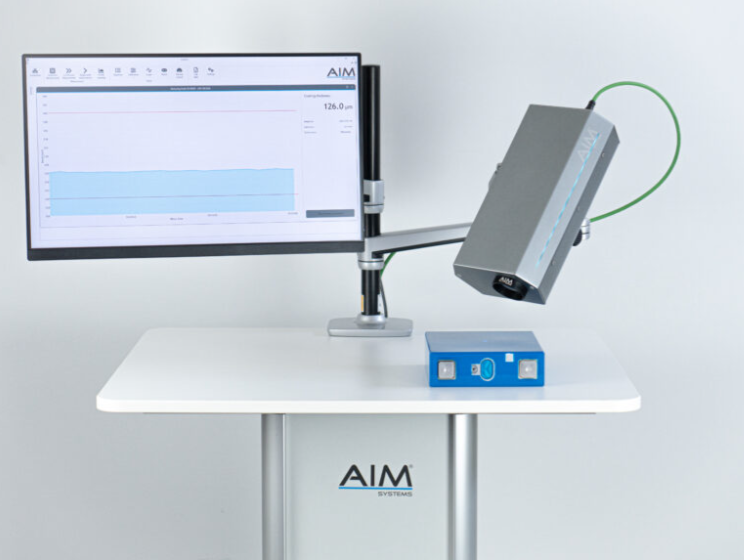
Choose methods around the layer stack.
Magnetic and eddy-current methods have defined coating and substrate combinations. XRF or cross-sections may also be useful for metallic-layer evaluation or reference measurements.
Compare the result needed on the actual part. Photothermal measurement can complement the inspection plan where its calibrated response meets the requirement.
Repeat the right locations
Match the coverage to the quality plan.
Defined point checks
Use CoatPro with repeatable presentation for selected positions on a face or accessible feature.
A programmed sequence
Use controlled motion to collect the same set of locations across parts. Include presentation and motion in the cycle time.
An area thickness image
Evaluate CoatPro XD when the requirement is distribution over a visible region. Confirm the coating response and spatial detail for that view.
Consider the geometry early.
Small faces, curves, edges and chamfers affect access and sensor presentation. A fixture or handling route should expose the locations that matter while keeping the part stable.
One camera view does not inspect hidden faces. Define any additional views or point checks needed to cover the part.

Test the actual coating and part
Use samples to establish a reliable measurement.
Describe the construction
Provide the magnet grade, coating materials and layer sequence. Include magnetized state, finish and inspection conditions.
Supply the reference range
Use representative low, nominal and high coating builds with accepted reference values at identifiable locations.
Check the complete workflow
Evaluate repeatability, geometry, measurement time and required records, then agree on the practical inspection setup.
Review nickel, epoxy and zinc as separate applications.
A bright metallic finish and an organic coating can produce different optical and thermal responses. Qualify the material pair and thickness range instead of carrying one calibration across different coating families.
Record the part or batch, inspection location and recipe needed to interpret each result. Define plant communication and any automatic pass/fail action as part of the installation.
Thickness is one part of coating quality. Adhesion, pinholes, corrosion protection and magnetic performance need the separate checks defined in your quality plan.
Related solutions
Explore the equipment and inspection workflow.
Compare calibrated point values, programmed sequences and area images.
Understand the optical and thermal response and the role of calibration.
Plan repeatable access to the required inspection locations.
Review related protective layers and material combinations.
Common questions
Magnet coating measurement FAQ.
Can the part be measured after magnetization?
Provide the actual magnetized part and its handling conditions for evaluation. The photothermal thickness signal does not use magnetic induction, but the complete sensor arrangement and installation still need to suit the component.
Can it report nickel, copper and nickel separately?
Do not assume that a combined coating response resolves each layer. Define the layer-specific requirement and reference values so the proposed measurement can be evaluated on the complete stack.
Can bright nickel, zinc or epoxy coatings be measured?
These can be reviewed as candidate applications. Surface finish, absorption, thermal contrast, substrate and thickness range determine whether a useful calibrated result is available.
When is an area map useful?
A map can help when variation within a visible region matters more than a few selected readings. CoatPro XD coverage and spatial detail must be confirmed for the coating and geometry being inspected.
Does this eliminate contact measurements?
It may replace particular inspection tasks once qualified for them. Existing gauges or other reference methods can remain useful for calibration, verification and layer-specific checks.
Does an acceptable thickness confirm corrosion protection?
No. Coating thickness supports the quality assessment, but it does not by itself establish the absence of pinholes, adequate adhesion or corrosion resistance.
Technical resources: CoatPro · CoatPro XD.
Application review
Build the inspection around your coated magnet.
Send the coating specification and the locations you need to inspect. I’ll help define the measurement objective, sample evaluation and practical AIM system arrangement.
Helpful details to send
- Magnet grade and magnetized or unmagnetized state
- Coating materials and complete layer sequence
- Total or layer-specific thickness requirement and tolerance
- Part drawing, required locations and reference measurements
- Production rate, handling constraints and data needs
A drawing, part photo or sample description is a useful starting point.