Choose the Upgrade
Evaluate a manual-adjust air ring, air ring with automatic gauge control, high-output cooling system, or IBC and bubble-control upgrade.

Estimate the potential payback of a blown film air ring, automatic gauge control, intensive cooling, or IBC upgrade in just a few minutes.
Evaluate a manual-adjust air ring, air ring with automatic gauge control, high-output cooling system, or IBC and bubble-control upgrade.
Add your current throughput, operating hours, material cost, gauge variation, scrap, and estimated project cost.
See the estimated annual benefit, added production, resin savings, payback period, and three-year net benefit.
Blown film air ring upgrades can create value through increased output, improved bubble stability, tighter gauge control, reduced resin overbuild, lower startup scrap, and faster product changeovers. This calculator helps build a practical first-pass business case using your current operating conditions and documented equipment performance ranges.

Blown Film Cooling and Gauge Control Technology Partner
A blown film air ring is one of the most important performance components on a blown film extrusion line. It directs cooling air around the outside of the molten film bubble as the polymer exits the die. The quality, velocity, distribution, and stability of that airflow can directly influence production output, frost-line height, bubble stability, film-thickness variation, startup scrap, and operator consistency.
A blown film air ring is the external cooling assembly positioned around the extrusion die. It delivers a controlled stream of air to remove heat from the molten polymer bubble. As the film cools, it transitions from a soft melt into a stable film structure at the frost line. A better air ring removes heat more uniformly and keeps the cooling air attached to the bubble for a longer distance.
On many blown film lines, the extruder may be capable of producing more material than the cooling system can remove heat from. When external cooling becomes the bottleneck, increasing screw speed can cause the frost line to rise, the bubble to breathe or move, and film properties to become less consistent.
A high-performance air ring improves the way cooling air interacts with the film surface. The goal is not simply to blow more air. The goal is to deliver high-volume, low-turbulence, properly directed airflow that cools the bubble efficiently without introducing unnecessary instability.
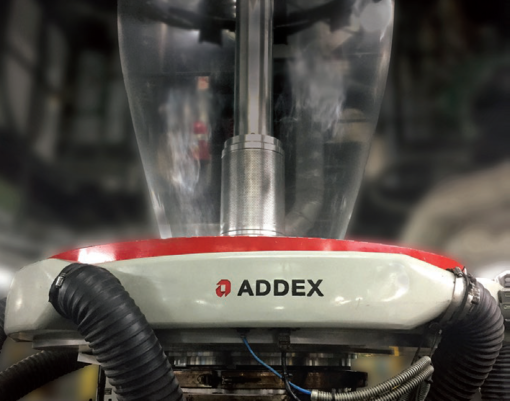
When cooling is the production bottleneck, a more efficient air ring can allow the line to run at a higher sustained extrusion rate. Increased pounds per hour can create substantial annual value when the extruder, blower, tower, collapsing frame, haul-off, and winder can support the additional production.
Better-directed cooling air can stabilize the molten film sooner. A steadier bubble can reduce movement at the frost line, improve layflat consistency, and make difficult resins, blow-up ratios, and thin-gauge products easier to operate.
Manual or automatic airflow adjustment can selectively change cooling around the circumference of the bubble. This can help correct persistent thick and thin regions associated with the die, melt distribution, or process conditions.
A line with excessive profile variation is often operated above nominal gauge to protect the thinnest part of the film. Tighter profile control may allow the producer to move the average thickness closer to target while continuing to meet the minimum specification.
Faster stabilization and more repeatable settings can reduce the time required to establish an acceptable bubble, gauge profile, layflat, and output rate after a startup, resin change, width change, or product transition.
Better hardware and automatic control can reduce the amount of process knowledge that must remain with one experienced operator. Recipe storage, automatic profile correction, and digital bubble control can improve consistency between shifts.
A manual-adjust air ring gives the operator multiple narrow adjustment zones around the bubble. These adjustments redistribute cooling air to correct localized thick and thin areas without reducing the air ring’s total cooling capacity or line output.
Addex states that its MGC system can correct gauge variation by 25% or more on stationary dies and by 15% to 20% or more on oscillating or rotating dies. Actual resin savings are lower because not every profile improvement can safely be converted into reduced average film thickness.
An automatic gauge-control air ring uses an online thickness scanner, profile mapping, control software, and an actuator with sliding airflow-control fingers to continuously correct circumferential film-thickness variation.
Addex EGC preserves total airflow and cooling capacity while making profile corrections. Its 1-degree film-profile mapping and automatic twist compensation help place each correction in the proper location around the bubble.
The primary economic value often comes from reduced gauge variation, lower material overbuild, reduced profile-related scrap, and less operator intervention.
Intensive Cooling uses enhanced lip geometry and additional bubble-locking or stabilizing points to keep high-velocity cooling air in effective contact with the bubble.
Beyond higher output, it can improve bubble stability and broaden the usable operating window across materials, film thicknesses, and blow-up ratios. Addex states that the design has no negative impact on film properties and requires fewer adjustments than conventional air rings.
This approach is most valuable when external cooling is the true line bottleneck and the remaining extrusion and downstream equipment has enough unused capacity to process the additional output.
A stacked cooling system adds multiple high-performance cooling stages above the die. Addex publishes output references of 20% to 30% for lower-melt-strength applications and up to 50% for suitable higher-melt-strength applications.
The air ring is typically oversized approximately 2 to 4 inches relative to the die, and IBC operation is listed for die sizes 12 inches and larger. The upper performance range should only be used after confirming resin behavior, blower capacity, extruder capacity, tower geometry, winding capacity, and downstream limitations.
Digital IBC control manages the supply and exhaust air used by an existing Internal Bubble Cooling system. Addex DIBC uses pure digital ultrasonic sensing, automatic temperature compensation, and multi-point sensor firing to improve bubble-diameter stability and control response.
The system is designed to resist electrical interference and continue operating if a sensor is briefly blocked during startup. Blower-speed control is available for trimmed film, while air-valve control provides the tightest layflat control.
IBC ROI is commonly based on faster size changes, less transition scrap, tighter layflat control, fewer control interruptions, and improved operating consistency.
The plenum distributes blower air around the circumference of the air ring. Unequal hose lengths, pressure losses, and imbalanced inlet flow can create profile errors before the air reaches the cooling lips.
A properly designed plenum helps provide more uniform airflow, lower pressure loss, better blower efficiency, and a more consistent starting profile.

A manual-adjust air ring is typically best when the gauge error is repeatable, the product runs are long enough for manual optimization, and the customer wants a lower-cost path to better cooling and profile adjustment.
An air ring with automatic gauge control becomes more attractive when profile variation changes during the run, product specifications are tight, resin usage is high, operators frequently adjust the line, or the producer is intentionally running heavy to protect against thin spots.
The calculator above uses documented Addex performance ranges as planning assumptions. These values should be treated as a starting point for ROI screening, not as a universal guarantee for every line.
Actual improvement depends on whether cooling is currently limiting production and whether the extruder, die, blower, tower, collapsing frame, haul-off, winder, formulation, and downstream demand can support a higher rate.
The calculator separates several possible value drivers because air ring technology does not produce the same financial benefit on every line. A manual-adjust air ring may be justified primarily by higher output and improved stability, while an automatic gauge-control system may be justified by resin savings and reduced film-thickness variation.
This estimates the annual value of producing and selling more film. The calculator subtracts material cost from average selling price to estimate the profit generated by each additional pound, then applies the expected production increase and the portion of added capacity that can realistically be sold. This is a simplified estimate and does not include packaging, freight, commissions, taxes, fixed overhead, or other variable expenses.
Gauge-profile improvement may allow the average film thickness to move closer to target while the thinnest point remains within specification. This can reduce resin consumption without reducing the amount of saleable film produced.
Better bubble stability, faster profile correction, and repeatable process settings can reduce the amount of off-spec material generated during startups, product changes, bubble upsets, and gauge-profile adjustments.
Digital IBC and high-speed airflow control can reduce the time required to move from one bubble size or layflat target to another. The financial value includes recovered production time, reduced transition scrap, and less operator intervention.
Simple payback compares installed project cost with estimated annual benefit. Three-year net benefit subtracts the project cost from three years of projected operating benefit. Both are directional screening metrics and should be confirmed with production trials and an application-specific quotation.
Review related guidance on reducing blown film gauge variation and identifying blown film production bottlenecks.
A blown film air ring directs cooling air around the outside of the molten film bubble as it exits the extrusion die. It removes heat, helps establish the frost line, and influences bubble stability, output, and circumferential film-thickness uniformity.
Yes, when external cooling is the line’s current production bottleneck. A more efficient air ring can cool and stabilize the bubble sooner, allowing a higher extrusion rate. The actual increase depends on the resin, die, blower, extruder, tower, winder, and downstream capacity.
Adjustable airflow changes the cooling rate at specific locations around the bubble. Because cooling affects how the molten film stretches, localized airflow correction can help reduce persistent thick and thin regions in the circumferential gauge profile.
A manual-adjust air ring requires an operator to identify and correct profile errors using individual adjustment points. Automatic gauge control uses an online thickness scanner, profile mapping, software, and an actuator with sliding airflow-control fingers to continuously make corrections during production.
Intensive cooling uses specialized air-ring lip geometry and additional stabilizing airflow stages to keep high-velocity cooling air attached to the bubble more effectively. The objective is to remove more heat, improve bubble stability, and increase output when cooling is limiting the process.
A stacked cooling system uses two or more external cooling stages positioned above the die. It is designed for applications seeking maximum cooling-limited output. Suitability depends on resin melt strength, die size, tower geometry, blower capacity, and the ability of the rest of the line to process more film.
IBC means Internal Bubble Cooling. A DIBC controller manages the supply and exhaust air used by the IBC system to improve bubble-diameter stability, layflat control, changeover speed, and operational consistency.
An air ring changes the cooling conditions rather than the resin formulation. However, cooling rate and frost-line position can affect orientation and film behavior, so the application should be reviewed to confirm that output gains do not compromise optical, mechanical, sealing, or dimensional requirements.
Air ring ROI may include added sellable output, reduced resin overbuild, lower startup and profile scrap, faster product changes, reduced downtime, and lower operator involvement. Estimated annual benefit is compared with installed project cost to calculate simple payback and longer-term net benefit.
Important information includes die diameter, resin types, product thickness, layflat, blow-up ratio, current output, target output, frost-line height, blower specifications, IBC configuration, die rotation, gauge profile, available tower clearance, and the capacity of the extruder and downstream equipment.
Yes. Many high-performance manual, automatic, intensive-cooling, and IBC systems are designed as retrofits. The installation must be engineered around the existing die, blower, IBC hardware, tower geometry, controls, scanner, and available mounting space.
The Addex MGC datasheet states that the system can correct gauge variation by 25% or more on stationary dies and by 15% to 20% or more on oscillating or rotating dies. Actual material savings will be lower because not every profile improvement can safely be converted into reduced average film thickness.
The Addex EGC system redistributes airflow to correct the film profile while preserving total airflow and cooling capacity. This allows the system to control thick and thin areas without sacrificing the air ring’s overall cooling performance.
No. Published performance ranges depend on the selected equipment and a suitable application. Output gains require cooling to be the limiting factor and require sufficient extruder, blower, die, tower, winder, and downstream capacity. Application review is necessary before using an output percentage for capital approval.