
Electrophoretic coating · Steel & aluminum parts
E-Coat Thickness Measurement Before & After Bake
Check e-coat thickness at the locations that matter, without touching the coating. AIM CoatPro supports repeatable inspection of suitable electrophoretic coatings on metal parts and assemblies.
Use the process stage, part geometry and inspection plan to decide where to measure, how to present the part and what the result must tell production.

Choose the process stage
Earlier feedback and final verification have different jobs.
CoatPro is a starting point for e-coat on steel and aluminum, including applications before and after bake. Test the actual formulation and condition at the intended measurement location.
| Inspection purpose | Process location | Result to establish |
|---|---|---|
| Feedback before bake | After deposition, in the defined pre-bake condition. | A calibrated reading for that coating state, with limits suitable for the intended process decision. |
| Verification after bake | After bake at the agreed inspection condition. | Thickness checked against the finished-film requirement and accepted reference method. |
| Prediction of the baked result | An early measurement correlated with the later film. | A demonstrated relationship using matched samples across the expected process range. |
Swipe to see all columns.
A pre-bake reading is not automatically final dry-film thickness. Establish and verify the relationship if production needs the earlier number to predict the baked result.
Define the inspection plan
Repeat the locations that answer the quality question.
Start with the required drawing locations, known coating risks and the frequency of inspection. A consistent set of locations makes part-to-part comparisons more useful.
On a vehicle body, tray or larger assembly, a programmed route can collect readings at accessible points. Define those positions clearly so the record represents the coverage actually inspected.
Review access to formed features.
Recesses, lips and changing surface angles can affect illumination and detection. Check the sensor view, clearance and working distance on the real geometry before finalizing the route.
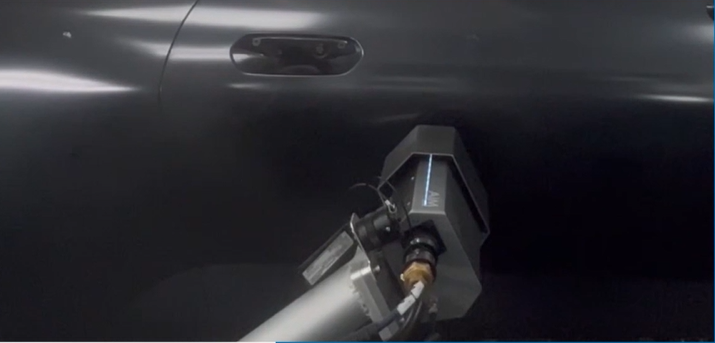
AIM CoatPro & controlled presentation
Build automation around the selected locations.
Fixtured point inspection
Present a component at a repeatable position for a thickness check near the line or in the quality area.
Indexed production checks
Bring the required location into view as each part moves through a defined station.
Programmed point sequence
Use a robot or controlled axis to inspect several locations on a formed part or larger assembly.
CoatPro supports point, continuous and sequence modes. Choose the mode and motion around the required coverage and response time.
AIM’s e-coat application experience centers on CoatPro. If the requirement is an area thickness image, evaluate that e-coat application separately with AIM before specifying CoatPro XD.
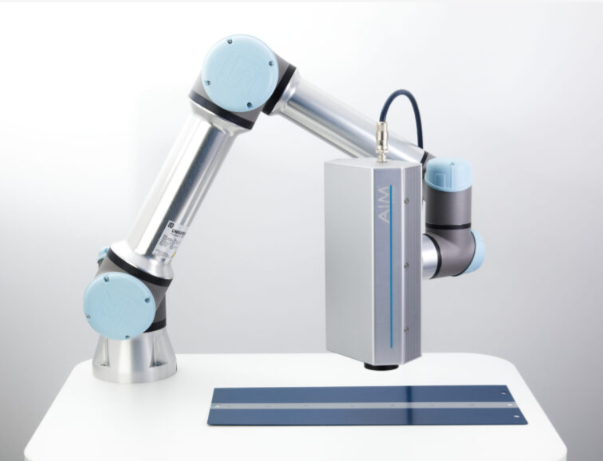
Make the result traceable
Connect each reading to the part and the location.
Define the information needed to interpret a result later: part or batch, inspection point, coating recipe, measurement stage and the limits used for evaluation.
CoatPro supports network communication, Modbus TCP and graphical or data exports. Part tracking, PLC handshakes and database connections are planned for the production installation.
The measurement can guide an operator or feed a control system. Automatic adjustment also needs an agreed controller, actuator and response strategy.

Test the actual part
Use sample evaluation to establish the practical limits.
Match the material and state
Provide the e-coat formulation, steel or aluminum substrate, thickness range and pre-bake or post-bake condition.
Establish the reference
Use representative parts with known thicknesses at identified locations and the accepted reference method.
Check the complete cycle
Review sensor access, presentation, measurement time, route length and the time available for each part.
Non-contact inspection may complement the existing post-bake checks. Keep the required final-film and coating-performance tests in the quality plan while the new measurement is evaluated.
Understand photothermal measurement and calibration →Technical resources: AIM e-coat application example · CoatPro measurement modes.
Related solutions
Plan the next step for your e-coat line.
Review the equipment and integration options for the defined inspection.
Connect the pre-bake reading with the intended production decision.
Plan location coverage, part presentation and an automated route.
Estimate potential value using your inspection effort, rework and process assumptions.
Common questions
E-coat measurement FAQ.
Can e-coat be measured before the oven?
Yes. AIM has tested e-coat on aluminum and steel before and after baking or cross-linking with CoatPro. The actual formulation, condition and range still need application testing.
Does a pre-bake measurement equal the final dry-film thickness?
Not automatically. Establish the required output and use matched before-and-after references if the early measurement must predict the baked result.
Can a vehicle body be inspected automatically?
A programmed route can collect thickness values at selected accessible locations. Specify the actual points and coverage; a point sequence does not create a single image of the entire body.
Can the sensor measure inside recesses?
That depends on the geometry and optical access. Review drawings or representative parts to confirm which locations the sensor can see at a suitable distance and angle.
Does this replace our handheld gauge?
It may complement or replace specific inspection tasks once the measurement is accepted for them. Existing post-bake gauges can remain useful for reference measurements and final checks.
Does thickness confirm corrosion protection or cure?
Thickness is one part of the quality assessment. Cure, adhesion, corrosion performance and other acceptance requirements need the tests defined in the quality plan.
Application review
Let’s map the inspection to your e-coat line.
Send the part, coating specification and the locations you need to verify. I’ll help define the sample study and production workflow with AIM.
Helpful details to send
- E-coat formulation and steel or aluminum substrate
- Pre-bake or post-bake condition and inspection temperature
- Thickness range, tolerance and reference method
- Annotated part drawing with required inspection locations
- Part handling, cycle time and the desired production record
A drawing, part photo or sample description is a useful starting point.