
Catalyst-coated membranes · Direct & decal coating
Fuel Cell Platinum Loading & Membrane Measurement
Keep catalyst loading and membrane variation visible as the web runs. Scantech measurement systems can be configured around direct membrane coating or a decal-and-transfer process.
Define the output first: platinum loading, total catalyst coat weight, membrane basis weight or physical thickness. Each needs the right measurement approach.
Choose the measurement
Platinum loading and total coat weight are different results.
A catalyst coating contains more than platinum. Keep the Pt contribution, complete coating and membrane results separate when defining the system.
| Required result | What the result describes | What the configuration needs |
|---|---|---|
| Platinum loading | The platinum contribution per unit area. | Scantech’s specialized X-ray transmission solution, qualified for the catalyst formulation, construction and loading range. |
| Catalyst coat weight | The mass per area of the complete coating, including its other constituents. | A defined total or net coating measurement, with substrate or carrier contributions handled appropriately. |
| Membrane basis weight | The membrane’s mass per unit area. | A suitable measurement position and calibration for the membrane construction. |
| Physical thickness | The geometric thickness of the specified membrane or coated structure. | An appropriate thickness measurement approach. Any mass-to-thickness conversion also needs a validated material model. |
Swipe to see all columns.
Specify the layer and the material condition. A wet coating, a dried coating on a carrier and the finished catalyst-coated membrane are different measurement tasks.
Catalyst loading
Give platinum its own measurement.
Total coating mass can change for reasons other than platinum loading. If Pt is the process target, make that an explicit output in the system scope.
Scantech offers a specialized X-ray transmission (XRT) approach for separate catalyst loading measurement. It is an application-specific sensor and software solution, evaluated against the actual material stack and coating formulation.
The review covers loading range, coating pattern, substrate, one-sided or two-sided construction and the laboratory reference. That defines which independent results the proposed system can provide.
Measure toward a useful production decision.
Profiles can help operators recognize loading drift and cross-web variation between laboratory checks. Targets and alarms should reflect the accepted catalyst loading range and the response available on the line.
Reducing precious-material overcoating is a project objective to evaluate with your production data and tolerances.
Technical background: Scantech hydrogen and catalyst-measurement brochure.
Direct coating & decal transfer
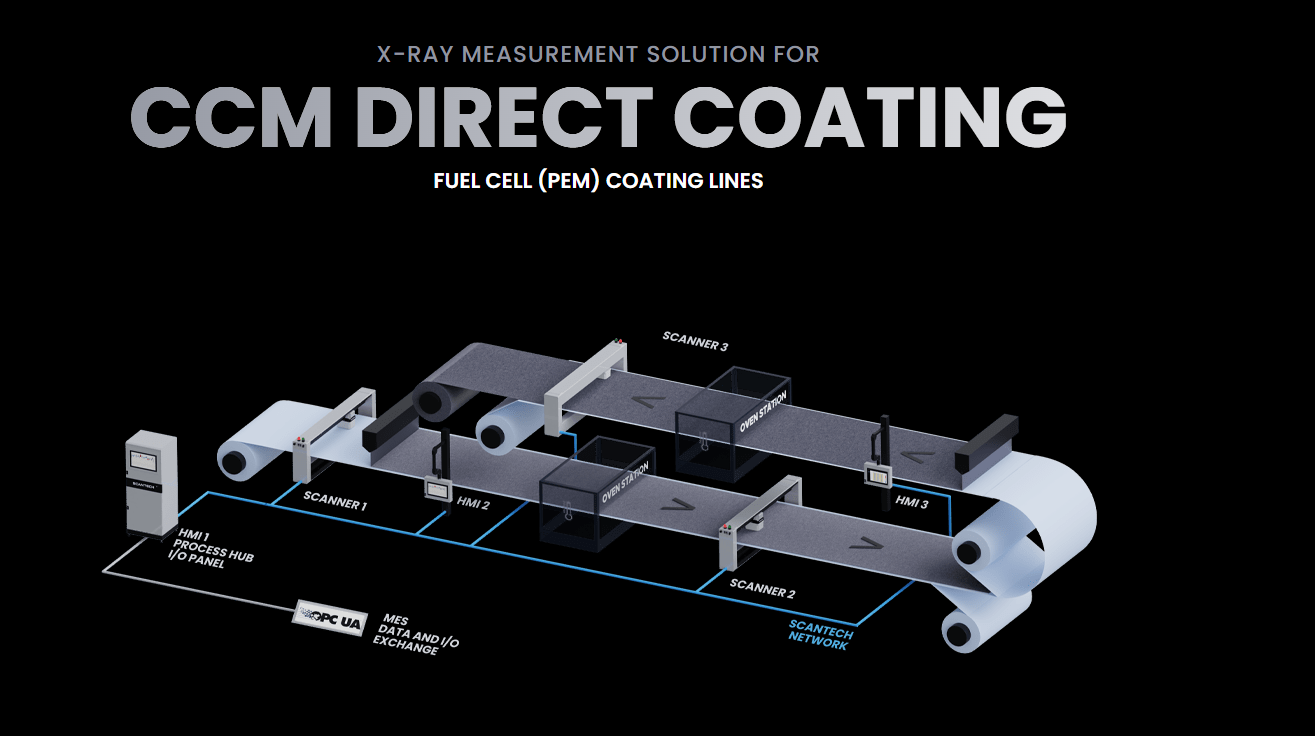
Choose measurement positions around your production route.
Direct coating onto the membrane
Review the incoming membrane and the coated material at the stages needed to separate the requested results. Coating order and drying locations matter, particularly when each catalyst side needs its own result.
Decal coating and transfer
Coat and dry the catalyst on a release carrier before transfer to the membrane. Carrier-based coating measurements and finished membrane measurements describe different structures, so each needs its own definition and calibration.
Match comparisons to corresponding material.
When a net result comes from more than one station, account for substrate variation, travel time and web registration. Same Spot coordinates scanner trajectories where that approach fits the application.

Profiles, recipes & production context
Make the loading data useful to the people running the line.
FLEXSCAN brings configured measurement channels into live profiles, trends, recipes and alarm views. Define the coating zones, units and targets around the product being made.

See process variation
Review the available loading and membrane channels against the product targets and the relevant coating positions.
Connect the line
Define PLC and plant-data interfaces, including OPC UA where specified, and the production identifiers required downstream.
Define the record
Select the operational views and reporting needed for the job. TREX provides deeper report retrieval and organization when included.
Sensors, scanners & integration
Build the system around the material stack.
The catalyst chemistry, carrier or membrane, coating pattern and loading range determine the measurement approach. Scanner width, line speed, access and measurement locations then shape the installation.
Scantech uses O-frame scanning platforms, including ULO3, in its fuel-cell application layouts. Final frame and sensor selection follows the line and sample review.
Explore complete web gauging systems →Decide what happens when a result moves.
Start with the operator response, quality record or machine signal you need. Automatic correction requires a compatible actuator, a defined interface and a commissioned control strategy.

Watch the overview
Scantech at Hyvolution 2025
A short look at Scantech at Hyvolution, the hydrogen-industry event.

Related solutions & tools
Take the next step around your application.
Review net coating measurements, station selection and line integration.
Explore the general mass-measurement approach; separate Pt loading uses a specialized configuration.
Use your material costs and realistic process-improvement assumptions.
Evaluate mass, thickness and density conversions with the correct material assumptions; this does not calculate Pt concentration.
Modernizing an existing web gauge?
A beta or gamma gauge replacement review should cover the current measurement and reporting duties as well as the new catalyst or membrane requirements.
Manufacturer application resources: direct CCM coating · decal coating and transfer.
Common questions
Fuel cell measurement FAQ.
Is platinum loading the same as catalyst coat weight?
No. Platinum loading is the Pt contribution per unit area. Total catalyst coat weight also includes the other coating constituents. Specify both independently if your process needs both results.
Does this platinum measurement use XRF?
Scantech’s hydrogen solution uses a specialized X-ray transmission (XRT) approach. The proposed sensor and calibration are confirmed during application evaluation.
Can the system measure membrane thickness?
The appropriate measurement approach depends on the membrane construction and required result. Specify physical thickness separately from basis weight; a thickness value calculated from mass also requires a suitable material and density model.
Can both direct coating and decal processes be evaluated?
Yes. The measurement locations and available outputs depend on the route, carrier or membrane, layer stack and point in the process.
Can one scanner separate every layer and both catalyst sides?
That should not be assumed. Define the independent outputs you need so the sensor combination and measurement locations can be selected to support them.
Application review
Let’s define your catalyst measurement.
Share the coating route, layer stack and results you need. I’ll coordinate an application and sample review with Scantech.
Helpful details to send
- Direct membrane coating or decal-and-transfer process
- Membrane, carrier and catalyst composition
- Pt loading range, coating pattern and required tolerances
- Web width, speed and wet or dry measurement locations
- Coated and uncoated samples, reference method and reporting needs
A drawing, sample description or current gauge specification is a useful starting point.