
Updated: June 27, 2026
Drying PET should be straightforward, right?
You set the dryer temperature, confirm the dew point, make sure the hopper has enough residence time, and keep the process moving.
But when PET regrind or PCR enters the picture, things can get a little more interesting.
I recently ran into an application where a processor was drying clear PET along with PET PCR regrind. The resin itself looked clean, but the dryer heat exchangers were building up a colored residue over time. The plant had to clean the “radiators” every couple of months to keep the dryers running properly.
At first glance, it would be easy to blame the dryer, the desiccant, or some mystery contamination. But in applications involving recycled PET, the issue is often more complicated.
The problem may not be the PET itself.
It may be what is coming off the regrind during the drying process.
For processors evaluating dryer performance, conveying efficiency, blending accuracy, and resin handling practices, our Resin Conveying & Blending Solutions page provides an overview of the technologies commonly used throughout the material handling process.
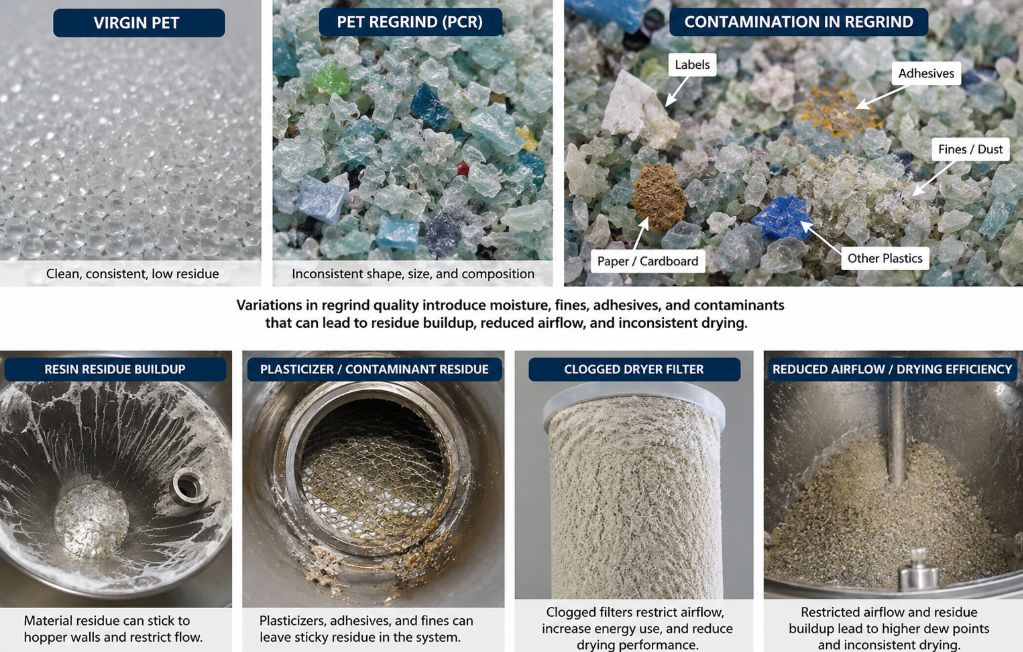
Virgin PET and PET regrind can behave very differently in a drying system. Fines, labels, adhesives, colorants, degraded polymer, and other contaminants may contribute to residue buildup, filter fouling, restricted airflow, and inconsistent drying performance.
Virgin PET and PET Regrind Do Not Always Behave the Same
Virgin PET pellets are usually consistent, controlled, and manufactured to a known specification. Regrind and PCR can be much more variable.
Even when the material is still technically PET, recycled content can carry additional variables into the drying process, including:
- Fines and dust
- Degraded polymer
- Additives
- Colorants
- Label residue
- Adhesives
- Coatings
- Processing aids
- Small amounts of non-PET contamination
Inconsistent additive distribution, color concentration, or regrind ratios can also contribute to processing variability. Learn more about why gravimetric blending and process control matter.
This does not always mean the material is bad. It just means the dryer may see more than moisture.
When hot dry air passes through the hopper, some of those contaminants can volatilize, soften, or become entrained in the return-air stream. Once that return air leaves the hopper and starts moving back through cooler parts of the dryer system, those compounds can condense, solidify, or collect on internal surfaces.
That is when processors start seeing residue on heat exchangers, filters, return-air components, and sometimes even the desiccant circuit.
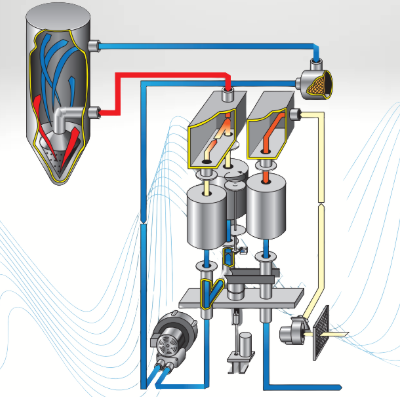
Simplified desiccant dryer process loop. Dry air is circulated through the hopper, moisture is removed by the desiccant system, and the conditioned air is reheated before returning to the material.
Why Residue Often Shows Up on Heat Exchangers
Heat exchangers and aftercoolers are common places for residue to show up because they are cooler than the return air coming from the drying hopper.
The return air may be carrying moisture, fines, and volatile compounds from the resin. When that air passes over a cooler surface, some of the contamination can drop out of the air stream.
Depending on the resin and contamination source, the buildup may look like:
- Sticky residue
- Oily film
- Waxy buildup
- Powder mixed with condensate
- Colored deposits
- Dust packed into coil fins
- Dark or burnt-looking material
In the PET/PCR example above, the residue had a purple color. That color does not necessarily mean the desiccant is breaking down. It could be related to additives, colorants, labels, adhesives, or other materials that came in with the recycled stream.
The key question is not just, “Why is the residue purple?”
The better question is:
What is being carried in the dryer return air, and where is it dropping out of the air stream?
Why This Matters
Residue buildup inside a dryer system is more than a housekeeping issue.
If the buildup is allowed to continue, it can create several problems:
- Reduced airflow
- Dirty or clogged filters
- Poor heat transfer
- Unstable return-air temperatures
- High dew point alarms
- Inconsistent drying performance
- More frequent maintenance
- Possible contamination of the desiccant
- Increased risk around heated equipment if buildup is ignored
A dryer can only perform properly if air is moving through the system as designed. Once filters, coils, or return-air passages start to plug, the dryer may still be running, but it may not be drying consistently.
For PET, that matters. Moisture control is critical because PET is sensitive to hydrolytic degradation. Poor drying can affect intrinsic viscosity, melt strength, appearance, and final part performance.
Common Signs of a Volatile or Plasticizer Buildup Problem
Processors drying PET regrind, RPET, PCR, flexible PVC, or other additive-heavy materials should watch for a few warning signs.
These include:
- Heat exchangers that need frequent cleaning
- Return-air filters loading faster than expected
- Sticky or oily material on dryer components
- Colored residue inside the return-air path
- Odor coming from the dryer or hopper
- Dew point drifting higher over time
- Dirty filter alarms
- Airflow problems
- Reduced drying consistency
- More frequent desiccant maintenance
None of these symptoms automatically means the dryer needs to be replaced. In many cases, the dryer may be doing exactly what it can, but the application needs better protection in the return-air circuit.
That is where a plasticizer trap can be useful.
What Is a Plasticizer Trap?
A plasticizer trap is installed in the dryer return-air stream to help capture volatile materials before they contaminate the desiccant or other dryer components.
The basic idea is simple:
Hot return air leaves the hopper carrying volatiles or other contaminants. The plasticizer trap cools that air so the volatiles can condense, solidify, or drop out of the air stream in a controlled location. Instead of allowing that residue to build up in the dryer heat exchanger, filters, or desiccant bed, the trap gives the contamination a place to collect where it can be maintained.
This can be helpful in applications where the material gives off more than just moisture during drying.
Examples may include:
- PET PCR regrind
- RPET
- Flexible PVC
- Materials with plasticizers
- Regrind with unknown additives
- Resin streams with adhesive, label, or coating contamination
- Materials that generate sticky or oily residue in the return-air path
The important point is that a plasticizer trap is not just a filter. It is a cooled separation device. Because of that, the cooling requirement matters.
Plasticizer traps may require a dedicated cooling water supply or chiller connection to condense and capture volatile material effectively. For example, one ABS plasticizer trap configuration may require cooling water in the range of several gallons per minute, depending on dryer size, return-air temperature, resin type, throughput, and the amount of volatile material being generated. Actual cooling requirements should always be confirmed during application review.
Actual cooling requirements should always be confirmed based on dryer size, return-air temperature, resin type, throughput, and the amount of volatile material being generated. If actual production rates are unknown, our Extrusion Throughput & Line Speed Calculator can help estimate throughput based on product dimensions and operating conditions.
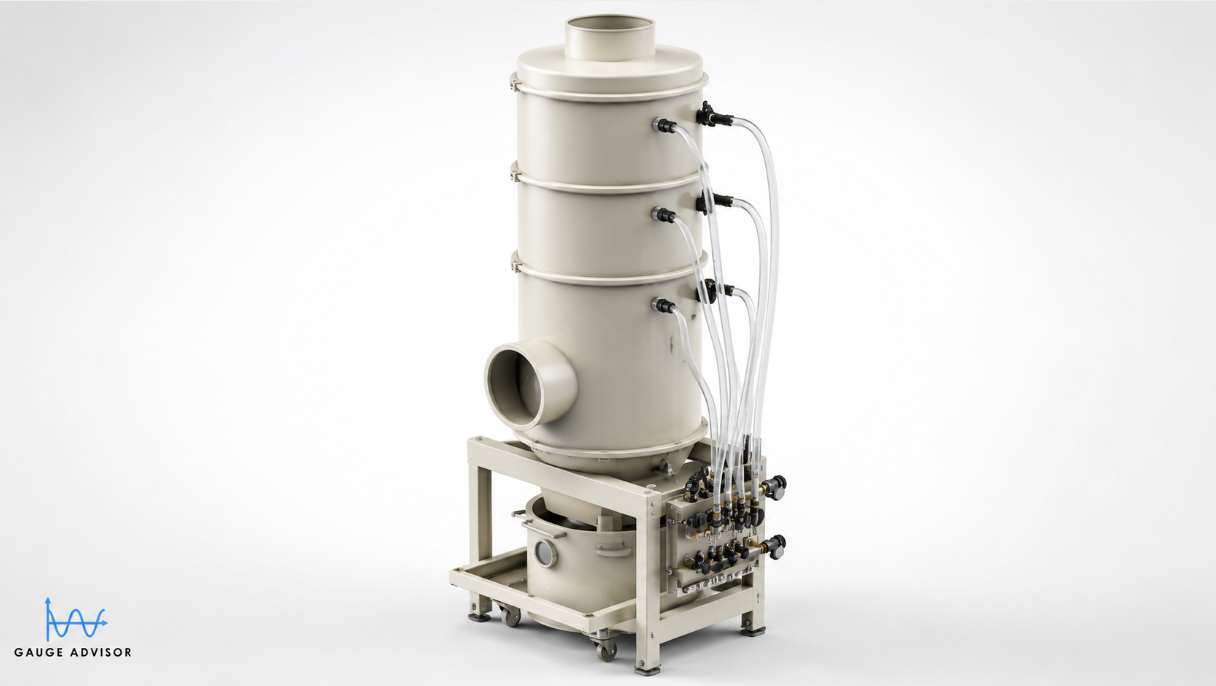
3D rendering of a plasticizer trap assembly. Rendering is for illustrative purposes only and may not show all fittings, dimensions, or production details.
Do You Need a New Dryer or Just a Retrofit?
This is the part that matters for many plants.
Not every residue problem requires a complete new dryer.
If the existing dryer is otherwise sized correctly, maintaining dew point, moving enough air, and mechanically sound, a retrofit option such as a plasticizer trap may be the most practical first step.
A plasticizer trap may be worth considering when:
- The dryer is working, but the heat exchanger keeps getting dirty
- The residue seems to be coming from recycled material or additives
- The desiccant is being exposed to contamination
- The plant wants to reduce cleaning frequency
- The issue is isolated to certain materials or regrind percentages
- The customer does not want to replace the entire dryer system
On the other hand, a new dryer may make more sense when:
- The dryer is undersized
- The dew point is unstable
- The controls are outdated
- Airflow is inadequate
- The dryer has chronic maintenance issues
- The system cannot handle current throughput
- The hopper design is contributing to poor drying
- The plant is expanding or adding new lines
This is why it helps to review the entire drying process before jumping to a recommendation.
Don’t Overlook the Hopper
Dryer performance is not just about the dryer cabinet.
The hopper matters too.
A good drying hopper should provide uniform airflow, proper residence time, and consistent material exposure to dry air. Poor hopper design can create air channeling, material channeling, uneven temperature exposure, and inconsistent drying.
This becomes even more important with PET and PCR regrind because the process already has less room for error.
If material is not moving through the hopper properly, or if the drying air is not distributed evenly, some pellets may be under-dried while others are exposed to unnecessary heat. That can contribute to process instability, material degradation, or inconsistent performance at the machine.
Before blaming the dryer, it is worth reviewing:
- Hopper size
- Residence time
- Airflow path
- Diffuser design
- Return-air temperature
- Material flow pattern
- Whether the hopper is fully loaded or frequently starved
- Whether regrind and virgin material are drying evenly
In some cases, the dryer may be capable, but the hopper and airflow layout are limiting the process.
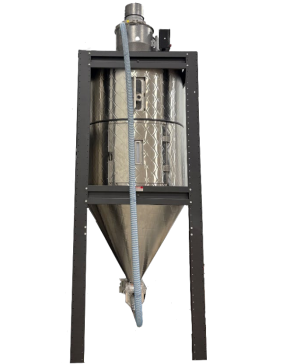
Advanced Blending Solutions CK-Series drying hopper used to remove moisture from hygroscopic materials such as PET, PETG, nylon, and other engineering resins before processing.
What to Check Before Making Changes
If a dryer is building residue while processing PET regrind or PCR, here are the first things I would want to know:
- What resin is being dried?
- What percentage is virgin, regrind, or PCR?
- Is the regrind post-industrial or post-consumer?
- What is the drying temperature?
- What is the throughput in lb/hr?
- What is the dryer make and model?
- Where exactly is the residue collecting?
- Is the residue dry, sticky, oily, waxy, or powdery?
- Does the issue happen with virgin PET, regrind, or both?
- How often are filters being changed?
- How often are heat exchangers being cleaned?
- Is the dryer showing dirty filter alarms or high dew point alarms?
- Is cooling water available near the dryer?
- What cooling water temperature and flow rate are available?
A photo of the residue and the affected dryer component is also very helpful.
A dry powder points in one direction. A sticky or oily film points in another. A colored residue mixed with fines may indicate that volatile compounds and dust are collecting together.
How Advanced Blending Solutions TD-Series Dryers Fit In
Advanced Blending Solutions offers TD-Series desiccant dryers through the Thoreson McCosh dryer lineup. These dryers are designed as closed-loop, non-valve drying systems with a triple-bed indexing design, extra-large filters, high-pressure blowers, dew point monitoring, temperature graphing, dirty filter alarms, and other controls to help operators understand what is happening inside the drying process.
For applications involving PET, RPET, PCR regrind, or other materials that may produce volatile buildup, the system discussion may include:
- Dryer sizing
- Hopper sizing
- Airflow review
- Return-air filtration
- Aftercooler requirements
- Plasticizer trap options
- Dew point monitoring
- Dirty filter alarms
- Dryer controls
- Material-handling layout
- Conveying and receiver design
Conveying airflow requirements can vary significantly depending on material type, distance, throughput, and system layout. Our Resin Vacuum Pump Sizing Calculator can help estimate vacuum pump requirements for pneumatic conveying systems.
The goal is not always to sell a new dryer. Sometimes the right solution is a retrofit. Sometimes it is better filtration. Sometimes it is a plasticizer trap. Sometimes the dryer is too small or outdated and a new TD-Series system makes sense.
The right answer depends on the application.

Advanced Blending Solutions TD-Series desiccant dryers are available in multiple capacities and can be configured with options such as pre-coolers, after-coolers, additional desiccant beds, and dew point monitoring.
Not Sure What’s Building Up in Your Resin Dryer?
Residue in a dryer return-air system can be frustrating because the root cause is not always obvious.
What looks like a dirty heat exchanger may actually be related to PCR content, volatile release, return-air temperature, inadequate filtration, airflow restriction, hopper design, or desiccant contamination.
Gauge Advisor helps plastics processors evaluate resin conveying, blending, drying, and material handling systems to identify the true source of performance issues before investing in new equipment.
As the authorized sales and support partner for Advanced Blending Solutions, we can help evaluate your current drying process and recommend options ranging from plasticizer trap retrofits and filtration improvements to complete ABS / Thoreson McCosh TD-Series desiccant drying systems.
If you are drying PET, RPET, PCR regrind, flexible PVC, or another material that is creating residue in the return-air stream, reach out and include as much of the following information as possible:
- Resin type
- Virgin/regrind/PCR percentage
- Dryer make and model
- Drying temperature
- Throughput in lb/hr
- Available cooling water temperature and flow
- Description or photo of the residue
- Whether the issue occurs with virgin material, regrind, or both
The more information you provide, the easier it becomes to determine whether the issue is related to material contamination, volatile buildup, airflow, filtration, dryer sizing, or another part of the process.

 By: Matthew Baker
Founder, Gauge Advisor LLC