Monitor actual extrusion rate
Display and record the rate the extruder is consuming, compare it with the target, and alarm on application-defined deviation without changing screw speed.
Review monitor-only mode →
Measure the resin an extruder actually consumes, calculate mass flow continuously, and use that signal for production monitoring or application-specific closed-loop output control. Advanced Blending Solutions weigh hoppers connect material handling to the rate the line is really running.
 Gauge Advisor is an authorized Advanced Blending Solutions sales & applications support partner. We help processors define the measurement objective, equipment arrangement, controls scope, integration, quotation, commissioning, and support path.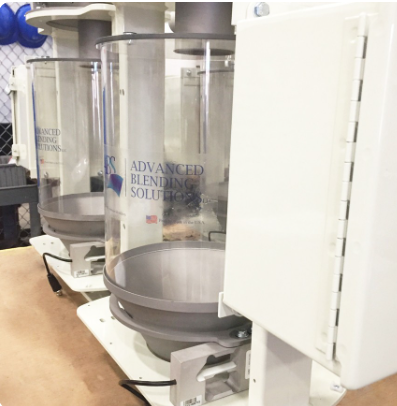
Track mass change over time instead of relying only on screw speed or a manual sample.
Use the signal for display, records, alarms, or an engineered closed-loop response.
Coordinate the hopper with conveying, blending, refill, mounting, and process controls.
Material behavior, rate range, vibration, refill events, temperature, and line dynamics govern fit.
A gravimetric weigh hopper can be valuable without automatically changing the process. Define the decision first—visibility, control, layer coordination, or modernization—then engineer the hardware and software around it.
Display and record the rate the extruder is consuming, compare it with the target, and alarm on application-defined deviation without changing screw speed.
Review monitor-only mode →Use the measured throughput in a closed loop that adjusts an approved process variable—commonly extruder speed—within engineered limits and operating states.
Review closed-loop control →Connect total or layer-specific material rate with coextrusion ratios, line-speed data, or downstream measurement when the complete control narrative is defined.
Review application fit →Add reliable consumption visibility or modern controls after documenting headroom, refill hardware, vibration, electrical interfaces, software ownership, and safe test states.
Prepare a retrofit audit →The weigh hopper is a scale in the material path. It watches how quickly resin mass disappears. The controller turns that change into pounds per hour or kilograms per hour, then either reports the number or uses it in an approved control loop.
Meters one material stream at a commanded rate. In a starve-fed process, the feeder may be the device that establishes extrusion rate.
Maintains the commanded ratio of virgin resin, color, additive, regrind, or other recipe components before they reach the process.
Compare continuous blenders →Measures the combined material consumed below a blender or receiver. Its job is actual total mass flow, not ingredient proportioning.
The calculation is simple to describe, but the installation must protect it from refill disturbances, vibration, unstable material flow, poor mounting, and a control loop that reacts faster than the process can respond.
Refill adds mass while production removes it. The sequence must define when measurements are valid, how the controller handles refill, and how enough material remains available to the extruder.
Rigid piping, hose pull, vibration, platform movement, contact with surrounding structure, and poorly supported equipment can introduce false load-cell forces.
Startup, shutdown, empty-hopper, refill, manual mode, purge, upset, sensor fault, communication loss, and maximum adjustment limits need defined behavior.
Advanced Blending Solutions publishes extruder-mounted throughput hoppers for standard pellets, regrind, high-temperature duty, and application-specific discharge or material-protection needs.
The current Advanced Blending Solutions presentation lists extruder-mounted throughput hoppers from 5 to 5,000 lb/hr. Treat that as a preliminary family range—not a guaranteed capacity. Final usable rate and turndown are application-dependent and require review of the resin, bulk density, flow behavior, refill frequency, hopper working mass, process temperature, mounting, load-cell environment, and control objective.
Published standard-temperature pellet models use a removable cast-acrylic viewing and cleanout section with a stainless-steel cone.
Published regrind configurations use a stainless-steel body, sight glass, and cleaning access suited to irregular reclaimed material.
High-temperature and knife-gate options can be reviewed around resin temperature, isolation, discharge behavior, cleanout, and maintenance.
Advanced Blending Solutions literature also shows purge-port and magnet-drawer configurations. Standard I/O and Ethernet support control-system integration; confirm the exact signals and protocol by project.
Coordinate conveying or blending so the hopper can refill without starving the process.
Measure mass change during a defined interval with stable mechanical conditions.
Convert the load-cell result into an application-appropriate throughput value.
Apply the result according to the approved operating and fault narrative.
Application-dependent performance: Rate range, update behavior, measurement quality, and closed-loop response depend on hopper size, working mass, bulk density, material flow, refill frequency, vibration, mounting, temperature, load-cell selection, signal filtering, calibration, process dynamics, and commissioning. Final performance must be reviewed and accepted around the real line.
The business case is strongest when rate uncertainty creates scrap, delayed startups, unexplained material use, layer imbalance, missed production targets, or too much operator time spent collecting manual samples.
See when actual consumption reaches the planned rate instead of waiting for a later manual calculation or finished-product result.
Compare commanded and measured output so maintenance and process teams can investigate changes before they become a larger production loss.
Organize time-stamped throughput data for production review, job records, trend analysis, and reconciliation by the agreed data scope.
Define the same target, allowable deviation, response, and exception handling for every trained operator and production run.
Quantify current rate-check labor, startup scrap, giveaway, missed output, unexplained consumption, layer-ratio losses, and the value of a reliable production record. Do not assume savings from a generic percentage; use plant history and an agreed acceptance test.

A displayed throughput value does not automatically mean the system should change extruder speed. Define which controller owns the target, which device may be adjusted, how fast it may move, and what happens in every non-normal state.
Calculate, display, trend, and alarm on actual mass flow while the operator or existing line control retains process authority.
Compare measured mass flow with a target and adjust an approved command—often extruder speed—within configured limits.
Use throughput with coextrusion ratios, haul-off or line speed, work orders, downstream gauging, or supervisory records when explicitly scoped.
| Decision | Monitor-only | Closed-loop throughput | Line or layer coordination |
|---|---|---|---|
| Primary purpose | See and record actual rate | Hold a commanded total mass-flow rate | Coordinate rate with another measured or commanded process variable |
| Automatic process change | None | Yes, within the engineered loop | Application-specific and interface-dependent |
| Key definition | Display, alarm, history, and reporting needs | Control owner, manipulated variable, tuning, limits, and fault behavior | Units, timing, layer ownership, line state, and data authority |
| Acceptance test | Compare displayed rate with an agreed reference method | Verify stability and response across approved operating states | Verify end-to-end behavior with every connected system |
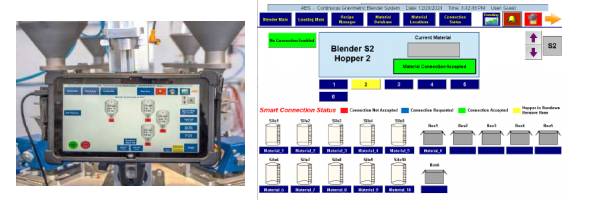
Advanced Blending Solutions has in-house controls engineering for resin handling, blending, and related process integration. The project can be coordinated around Allen-Bradley, Beckhoff, or another reviewed plant interface, with local HMI functions, Ethernet or I/O communications, reports, historian connections, and remote-support requirements defined by scope.
Upstream material delivery, downstream process dynamics, available headroom, heat, vibration, cleanout, and the line's control philosophy determine whether a standalone hopper, blender-mounted arrangement, or different gravimetric architecture is useful.
Monitor total consumption, coordinate coextrusion layers by the defined architecture, and compare resin use with line speed and downstream thickness performance.
Explore film & sheet measurement →Track the material rate behind a continuous product and, when engineered, connect mass flow with haul-off or line-speed data for production review.
Add actual compound consumption to a line that also depends on conductor speed, product dimensions, concentricity, and tension control.
Relate resin throughput to a continuous web process while keeping mass-flow control separate from downstream coat-weight or thickness measurement.
Review whether a downstream total-consumption hopper adds useful visibility beyond the individual feeders already controlling a starve-fed process.
Audit the physical material path and controls before promising a retrofit. The missing space, flexible connection, cleanout access, or software interface can govern the project.
A downstream weigh hopper is a natural fit when material consumption represents the extruder's actual demand. In a starve-fed system, gravimetric feeders may already establish the process rate. Review what is being measured, what device owns output, and whether another scale adds independent value before specifying equipment.
The weigh hopper cannot correct an empty receiver, unstable blend, blocked line, bad refill sequence, or undefined control responsibility. Coordinate the upstream and control layers.
Meter and maintain ingredient ratios before the combined stream reaches the weigh hopper.
Compare blender platforms → Material availabilityCoordinate receivers, pumps, valves, filtration, and refill demand so measurement does not starve the process.
Plan conveying → Control responsibilityDefine the sequence, data, alarms, handshakes, remote support, and plant integration.
Review controls → Complete architectureSee how receiving, storage, conveying, drying, routing, blending, and controls work together.
Explore the pillar page → Planning toolEstimate theoretical output from product geometry, density, and speed before comparing it with measured consumption.
Open the calculator →Select every task that applies so the starting recommendation accounts for conveying, drying, routing, blending, storage, separation, controls, and process-scrap recovery—not only the weigh hopper.
Selector boundary: the selector organizes a preliminary equipment path. Final throughput-control architecture still requires the line rate, material, refill method, mounting, controls, interfaces, and acceptance criteria.
You do not need to select a hopper model first. Send the production and installation facts; Gauge Advisor will organize the Advanced Blending Solutions application review.
Request sizing & pricingTheoretical throughput and actual material consumption answer different questions. Use both when building the application and acceptance plan.
Estimate theoretical output from film, sheet, tubing, round-product, or custom-profile geometry.
Open the calculator → Interactive selectorOrganize conveying, drying, routing, blending, storage, controls, and recovery tasks.
Open the full selector → Downstream measurementCompare inline thickness, basis-weight, profile, and process-control paths downstream of extrusion.
Explore film & sheet systems → System architectureMap material receiving through storage, conveying, drying, routing, blending, and process delivery.
Review the complete path →Use these answers to define the project boundary before selecting hardware or promising a control result.