New integrated resin-handling system
Create the operating sequence, panels, PLC/HMI software, plant interfaces, alarms, documentation, commissioning, and training around new equipment.
Map a new architecture →
Coordinate how resin moves from receiving and storage to the production line. ABS controls can connect conveying, routing, drying, blending and extrusion throughput with operator screens, alarms, reports and plant systems.

Engineering, software, panel building, startup, and service are coordinated around the equipment.
Lead with Allen-Bradley or use Beckhoff when it is the better supported architecture.
Define sequences, HMIs, reports, interfaces, interlocks, and future capacity around the project.
Phone triage, authorized remote diagnostics, planned changes, field service, and training.
Start by describing how operators and equipment should respond during production, changeovers, faults and maintenance. Include any planned expansion so the system has room to grow.
Create the operating sequence, panels, PLC/HMI software, plant interfaces, alarms, documentation, commissioning, and training around new equipment.
Map a new architecture →Add receivers, pumps, routes, silos, blenders, dryers, or destinations while accounting for existing I/O, networks, software versions, and panel capacity.
Prepare a retrofit audit →Coordinate material handling with extrusion throughput, layer ratios, work orders, temperature, power, supervisory systems, or auxiliary equipment by scope.
Review software modules →Diagnose an existing sequence, update screens or logic, restore documentation, review obsolete hardware, add data history, or plan a controlled migration.
Build a support path →Every source, destination, pump, receiver, valve, level device, dryer, blender, line handshake, alarm, and operator choice needs a defined behavior. ABS can coordinate the physical system and the logic that makes it usable.
ABS does more than supply a PLC cabinet. Its in-house controls and panel-building organization can define the control architecture, create or modify software, connect resin-handling and production equipment, commission the system, and remain available for diagnostics and planned changes.
Document sources, destinations, equipment, operator actions, normal sequence, changeovers, exceptions, and failure behavior.
Select PLC, HMI, I/O, panels, network, protocols, remote-access boundary, and practical expansion capacity.
Build sequences, recipes, screens, alarms, permissives, reports, and application-specific test criteria.
Coordinate startup, training, documentation, authorized remote diagnostics, field service, and future modifications.
In plain language: the control narrative is the rulebook for the plant. It says what may run, what must be true first, what operators see, what happens when something fails, and how the system returns to production safely and deliberately.
A plant-wide architecture coordinates material availability and movement from receiving through the processing line while preserving clear equipment ownership, interlocks, alarms, data, and support boundaries.
Define which pump, valve, receiver, route, dryer, blender, or line can operate—and what conditions must be true first.
Define alarm priority, retry logic, shared-equipment conflicts, unavailable equipment, overrides, safe stopping, and deliberate recovery.
Define screens, recipes, acknowledgements, maintenance views, data retention, reports, and information passed to supervisory systems.
Allen-Bradley is the strongest starting point for many North American plants. Beckhoff is a published ABS alternative. ABS must review other control standards or interfaces to confirm compatibility and the work required.
CompactLogix or ControlLogix architectures can align the resin-handling system with an installed Rockwell Automation environment and plant maintenance practice.
Industrial PC-based panel or rack architecture can fit plants that already support Beckhoff or prefer a PC-based control environment.
A different controller, OEM interface, or supervisory connection may be possible, but it requires a specific technical and lifecycle review before it is promised.
| Decision | What to confirm | Why it matters |
|---|---|---|
| Plant standard | Installed PLC/HMI base, technician skill, programming software, backups, spare parts, and preferred integrator workflow. | A technically capable platform still fails commercially if the plant cannot maintain or recover it. |
| System ownership | Which equipment ABS controls, which remains OEM-controlled, and where line, safety, and supervisory handshakes begin and end. | Clear boundaries prevent duplicate commands, missing permissives, and ambiguous troubleshooting. |
| Network and data | Required interfaces, address scheme, user access, historian connection, cybersecurity review, and remote-support method. | Network and data decisions affect architecture, licenses, testing, and plant IT approval. |
| Lifecycle | Firmware, software versions, documentation, program backup, change control, obsolescence, expansion capacity, and service plan. | The control system must remain supportable after startup and through future equipment changes. |
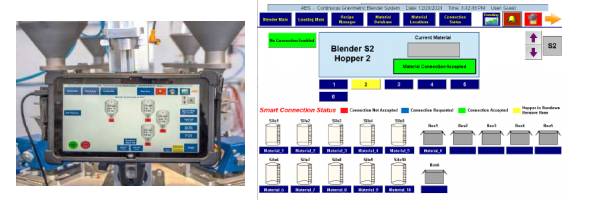
The HMI should help an operator understand the active recipe, requested route, equipment state, alarms, permissives, and next action without needing to interpret raw PLC tags. ABS publishes industrial HMI options and can scope tablet access, custom screens, reports, and plant interfaces around the application.
Coordinate feeder state, recipe, gravimetric rate, alarms, totals, and line demand.
Control throughput and application-specific layer ratio or thickness functions by scope. Review extrusion throughput control and gravimetric weigh hoppers.
Assign pumps, queue receiver calls, manage shared demand, and respond to load failures.
Use VFD control to match conveying velocity to routes and material duty where equipped.
Compare selected source and destination, connection state, route permissions, and HMI guidance.
Monitor levels, fill destinations, transfer permissives, high-level conditions, and alarms.
Organize consumption, work-order, blend, shift, day, alarm, and production records by scope.
Review inventory, reports, temperature, power monitoring, and auxiliary communications.

ABS is listed as a Canary Certified Partner and can scope Canary connectivity, tag counts, historical storage, Axiom visualization, and the resin-handling context behind the data.
Canary is an industrial data historian—not the PLC. The PLC runs the equipment and operating sequence. Canary captures selected time-stamped process tags so engineers can review trends, compare periods, reconstruct an event, build dashboards, and create reports through Canary Axiom.
The partnership matters because ABS understands what each pump, receiver, silo, route, blender, dryer, and alarm means. The controls team can identify useful tags, configure the connection, organize equipment context, size the tag package, and help turn raw points into information a plant can use.
Trend pump state, vacuum, load, VFD speed, filter differential pressure, receiver calls, fill times, and failed loads.
Review silo levels, transfers, active routes, blend rate, extrusion throughput, consumption, work orders, and shift comparisons where tagged.
Place alarms and equipment states on one timeline so engineering can reconstruct the sequence instead of relying only on recollection.
When a plant does not have a controls specialist available, a control fault can become hours of trial and error. ABS publishes a 24-hour support path and can combine phone triage, approved remote access, augmented-reality guidance, and field service according to the issue and service scope. For installed ABS or legacy Thoreson McCosh systems, review service and controls retrofit support.
Start with the alarm, equipment state, recent change, affected production, and safe observations so the right technical path can be chosen.
When configured and authorized, ABS controls specialists can connect to review the sequence and diagnose software or control issues.
Program updates, screen changes, new equipment, interlocks, reports, and modernization work are separately reviewed, authorized, backed up, and scoped.
Phone- or tablet-based augmented-reality support can help ABS see equipment and mark what a plant technician should inspect.
Maintain current drawings, program and HMI backups, software versions, network information, alarm history, change records, device labels, spare-parts lists, and a clear authorization path. Those basics shorten the distance from a symptom to a useful diagnosis.
Each equipment page explains the physical application. This page explains how those subsystems are sequenced, integrated, observed, supported, and expanded.
Pumps, filtration, receivers, manifolds, load calls, shared demand, and route interlocks.
Plan central conveying → BlendingRecipes, feeder state, gravimetric rate, totals, alarms, extrusion demand, and throughput control.
Compare blenders → Verified routingAllowed source-to-destination routes, connection verification, HMI guidance, and operator-error reduction.
Review verified routing → DryingTemperature, airflow, dew point, hopper demand, loading, alarms, trends, and dry-material distribution.
Plan resin drying → Bulk receivingVehicle records, pumps, filter receivers, airlocks, storage routes, levels, fill permissives, and reports.
Plan bulk receiving →Need to plan the complete system? Start at Resin Conveying, Blending & Vacuum Pump Systems to map receiving, storage, conveying, routing, drying, blending, and controls as one coordinated equipment project.
Answer a short set of application questions to organize the equipment architecture and next engineering step before requesting a controls review.
Scope boundary: the selector helps establish the physical system. A controls quotation still needs the operating narrative, existing platform, I/O, interfaces, data, cybersecurity, and commissioning requirements.
You do not need to select every controller or panel component first. Start with what the system must do, what already exists, how the plant supports controls, and how success will be tested.
Use Gauge Advisor's planning tools to organize the physical system, conveying demand, and commercial justification before final ABS controls engineering.
Screen receiving, storage, conveying, drying, blending, routing, controls, and the next engineering step.
Open the selector → Conveying dutyOrganize material, rate, line length, elevation, bends, and line size before pump and sequence review.
Estimate pump demand → Project justificationModel labor, downtime, material loss, contamination, changeover, energy, and production improvement.
Estimate project ROI → System reliabilityReview filtration, pressure loss, dust and fines, service access, differential pressure, and system protection.
Read the filtration guide →These answers establish a starting scope. Final controls design requires the actual process, equipment, I/O, platforms, interfaces, cybersecurity, safety boundaries, testing requirements, and project-specific ABS engineering.