Updated October 10, 2026
Prepreg is a continuous fiber, fabric, or tape that has already been combined with a controlled amount of resin. As the material moves through impregnation, cooling, slitting, and winding, engineers need to answer three basic process questions: how much material is on the web, whether it is distributed evenly across the width, and whether the web is moving at stable tension and in the correct lateral position. Online measurement and web-handling equipment can answer those production questions, while laboratory tests still verify tack, resin flow, volatile content, impregnation, and cure behavior.
Planning measurement or tension equipment for a prepreg line?
Tell us about the reinforcement, resin, and moving web. Gauge Advisor can review Scantech basis-weight measurement and FMS tension or guiding options, then help define the equipment and integration scope.
Review the material stack, measurement locations, and reference data needed to evaluate the Scantech application.
Review operating tension, roller geometry, web width, and the handling problem before selecting FMS equipment.
Separate measurement and handling requirements, then review installation space, controls, and the production data you need.
Start with three details. These are optional; share what you know and we can clarify the rest.
Continue to the contact form to add your contact details and send your request. Gauge Advisor provides authorized Scantech and FMS sales and applications support.
Scantech and FMS address different parts of a prepreg line
Company background: Scantech was founded in 1992 and is headquartered in France, where its engineering team developed low-energy x-ray measurement for film, sheet, coating, and other continuous-web processes. FMS Force Measuring Systems AG was founded in 1993 after a management buyout from FAG Kugelfischer and is headquartered in Oberglatt, Switzerland; its U.S. subsidiary was established in the Chicago area in 1999. The companies therefore bring more than three decades of complementary experience to the same moving web: Scantech in online measurement and control, and FMS in web tension and guiding.[14][16][17]
The two manufacturers featured in this guide do not make competing versions of the same device. Scantech measures the material profile. FMS measures and controls how the moving web is handled. Understanding that difference makes the rest of the article easier to follow.
Scantech makes traversing web scanners, low-energy x-ray measurement heads, software, and control interfaces. On a prepreg line, the system can measure total basis weight or coat weight, show where the web is heavy or light across its width, trend changes along the roll, and create production records.
FMS makes force sensors, tension electronics, web-guiding systems, and segmented tension rollers. These systems show how strongly the web is being pulled, help keep it centered, and can reveal when individual zones or slit lanes are tighter or looser than the average.
Neither system directly proves tack, resin flow, gel time, volatile content, internal wet-out, degree of cure, or final mechanical performance. Those characteristics still require the applicable laboratory or customer-approved test method.

Four common ways prepreg is manufactured
The process route changes where resin is added, where heat is used, and where measurement is most useful. Select the route that is closest to the line you are reviewing.
Hot-melt thermoset: make a resin film, then press it into the fiber
A controlled resin film is made on release paper or another carrier. The reinforcement is combined with one or two resin films and passes through heated rolls or nips that press the resin into the fiber. The material is then cooled, lined, slit, and wound.
Resin-film basis weight, viscosity, roll temperature, nip pressure, line speed, reinforcement spread, cooling, and cumulative heat exposure.
Scantech auto-calibrated x-ray for resin-film or finished-prepreg basis weight, plus FMS tension and guiding through unwind, impregnation, cooling, slitting, and winding.
Correct weight does not by itself prove good impregnation, tack, resin flow, gel time, or final cure performance.
Hot-melt prepregging uses heat and pressure to move a resin film into the reinforcement. Solvent-dip processing lowers resin viscosity with solvent, then removes that solvent in an oven while partially advancing the resin. Thermoplastic and towpreg lines use different material and web-handling details, but the same basic questions remain: how much resin is present, how evenly is it distributed, and how is the material being handled?[3]
Seven places where measurement or tension control can help
Click each stage to see its job, the useful data, and the problems that can be hidden by a later measurement.
1. Prepare the resin or resin film
For a hot-melt thermoset line, the resin is prepared under a controlled recipe and converted into a repeatable film on release paper. The goal is to send a consistent matrix into the impregnation section.
- Record the resin batch, temperature, viscosity, mixing and vacuum history, filter condition, and film basis weight.
- Confirm whether the line receives finished resin or prepares it on site.
- Include release paper or carrier material in the measurement model when it remains in the scanner beam.

What each prepreg measurement actually tells you
Basis weight, thickness, resin content, impregnation, and tack are different properties. A good measurement plan states which result is measured directly, which result is calculated, and which result still requires a laboratory test.
| Result | What it means | Strong starting path | Important limit |
|---|---|---|---|
Fiber basis weight Incoming baseline | The mass of reinforcement per unit area before resin is added. | Supplier certificate, laboratory check, or an upstream Scantech station when roll or cross-web variation matters. | One nominal fiber value can hide roll-to-roll or cross-web changes that make the resin calculation wrong. |
Total prepreg basis weight Direct production profile | The total mass per area of everything that is in the scanner beam at that location. | A scanning Scantech auto-calibrated low-energy x-ray basis-weight system with application-specific product calibration and profile reporting. | Release paper, carrier film, moisture, backing, or other layers contribute unless they are removed or included in the model. |
Resin add-on and resin content Calculated | The mass of resin added to the reinforcement and its percentage of the defined prepreg construction. | Registered upstream and downstream measurement, or a qualified downstream result with a proven incoming baseline. | The calculation must define whether it is wet, dry, or solids-only and how volatiles, filler, backing, and sizing are handled. |
Physical thickness Geometry | The surface-to-surface distance of the resin film or prepreg. | A separate point or inline thickness method when the web is stable and the surface can be measured. | Thickness can change because of compaction or trapped air even when mass per area stays the same. |
Impregnation or wet-out Internal distribution | How completely resin has moved into the fiber bundle or fabric. | A qualified laboratory or nondestructive method selected for the product. | Correct resin mass does not prove that the resin is distributed correctly inside the reinforcement. |
Tack, flow, gel time, and volatiles Handling and cure | Properties that affect layup, storage, resin movement, cure response, and usable life. | Controlled ASTM, ISO, customer, or NCAMP test methods. | A basis-weight scanner cannot replace these material-property tests. |
Scantech uses auto-calibrated x-ray instead of a radioactive beta source
Scantech builds its web-gauging platform around low-energy x-ray transmission rather than a sealed radioactive beta source. On its published coating systems, Scantech describes the basis-weight technology as an autocalibrated transmission sensor, so automatic calibration functionality is built into the measurement architecture. For prepreg lines, this provides a modern full-width profile without radioactive-source decay, sealed-source inventory, or end-of-life isotope disposal. Combined with electronic source control, automatic calibration, modern data handling, and easier lifecycle management, these advantages are driving x-ray systems to replace legacy beta gauges across coating and continuous-web applications. For the deeper technical and lifecycle comparison, read Why X-Ray Is the Superior Choice for Anode and Cathode Coating Measurement.[14][15]
Low-energy x-rays are generated electronically and paired with automatic calibration, scanning mechanics, Flexscan profiles, alarms, recipes, and roll records. The result is a controlled, maintainable platform designed for modern profile measurement, traceability, and process control.
A sealed radioactive source decays continuously and adds source-specific licensing, inventory, service, transport, and disposal obligations. Modern x-ray removes that isotope lifecycle and is becoming the preferred path for new and upgraded coating lines.
Scantech integrates calibration functionality into the transmission system, supporting consistent recipes, faster standardization, and a more maintainable measurement architecture across qualified prepreg products.
Split view shows the broader beta-style scatter beside the tighter x-ray-style transmission path. The graphic is an analogy, not a literal particle-physics simulation.
- What the detector sees: attenuation through every material in the beam, including reinforcement, resin, release paper, liner, moisture, and other retained layers.
- What automatic calibration adds: calibration functionality is built into the Scantech transmission platform instead of being treated only as a manual operator task.
- Why plants are moving away from beta: x-ray eliminates radioactive-source decay and isotope disposal while adding electronic source control, modern profiles, alarms, recipes, roll records, and easier integration with process control.
Scantech shows where the prepreg is heavy or light across the web
A Scantech scanner moves an auto-calibrated low-energy x-ray measurement head across the web and builds a full-width basis-weight profile. It can show the average, edges, lanes, light regions, heavy regions, and changes over the length of the roll. Scantech identifies prepreg, towpreg, and composite impregnation lines as applications for coat weight, basis weight, moisture, thickness, profile software, data logging, and control functions.[1][15]

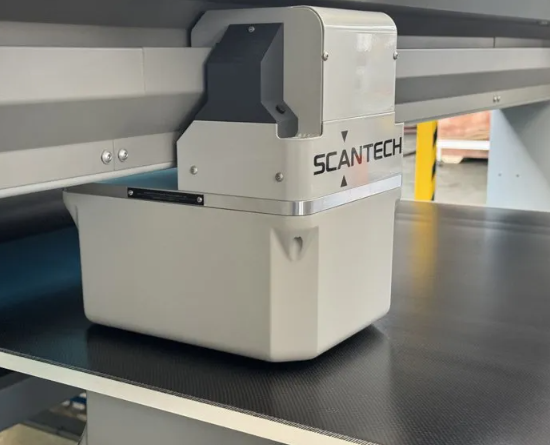
Use this when the incoming reinforcement and carrier contribution are stable enough that total prepreg basis weight is the main production variable.
Use an upstream and downstream station when fiber weight varies or when resin add-on must be separated at the same web location.
Track average, minimum, maximum, lanes, edges, alarms, recipes, trends, and the final roll record instead of relying only on occasional coupons.
Send a qualified average or profile signal to an operator or to a suitable line actuator after the response has been proven.

Measurement does not automatically correct the process
The scanner may show that the whole web is heavy, one lane is light, or an edge is building up. The correct response depends on what the line can change. Average weight may be adjusted through resin-film output, coating rate, gap, nip, or line speed. A cross-web problem may require coating-head adjustment, roll alignment, tow-spread correction, localized actuation, or maintenance. Closed-loop control must include transport delay, scan time, mapping, actuator limits, recipe limits, and a safe response when data is invalid.
FMS measures pulling force and keeps the web aligned
Web tension is the pulling force in the moving material. Drive current, brake pressure, and dancer position may change with tension, but they are not direct tension measurements. FMS load cells measure force at a roller. FMS guiding systems keep the web or liner in the correct lateral position.

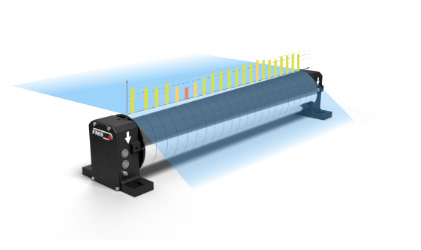
Use conventional force sensors when one tension value is needed for an unwind, process section, liner, or rewind.
Two sensing points can help reveal side-to-side loading, roller alignment, bearing, or web-path problems.
Use segFORCE when baggy bands, uneven strain, slit lanes, or roll build need more detail than one average tension value.
Use an FMS guide when reinforcement, release paper, liner, coating lane, or slit position must stay centered or follow a defined edge.
FMS lists coating, laminating, drying, and slitting among its converting applications. Its tension and guiding platform measures force and lateral position, while segmented tension measurement adds a profile across the width when the process needs that detail.[7][8]
When basis weight and tension are not enough
Scantech and FMS answer important production questions, but they do not replace every quality test. Add another method only when a separate physical property controls the product.
Basis weight is mass per area. Thickness is a distance. A resin film can become thicker or thinner because of compaction or trapped air without the same change in mass.
Correct resin mass does not prove that resin has entered the tow or fabric evenly. Internal distribution needs its own qualified check.
These material properties determine handling, storage, and cure behavior and remain laboratory release tests.
Wrinkles, broken fibers, contamination, missing resin, edge damage, and visual defects may require a camera-based web visual-inspection system.
Build a simple prepreg measurement and tension plan
Choose whether the main project is weight and profile measurement, web tension, guiding, segmented tension, or a coordinated combination. Scantech scanner inputs appear only when the selected goal includes weight or profile measurement. The result is a starting architecture, not a final model selection or quotation.
Estimate the annual value of reducing excess resin from poor weight control
This calculator starts with the nominal resin add-on and asks you to enter the current and target giveaway percentages. It is intended for a simple material-overapplication estimate, not a complete resin-content or process-capability study.
Calculation boundary: annual planned resin use equals nominal resin add-on multiplied by annual coated area. The giveaway percentages are user-entered planning assumptions. Use only the avoidable resin overapplication associated with weight-profile variation or operating cushion. Do not also count the same material as startup scrap, off-spec scrap, or another ROI bucket. The calculation excludes equipment cost, labor, downtime, qualification, financing, production mix, and quality escapes.
Online data helps control the line, while laboratory tests release the material
Online measurement provides faster feedback and shows variation across the web. Laboratory tests still determine whether the resin is at the correct handling and cure state and whether the prepreg meets the approved material specification.
These tests determine how much resin, reinforcement, filler, or other material is present in the sample.
These tests measure mass lost under a defined condition, including solvent, moisture, or other volatile material.
These tests help compare material lots, resin advancement, storage effects, and cure-related behavior.
These tests show how the prepreg handles during layup and how well resin has moved through the reinforcement.
NCAMP treats prepreg manufacturing as a controlled recipe. Its guidance includes defined raw materials, equipment, process flow, time and temperature history, release backing, in-process measurements, alarm limits, finished-resin tests, acceptance criteria, freezer storage, out-time, and traceable records.[4]
Common prepreg measurement and web-handling mistakes
Calling one downstream total-weight value resin content
Total prepreg basis weight includes reinforcement and any other material in the beam. Calculate resin add-on only after the reinforcement, backing, volatiles, and product state are defined.
Assuming the reinforcement basis weight never changes
A supplier certificate or periodic coupon may be enough for a stable product. When the incoming web changes across the width or by roll, an upstream measurement is the stronger way to separate fiber variation from resin variation.
Looking only at the average basis weight
The roll average can be correct while one edge, tow band, or lane is light. Review the full cross-web profile, lanes, and edge regions.
Treating auto-calibration as one recipe for every prepreg construction
Automatic sensor calibration does not remove material dependence. A change in reinforcement, resin chemistry, carrier, liner, moisture, temperature, thickness, or product state can require a different recipe, sample study, or correlation check.
Assuming correct resin mass means good impregnation
The correct resin quantity can remain near the surface or leave dry tow regions. Wet-out and internal distribution need their own verification.
Using drive current, brake pressure, or dancer position as tension
Those values may move with tension, but friction, roll diameter, inertia, bearings, and material behavior change the relationship. Use load cells when actual web force controls the process.
Adding automatic control before proving the actuator
A scanner improves diagnosis and reporting immediately. Closed-loop control additionally needs an actuator with enough authority, known response, correct mapping, transport delay, limits, and safe fallback behavior.
Using one average tension value for every tow or slit lane
One roller can report an acceptable total while individual tows or slit lanes are different. Use individual or segmented measurement when the local difference is the failure mode.
Ignoring solvent, epoxy, and carbon-fiber EHS boundaries
Solvent routes need appropriate ventilation, oven, flammable-liquid, emission, and recovery design. Uncured epoxy can create skin-sensitization risk. Carbon-fiber dust from slitting or trimming can affect workers and electrical equipment. These controls are separate from the basis-weight and tension systems.
Changing equipment without a qualification and change-control plan
Qualified prepreg properties can depend on the exact equipment and the total time and temperature history. Document how the new measurement or web-handling system will be introduced, correlated, accepted, and maintained.
Prepreg coating line application checklist
Use this checklist to decide whether the line needs one Scantech scanner, two registered Scantech stations, FMS tension measurement, FMS guiding, segmented tension measurement, or a coordinated combination.
- Manufacturing routeHot-melt, solvent-dip, thermoplastic, towpreg, or another process.
- Resin and product stateResin system, wet or dry condition, B-stage, viscosity, volatile range, carrier or release paper, and product temperature.
- ReinforcementCarbon, glass, aramid, fabric, UD tow, sizing, incoming basis-weight range, width, and roll-to-roll variation.
- Current quality measurementsFiber basis weight, total prepreg basis weight, resin content, volatiles, flow, gel time, tack, impregnation, thickness, and defects.
- Line architectureFilmer, release paper, unwind, creel, spreader, heated rolls or oven, cooling, liners, slitters, and rewinders.
- Web conditionsNormal and maximum speed, minimum and maximum tension by zone, wrap angles, roller support, flutter, wander, wrinkles, baggy lanes, and tacky surfaces.
- Scanner location and spaceMeasured width, passline, O-frame or C-frame access, straight length, carrier contribution, guarding, environment, and service space.
- Control actuatorsFilm-coater output, coating gap, line speed, nip pressure, roll temperature, tow spread, web guide, brake, drive, and rewind torque.
- Slitting and roll qualityLane widths, edge trim, cross-web tension, roll build, telescoping, blocking, liner alignment, and roll-report needs.
- Data and qualificationRecipes, PLC, OPC UA, historian, lot traceability, FAT, SAT, MSA, change control, customer reports, and retention period.
- Measurement referenceApproved laboratory methods, calibration samples, automatic-calibration verification, correlation plan, sample locations, and acceptance rules.
- Representative samplesIncoming reinforcement, resin film, good prepreg, borderline rolls, known profile problems, and current laboratory data.
Continue the prepreg measurement and web-control plan
Prepreg manufacturing and process-control FAQs
What is prepreg?
Prepreg is a fiber reinforcement, such as carbon, glass, or aramid, that has already been combined with a controlled amount of resin. The resin is usually partly reacted or otherwise prepared so the material can be stored, cut, laid up, and later cured into the final composite part.
What does basis weight mean?
Basis weight is mass per unit area, commonly reported in grams per square meter. A scanner can show the average basis weight and how that mass changes across the web width and along the roll.
What equipment is normally on a hot-melt prepreg line?
A typical line may include resin preparation and filtration, a resin filmer, release-paper handling, reinforcement creels or fabric unwinds, tow spreading, heated compaction rolls or nips, cooling, protective liners, online measurement, web-tension and guiding equipment, slitting, winding, cold storage, and laboratory testing.
What does B-stage mean?
B-stage means a thermoset resin is partly reacted, not fully cured. The prepreg should still have the intended tack and handling properties for layup, while its time and temperature history remain controlled.
Can one Scantech scanner measure resin content?
One downstream scanner measures total prepreg basis weight. Resin content can be calculated when the reinforcement and every other contribution are known and stable. When the incoming reinforcement changes materially, registered upstream and downstream measurements are the stronger architecture.
Why use a scanning profile instead of a fixed point?
A scanning profile covers the full width, including edges, tow bands, and slit lanes. A fixed point or an occasional coupon can miss a local light or heavy region.
What does Scantech auto-calibration mean on a prepreg line?
It means automatic calibration functionality is built into the x-ray transmission platform. It does not mean one calibration fits every prepreg. The reinforcement, resin, backing or carrier, moisture, temperature, thickness, and product state still have to be represented by the qualified application model and checked against the approved reference method.
Is Scantech ULO3 always the right scanner?
No. ULO3 is a logical O-frame starting family for many wide lines, with a published 500 to 3,500 mm product-width range. A compact, C-frame, vertical, or special architecture may fit another installation better. Final selection requires width, passline, access, material, calibration, guarding, and service review.
Where should FMS load cells be installed?
Common zones include reinforcement unwind or creel, before and after impregnation, cooling and liner sections, slitting, and rewind. The correct point is where the web wraps a roller with known geometry and the measured force represents the tension that must be controlled.
When is segFORCE useful on prepreg?
Evaluate segmented tension measurement when the problem is a baggy band, uneven strain, cross-web compaction difference, slit-lane imbalance, or roll build that cannot be explained by one average tension value.
What should still be tested offline?
Keep the approved constituent-content, volatile, resin-flow, gel-time, tack, impregnation, cure, and mechanical tests. Online basis-weight and tension data improve process visibility and traceability, but they do not replace material-release tests.
References and source notes
The references remain collapsible so the article is easy to read. They open automatically when printing.
Open technical references and source notes17 sources
Gauge Advisor is the authorized Scantech, FMS, and AIM Systems sales and applications support partner. Scantech sources support the prepreg application, company history, low-energy x-ray platform, and published automatic-calibration architecture. The Scantech coating reference documents the company’s autocalibrated transmission platform; final prepreg sensor, recipe, and performance remain application-specific. FMS sources support the company history, Swiss headquarters, web-tension, guiding, and segmented-tension architecture. AIM supports the optional physical-thickness application described in the article. Independent SAMPE, ASTM, ISO, NCAMP, peer-reviewed, and OSHA sources provide process, quality, test-method, and safety context. No competitive equipment manufacturers are cited.
- Scantech, CCE 2026 application overview. Identifies prepreg, towpreg, and composite impregnation lines; coat weight, basis weight, moisture, thickness, profile software, data logging, and control functions.
- Scantech, ULO3 scanner family. Current O-frame product-width and scanner-family information. Final line selection remains application-specific.
- Standiford et al., Development of Unidirectional Carbon Prepreg Using a Solvent-Based Processing Method, SAMPE 2021. Describes solvent-dip and hot-melt prepreg manufacturing routes.
- NCAMP NRP 101, Prepreg Process Control Document Preparation and Maintenance Guide. Controlled equipment, process parameters, time and temperature history, in-process measurement, alarms, records, storage, and change-control context.
- Somarathna et al., Formulation of Epoxy Prepregs, 2024. Peer-reviewed review of B-staging, viscosity, tack, formulation, and prepreg process control.
- ASTM International, Composite Standards. Current listing for prepreg constituent content, volatiles, resin flow, gel time, impregnation, tack, and related composite methods.
- FMS, Converting applications. Web tension, guiding, coating, laminating, and slitting context.
- FMS, FMS-segFORCE segmented tension roller. Current cross-web tension-profile architecture and application information.
- ISO 10352:2020. Fibre-reinforced plastics, moulding compounds and prepregs, determination of mass per unit area and fibre mass per unit area.
- ISO 11667:1997. Determination of resin, reinforcement-fibre, and mineral-filler content by dissolution methods.
- OSHA, Composites overview. Common process and health-hazard context for polymer-matrix composite manufacturing.
- OSHA Technical Manual, Polymer Matrix Materials. Epoxy exposure and composite-process hazard context.
- AIM Systems, CoatPro measuring system. Current information for noncontact point and continuous coating-thickness measurement, including wet or uncured coatings, inline integration, and application-specific calibration.
- Scantech, Company Presentation. Founded in 1992, headquartered in France, low-energy x-ray development history, non-nucleonic sensor strategy, and global support structure.
- Scantech, Cathode Simultaneous Coating Line Measurements. Public example of Scantech’s autocalibrated transmission sensor for coating basis weight. Used here to document the published automatic-calibration architecture; final prepreg configuration remains application-specific.
- FMS, Company Milestones. Documents the 1993 management buyout and founding of FMS Force Measuring Systems AG and the 1999 establishment of FMS USA in the Chicago area.
- FMS, Headquarters Switzerland. Official headquarters and in-house engineering, design, and production location in Oberglatt, Canton of Zürich, Switzerland.
Map the prepreg line before choosing the equipment
Gauge Advisor is the authorized Scantech and FMS sales and applications support partner. I help prepreg, towpreg, coated-fabric, battery, film, and other continuous-web manufacturers evaluate, select, quote, integrate, and support online basis-weight measurement, web tension, guiding, segmented tension, data, and control systems.
The application review is provided in connection with Scantech and FMS equipment. Gauge Advisor is an equipment sales and applications support firm, not a standalone composites consulting or resin-formulation service.
Send the process route, reinforcement, resin system, width, speed, line drawing, current quality tests, tension ranges, scanner access, control objectives, and representative samples when available. I will respond within one business day, often within a few hours.
- Scantech one-station or registered multi-station measurement
- ULO3 and alternative scanner-family review
- FMS load cells, amplifiers, controllers, and web guiding
- FMS-segFORCE cross-web or slit-lane tension
- Measurement, control, and roll-traceability review
- Quotations, factory coordination, integration, and support