Updated October 9, 2026
When a film or sheet line begins to drift, operators need more than a single thickness reading. They need a clear cross-direction profile, useful production trends, reliable roll records, and—when the process supports it—the ability to correct variation automatically. Scantech brings those pieces together in one online measurement and control platform.
Planning a film or sheet gauging system?
Share your product and line requirements. Gauge Advisor can review Scantech sensor and scanner options, software needs, and the scope of a new system or replacement gauge.
Match the measurement approach to material, thickness range, web width, and line speed.
Review installation space, present controls, reporting needs, and the proposed changeover scope.
Define the profile and production data you need, then assess whether the process supports automatic correction.
Start with three details. These are optional; share what you know and we can clarify the rest.
Continue to the contact form to add your contact details and send your request. Gauge Advisor provides authorized Scantech sales and applications support.
Connected process path: Match the Scantech sensor and scanner to the property being measured, then connect the profile data to the control, web-handling, and ROI decisions around it.
Related next steps: film and sheet measurement systems, X-ray transmission web gauging, web-gauging ROI calculator, blown-film gauge control, and continuous gravimetric blenders.

Scantech builds the complete gauging system—not only the sensor
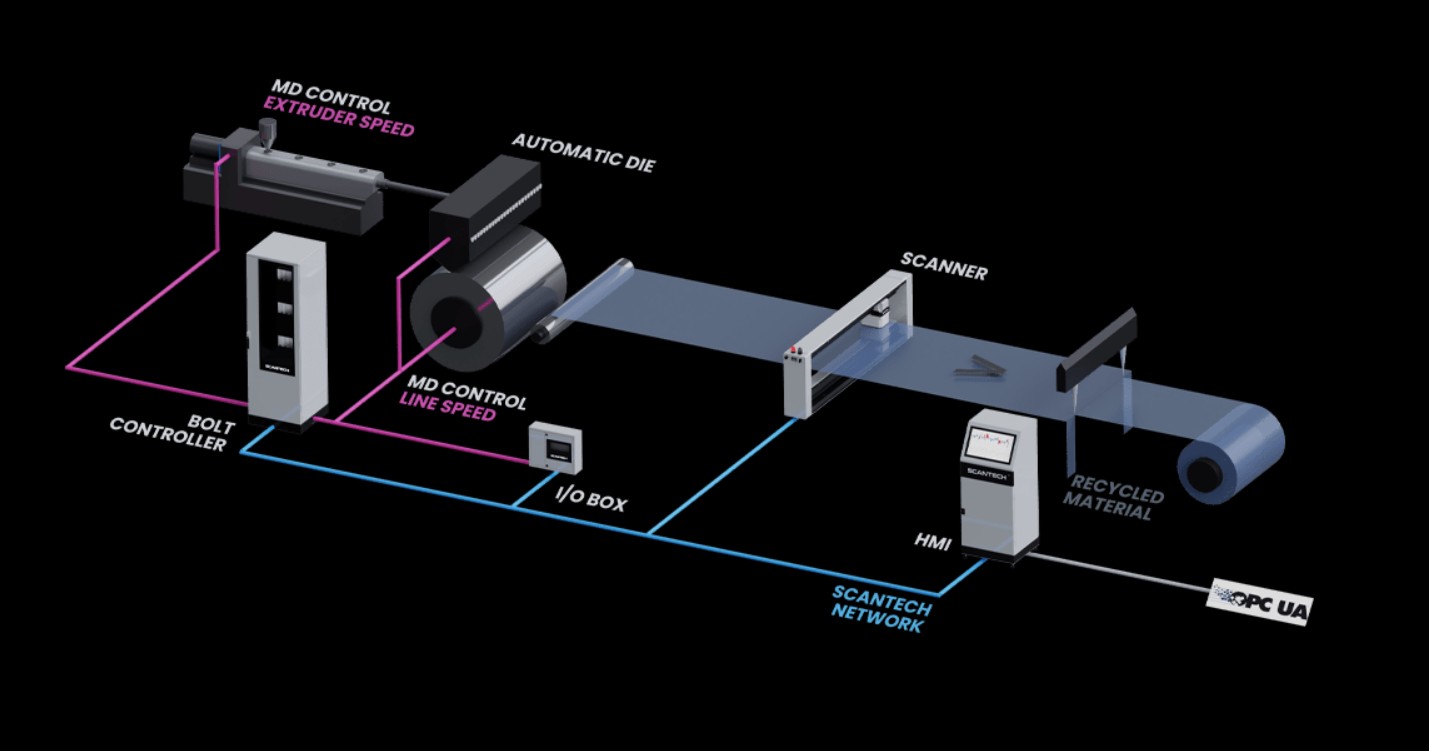
A scanner becomes valuable when the measurement is easy to understand and connected to the way the line actually runs. Scantech combines broad sensor experience with industrial scanner frames, operator software, quality reporting, line integration, and optional automatic control.
Low-energy X-ray, laser, confocal, infrared, microwave, visual inspection, and multi-sensor combinations allow the system to match thickness, basis weight, density, moisture, coating, filler, or defect requirements.
Flexscan turns individual readings into live cross-direction profiles, machine-direction trends, recipes, alarms, roll reports, and production records.
Scantech can support automatic mapping, machine-direction control, cross-direction profile control, die-bolt control, and communication with compatible line actuators.
Scanner families range from compact frames for tighter spaces to heavy-duty structures for wide, hot, or demanding production lines.
Scantech’s published extrusion literature cites more than 7,000 systems worldwide and more than 1,000 systems installed per year.[2]
Regional service, spare-parts support, Flexscan training, and local applications support help carry the project from initial selection through long-term operation.
Better visibility can translate directly into a more stable process
The first benefit is knowing what the entire web is doing while the product is still on the line. Once operators can see the profile and trend in real time, they can respond sooner and run closer to the true process target.
Use the live profile and average trend to hold product closer to target instead of relying on extra material as a safety margin.
See profile changes as the line warms up and make informed adjustments without waiting for the next offline sample.
Alarms, trends, and roll records help operators identify changes early and give quality teams a clearer production history.
Where the line has a compatible actuator, the measurement can support MD or CD control instead of stopping at display and reporting.
For a plant-specific estimate, use the Web Gauging ROI Calculator to compare material savings, scrap reduction, startup improvement, and production value.
From the web to the operator—and back to the process
The sensor is only one part of the result. Scantech connects five practical layers so the reading becomes useful production information.
Thickness, basis weight, density, coating add-on, filler, moisture, defects, or another quality result.
X-ray, optical, infrared, microwave, vision, or a synchronized multi-sensor measurement.
A frame selected for the web width, passline, opening, environment, access, and required edge coverage.
Live profiles, MD trends, recipes, alarms, roll summaries, quality records, and maintenance information.
OPC UA, PLC communication, automatic mapping, MD control, CD profile control, and compatible actuators.


A sensor portfolio built around different process questions
No single signal answers every measurement question. Scantech’s strength is the ability to combine several technologies within a common scanner, software, and support platform.
| Technology | What it helps measure | Where it is useful | Why customers choose it |
|---|---|---|---|
Low-energy X-ray | Basis weight and calibrated thickness through photon attenuation | Cast film, sheet, blown film, coating, battery materials, and other lightweight webs | Fast, non-contact profile measurement without the half-life and disposal considerations of a sealed isotope source |
Laser and optical | Physical caliper, surface position, width, edge, and geometry | Sheet, foam, nonwoven structures, and applications needing direct dimensional information | Adds a physical geometry measurement that can stand alone or complement an attenuation sensor |
Confocal | Precise surface position and caliper | Thin layers, smooth surfaces, coating, film, and higher-resolution dimensional applications | Supports detailed optical measurement in a compact non-contact architecture |
Infrared and microwave | Moisture, composition, porosity, or selected material properties | Processes where chemistry or moisture matters in addition to total thickness or weight | Adds another process variable when mass or geometry alone does not explain product performance |
Visual inspection | Gels, holes, scratches, contamination, streaks, wrinkles, and other visible defects | Transparent or opaque films and sheets needing continuous surface inspection | Can place profile measurement and visual inspection in one coordinated scanner architecture |
Multi-sensor systems | Density, porosity, coating add-on, wet-to-dry change, or separated process variables | Foam, coating, lamination, orientation, and advanced multilayer applications | Combines complementary signals and stations inside one Flexscan environment |
One platform across film, sheet, coating, and advanced webs
That breadth is especially useful for manufacturers with several lines or processes. The measurement may change, but the operator interface, reporting approach, integration path, and service relationship can remain familiar.
Thickness or basis-weight profiles, density, filler, barrier structures, visual inspection, automatic mapping, MD control, and die-profile control.
Post-layflat X-ray measurement, double-layer reconstruction, polar profiles, roll reporting, and feedback to compatible profile-control systems.
Multi-station measurement before and after stretching, profile registration, density, porosity, filler, and process-zone analysis.
Basis weight, physical caliper, and calculated density using complementary mass and geometry measurements.
Pre- and post-coating measurement, Same Spot registration, coating-add-on deduction, profiles, reports, and control.
Foil, electrode coating, calendering, separator film, slitting, loading, density, and visual-inspection applications.
Continuous surface-defect information integrated with the dimensional profile and production record.
Heavy and super-heavy scanner families for applications that require wide spans, rigid mechanics, and industrial service access.
See how a Scantech system can fit your process
Select the closest process to see a typical measurement approach and the production value it can provide. This is a starting point; Gauge Advisor will help match the exact sensor and scanner to the line.
Cast-film or sheet online gauging
A flat-web scanner can provide continuous thickness or basis-weight profiles, Flexscan trends and roll reports, and optional automatic mapping or profile control.
- See the full cross-direction profile while the line is running.
- React sooner to warm-up changes, die lines, profile drift, and average movement.
- Use the same platform for reporting, plant communication, and compatible control loops.
Scantech has continued to expand beyond its original X-ray technology
Scantech began with low-energy X-ray measurement in 1992 and has continued adding sensors, scanner frames, software, controls, and new application platforms.[1]
The founding team developed low-energy X-ray thickness and basis-weight measurement for lightweight webs.
Laser measurement was added, followed by combined X-ray and laser systems for density.
Scantech expanded Flexscan, multi-sensor measurement, heavy-frame scanners, infrared products, and global R&D.
The platform expanded into battery production, blown film, fuel cells, and confocal measurement.
Sensors, scanners, Flexscan, reporting, integration, visual inspection, and automatic process control are available within one product family.
Published extrusion literature cites more than 7,000 systems and more than 1,000 systems installed per year.
Scantech supports customers through subsidiaries and service resources across the Americas, Europe, and Asia.
Customers have one local applications and commercial contact from early discussion through quotation and support.
The relationship continues after the scanner is installed
Online gauging systems often remain on a line for many years. Scantech supports that lifecycle with regional service resources, spare-parts support, Flexscan training, and product support for scanners, HMIs, and control systems.[3][4][5]
Service resources across the Americas, Europe, and Asia support installation, maintenance, and long-term ownership.
A dedicated serial-number-based path helps customers identify and request scanner, HMI, server, and controller parts.
Training helps operators, quality teams, and maintenance personnel get more value from profiles, reports, recipes, and diagnostics.
Gauge Advisor provides a Western U.S. contact to coordinate requirements, quotations, integration questions, and factory follow-up.
Starting the conversation is simple
You do not need a finished specification or a complete RFQ. The following information is usually enough to begin selecting the measurement approach:
- ProcessCast film, sheet, blown film, coating, orientation, foam, battery, or another continuous web.
- Product rangeMaterial, minimum and maximum thickness or basis weight, and any important additives or layers.
- Line basicsWeb width, line speed, and the approximate area where the scanner could be installed.
- Primary goalReduce giveaway, improve profiles, shorten startup, create roll records, inspect defects, or automate control.
- Project timingNew line or retrofit, target installation window, and whether budgetary or formal pricing is needed.
Scantech film and sheet gauging FAQs
What makes Scantech different from a sensor-only supplier?
Scantech supplies the measurement head, industrial scanner, Flexscan operator interface, quality reporting, plant communication, and optional automatic-control tools as one coordinated platform. That gives the plant one technical path from the raw measurement to the operator and the process.
Why is low-energy X-ray attractive for film and sheet?
Low-energy X-ray provides fast, non-contact basis-weight and calibrated-thickness measurement and is not primarily affected by optical color, gloss, haze, or transparency. Because it generates X-rays electrically, it also avoids the half-life and end-of-life disposal considerations associated with a sealed beta source.
Can Scantech measure density?
Yes. In appropriate applications, Scantech combines mass per area from an attenuation sensor with physical thickness from an optical sensor. Flexscan can use the synchronized measurements to calculate density or bulk across the web.
Can Scantech inspect film defects as well as measure thickness?
Yes. Visual-inspection options can be integrated with selected scanner architectures to identify defects such as gels, holes, scratches, contamination, streaks, wrinkles, and opacity changes while the gauging system measures the dimensional profile.
Can the system control the extrusion line automatically?
Yes. Depending on the line, Scantech can support automatic mapping, machine-direction control, cross-direction profile control, die-bolt control, Same Spot registration, and communication with compatible actuators or profile-control systems.
Can a Scantech scanner be retrofitted to an existing line?
Often, yes. Scantech offers scanner families for compact spaces, standard flat-web passlines, wide lines, hot environments, and demanding industrial installations. A basic line drawing and available-space review help identify the most practical frame.
What information is needed to request a quote?
Start with the process, material, thickness or basis-weight range, web width, line speed, available scanner location, and the result you want from the system. Gauge Advisor can help develop the remaining details during the application review.
What is Gauge Advisor’s role?
Gauge Advisor is the authorized Scantech sales and applications support partner for the Western United States, helping define the application, coordinate the recommended system, prepare the quotation, answer integration questions, and support the project through installation and ongoing operation.
References
Open Scantech references5 sources
Gauge Advisor is an authorized Scantech sales and applications support partner. These sources support the company history, sensor and scanner portfolio, installed-base figures, control capabilities, and service resources described above.
- Scantech Company Presentation and History. Company founding, sensor and software milestones, application growth, R&D, and global organization.
- Scantech Extrusion Industry: Online Measurement and Control. Published application coverage, sensor portfolio, scanner families, controls, support structure, and installed-base figures.
- Scantech Measurement Scanners. Current scanner, HMI, control, service, training, and product-family overview.
- Scantech Worldwide Product Support. Support for scanners, HMIs, and bolt controllers.
- Scantech Spare Parts. Spare-parts request path for installed systems.
Ready to explore a Scantech scanner for your line?
Gauge Advisor is the authorized Scantech sales and applications support partner for the Western United States. Share what you manufacture, the measurement range, web width, line speed, and what you would like to improve. Gauge Advisor will help identify the most practical sensor and scanner approach and coordinate pricing with Scantech.
- Sensor and scanner recommendation
- New-line and retrofit layout review
- Flexscan, reports, OPC UA, and plant integration
- Automatic mapping, MD, and profile-control options
- Budgetary or formal quotation
- Ongoing local applications and commercial support