Updated August 21, 2026
In a plastics plant, a dust collector on the resin conveying system is not an ambient air cleaner. It is part of the process-air return path between the vacuum receivers and the vacuum pump. Its job is to capture pellet fines and other carryover before those particles load the pump, restrict airflow, or move through the central conveying network. That distinction is especially important in blown film, cast film, sheet extrusion, thermoforming reclaim, and compounding plants where virgin pellets, PCR, regrind, powders, and frequent material changes can create very different dust burdens.
Connected process path: Protect the vacuum pump and plant by treating dust collection as part of the full receiving, conveying, controls, and maintenance path.
Related next steps: resin dust collection and air filtration, central resin conveying systems, resin-handling service and retrofits, resin-handling controls and automation, and railcar unloading systems.

Four dust problems that are often given the same name
Before choosing a collector, define where the particles are and which air stream must be treated. The same word, dust, can describe four physically different problems.
Fines leave a receiver with the conveying air and travel toward the central pump. This is the primary ABS DCU application.
Dust, chips, or degraded material remain in the product stream after separation. A DCU can prevent recirculation through the pump side, but it does not dedust the pellets already going to the process.
Dust released at bag dumps, grinders, mixers, open hoppers, or cleanout points requires source capture, enclosure, housekeeping, or facility ventilation. A resin-conveying DCU is not an ambient air collector.
Barrel vents can contain condensables, moisture, monomer, oil, and fine polymer. That is a separate vent-filtration and vacuum-pump-protection problem from central pellet conveying.
The resin and the conveying air separate at the receiver
The material path and clean-air path should be shown separately during every project review. The DCU belongs on the return-air side. It does not sit between the receiver discharge and the blender, dryer, hopper, or extruder.
1. Material source: quantify what enters the conveying system
Virgin pellets may create relatively little dust, while ground sheet trim, brittle regrind, dusty PCR, mineral-filled compounds, masterbatch, and resin powders can change the loading by orders of magnitude. The material description must include the fine fraction, not only the polymer name.
- Separate pellets, irregular regrind, powder, fibers, stringers, and foreign material.
- Record the source, lot, moisture, temperature, bulk density, and reclaim percentage.
- Weigh actual collector-bin material by route or recipe when possible.
Why film, sheet, and compounding plants challenge the air system differently
The dust collector should be selected from the complete conveying duty, not only the extruder output. The number of receivers, simultaneous demand, pump airflow, material form, route velocity, filter loading, and cleanout interval all influence the result.
Multiple extruders, color and additive changes, long central routes, edge-trim reclaim, and lightweight pellets can create a variable return-air burden. A stable central DCU protects the pump while the plant manages recipes and reclaim.
High throughput and a large internal regrind loop can generate chips and fines from grinders, granulators, pipe impact, and repeated conveying. PET and other moisture-sensitive materials also connect filtration to drying performance.
Pellets, powders, fillers, fibers, pigment, and variable formulations may require powder receivers, stainless construction, special media, dust testing, and a complete hazard review rather than a standard pellet-only assumption.
Irregular particle shape, residual labels, dust, brittle flakes, stringers, and changing bulk density can increase carryover. Source separation, controlled velocity, receiver selection, and final air filtration should be reviewed together.
Current industry guidance for conveying PCR emphasizes that gas velocity, bend geometry, pipe condition, route length, receiver separation, and filter design all affect fines and carryover. The practical target is the lowest stable conveying velocity that still moves the material reliably, not the highest airflow the pump can produce.[14]
What is the filtration system telling you?
Select the closest symptom. The result separates immediate checks, the likely ABS equipment path, and the boundary that should not be overlooked.
Vacuum rises while conveying rate or receiver fill falls
A rising pressure drop across the filters increases system resistance. The pump may show more vacuum at its inlet while less usable airflow reaches the pickup point.
Trend differential pressure, cleaning pulses, compressed-air pressure, filter condition, receiver demand, route vacuum, and cycle time.
Restore cleaning performance, confirm filter media and area, inspect leaks and valves, and resize the DCU only after the actual airflow and dust burden are known.
A plugged pickup, collapsed hose, closed valve, loaded receiver filter, or undersized line can look like a central DCU restriction.
Several filtration architectures solve different parts of the problem
A central DCU is not automatically better than every separator or filter. It becomes the stronger choice when the plant needs a maintainable, pulse-cleaned, monitored return-air filter sized around a central vacuum system.
| Architecture | What it does well | Important limitation | Where it fits |
|---|---|---|---|
Receiver screen or local filter First separation | Keeps the conveyed material in the receiver and provides local protection at the destination. | Small filter area can load quickly, and one damaged or poorly seated element can send dust into the common return. | Every receiver needs an appropriate separation method. It does not replace central final filtration on a multi-receiver system. |
Central pulse-cleaned DCU Primary ABS focus | Provides central final filtration, filter-area scaling, differential-pressure monitoring, pulse cleaning, a collection bin, and service access before the vacuum pump. | It cannot correct excessive fines generation, receiver failure, product contamination, ambient dust, or an incorrect hazard design. | Central vacuum conveying for film, sheet, molding, compounding, and reclaim systems with a defined return-air path. |
Cyclone or preseparation stage High loading | Removes larger particles or heavy loading before a final filter and can reduce the burden on filter media. | Fine-particle performance depends on particle size, density, airflow, and geometry. A final filter may still be required. | Heavy regrind, flakes, chips, or high dust-loading applications identified through samples and measured loading. |
Bin vent filter Storage vessel | Lets displaced air leave a silo or bin while retaining dust at the storage vessel. | It does not protect the central vacuum pump from receiver return-air carryover. | Silo, day-bin, and storage venting. ABS publishes bin vent filters as a separate product family. |
Ambient or source-capture collector Worker environment | Captures airborne dust at bag dumps, mixers, grinders, open transfers, and other release points. | It is not a substitute for filtration inside the sealed pneumatic return-air loop. | EHS, housekeeping, and source-capture projects designed from hood, duct, dust, and facility requirements. |
Extruder vent or fume filtration Process vacuum | Handles moisture, condensables, polymer vapor, aerosols, or fine carryover from an extruder vent. | The contaminant chemistry and pump technology can differ substantially from dry resin conveying. | Vented extrusion and devolatilization systems requiring a separate application review. |
Why the ABS DCU platform compares well in central resin conveying
The strongest competitive case is not one isolated feature. It is the combination of industrial filter area, low-restriction flow design, monitored cleaning, serviceability, configurable construction, pump controls, and support within one resin-handling ecosystem.
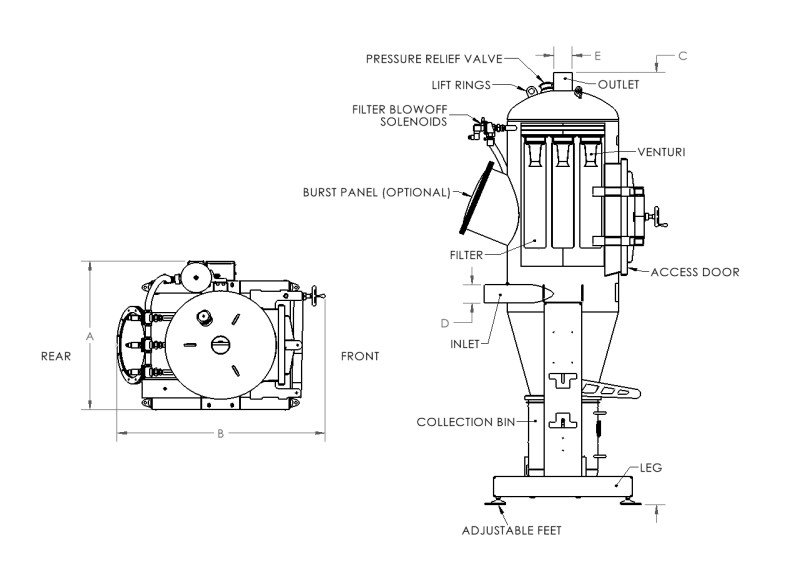
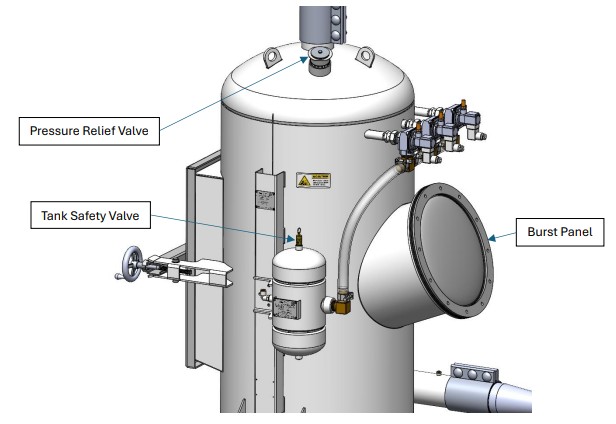
When paired with ABS pump controls, inlet-to-outlet pressure difference can drive alarms and cleaning logic so the system responds to filter condition instead of cleaning every element on an arbitrary timer.[1]
ABS describes the vessel and connections as optimized to minimize restrictions. The final design still needs the required airflow, vacuum, line size, simultaneous demand, and allowed clean and dirty pressure drop.
Pulse cleaning uses compressed air to dislodge accumulated dust into the bin. EPA guidance confirms that pressure drop rises as dust builds on fabric filters and that pulse-jet cleaning is a common way to restore operating resistance.[13]
A large front door, quick-release clamps, removable collection bin, clear service access, replacement media, and documented spare parts reduce the chance that a theoretically good collector becomes a neglected one.
DCU-16, DCU-24, and DCU-32 families use 4, 9, and 16 filter elements respectively, with published starting pairings from 5 to 100 pump horsepower.[2]
ABS offers polyester felt bag filters or PTFE-membraned pleated filters, mild or stainless steel bodies, multiple connection sizes, breaker-valve options, and special hazard-class configurations.
The removable bin creates a physical place to inspect and weigh the carryover. Full-bin indication can become an alarm instead of relying only on a maintenance calendar.
The DCU can be engineered with Tranquility pumps, receivers, Velocity Control, SMART routing, blenders, dryers, reclaim equipment, controls, remote diagnostics, and spare-parts support.
Small central system starting point
- Published pump pairing
- 5 to 7.5 HP
- Filter elements
- 4
- Connection range
- 1.5 to 3 in
- Example drawing weight
- About 350 lb
Mid-range central system
- Published pump pairing
- 5 to 15 HP
- Filter elements
- 9
- Connection range
- 2 to 4 in
- Example drawing weight
- About 500 lb
Large central system
- Published pump pairing
- 25 to 100 HP
- Filter elements
- 16
- Connection range
- 4 to 8 in
- Example drawing weight
- About 900 lb
The current ABS manual defines the standard unit for bulk materials with a minimum particle size of 10 microns and vacuum levels up to 16 inches of mercury. That statement is an intended-use boundary, not a published universal collection-efficiency curve at 10 microns. Filter performance still depends on the selected media, particle distribution, loading, installation, seals, cleaning, and maintenance.[6]
Build a preliminary ABS filtration path
The selector identifies whether the primary path is a central DCU, a complete conveying-system review, a combustible-dust workstream, or another type of filtration. It does not replace final ABS sizing or a qualified dust-hazard analysis.
Differential pressure is a diagnostic signal, not a dust-mass measurement
Pressure drop across the filter changes with airflow, media, dust cake, pulse cleaning, leaks, valves, and sensor condition. Establish the normal pattern by pump speed, route, and recipe before assigning one universal alarm value.
A repeatable clean-to-loaded cycle suggests that filter area, cleaning, dust burden, and airflow are in balance for that operating state.
Check pulse-air pressure, solenoids, media loading, dust characteristics, cleaning frequency, bin level, and whether the system has outgrown its original duty.
This is the intended basic pattern. The post-cleaning baseline should still be trended because slow upward drift can indicate residual loading or aging media.
Do not celebrate automatically. Inspect for a torn filter, loose clamp, failed gasket, open bypass, sensor problem, or major air leak.
EPA guidance for fabric filters uses differential pressure as a key operating indicator because dust buildup raises resistance and periodic cleaning is needed to avoid excessive pressure drop. It also cautions that unusual pressure behavior can indicate leaks, cleaning problems, or equipment condition rather than simply “more dust.”[13]
Estimate the annual fines burden reaching the central collector
This calculator converts an estimated collected-fines percentage into annual and daily mass. Use actual weighed bin material whenever possible. The result does not size the filter, predict collection efficiency, or replace a dust test.
Excluded: filter sizing, air-to-cloth ratio, particle-size distribution, collection efficiency, compressed-air use, labor, pump energy, downtime, actual bin geometry, bulk density, hazard classification, and material that settles elsewhere. Use the Resin Handling ROI Calculator for a broader financial case.
A burst panel does not make the complete installation compliant
Plastic powders and fine resin dust can create flash-fire or explosion hazards when the material is combustible, sufficiently fine, dispersed in air, confined, and exposed to an ignition source. OSHA now defines combustible dust within the Hazard Communication framework and continues a National Emphasis Program for facilities that generate or handle combustible dust.[15][16]
The current ABS manual states that the standard unit is for indoor, general-purpose, non-hazardous, non-classified areas and is not rated for a location where combustible-dust or vapor explosion hazards may exist.
ABS offers configurations for Hazard-Class combustible materials rated up to ST-2. That is an equipment option, not a substitute for the dust data, approved drawings, or complete facility design.
Dust characterization, DHA, vent sizing and discharge location, explosion isolation, grounding, electrical classification, housekeeping, ignition control, and authority review remain site-specific.
Vacuum, compressed air, gravity, electrical energy, the collection bin, and automatic pulse valves must be controlled before opening or servicing the unit. Follow the plant energy-control procedure and ABS manual.
NFPA 660 is the current consolidated standard for combustible dusts and particulate solids. NFPA 68 addresses deflagration venting, while NFPA 69 addresses explosion-prevention and isolation systems. The applicable edition, local adoption, insurer requirements, and authority having jurisdiction should be confirmed for the project.[17][18]
The best filtration result often comes from improving the complete ABS material-handling loop
The DCU protects the pump from what reaches the return air. Complementary equipment can reduce how much dust is created, improve primary separation, keep materials routed correctly, and turn the collector data into a maintainable plant system.
Verify that the intended resin or reclaim source is connected to the correct destination and reduce manual connection errors on complex coextrusion systems.
Size the pump from the real route and use VFD control to avoid running every material and distance at one unnecessarily high velocity.
Match receiver volume, inlet, filter, discharge, and material behavior so resin drops out before the air reaches the central DCU.
Capture the remaining carryover, trend differential pressure, pulse the filters, and collect the removed material before the pump.
Feed the correct recipe to film, sheet, or compounding equipment using SIMPLICITY, SL blenders, dryers, and Sasquatch reclaim where appropriate.
ABS also publishes after-sales support for maintenance, troubleshooting, spare parts, and technical assistance, plus a remote-support program for enrolled control systems. That support infrastructure is a practical advantage when filtration alarms, pump queues, cleaning logic, receiver demand, and material routing are connected through one controls platform.[11][12]
Information needed to size and configure the filtration system
- Process and equipmentBlown film, cast film, sheet, thermoforming, compounding, molding, recycling, central conveying, bulk transfer, or another process.
- Material envelopeResins, additives, fillers, powders, PCR, regrind, flakes, fibers, dust sample, particle-size information, moisture, temperature, and bulk density.
- Conveying dutyNormal and peak rate, routes, horizontal distance, vertical lift, bends, line sizes, flex hose, pickups, valves, receiver count, and simultaneous demand.
- Pump informationManufacturer, model, horsepower, blower type, speed, VFD, normal vacuum, relief setting, duty cycle, and current inlet condition.
- Receiver and filter dataReceiver models, inlet arrangement, filter media, cleaning method, differential pressure, carryover, discharge seal, and known failures.
- Dust burdenActual collected mass per day, route, or 1,000 lb conveyed; bin cleanout frequency; photos; sample; and where else material accumulates.
- Controls and alarmsPLC platform, pump queue, differential-pressure input, cleaning sequence, full-bin alarm, receiver demand, historian, and remote-access requirements.
- Utilities and layoutCompressed air, electrical service, floor or mezzanine support, inlet and outlet orientation, service clearance, lifting, drainage, and installation schedule.
- Hazard informationSDS, combustible-dust test data, Kst, Pmax, MIE, MEC, MIT, DHA, area classification, venting and isolation requirements, and authority review.
- Commercial scopeRetrofit or new system, desired timing, installation responsibility, startup, training, spare filters, service expectations, and quotation requirements.
Common resin-conveying filtration mistakes
Calling every dust collector an ambient air filter
The ABS DCU filters the process-air return before the vacuum pump. It does not provide room air changes, capture velocity at an open dump station, or control fumes from a hot extrusion vent.
Sizing from vacuum-pump horsepower alone
Horsepower is only a family-level screen. Actual airflow, vacuum, dust loading, simultaneous demand, connection size, media, dirty pressure drop, cleaning, and operating state determine the application.
Assuming the DCU removes fines already mixed into the product
The DCU captures particles carried in the return air. Fines that discharge from the receiver with the resin require source reduction, material dedusting, receiver changes, or another product-path solution.
Ignoring the receiver because the central collector exists
The receiver is the first separator. Poor inlet geometry, damaged media, re-entrainment, a leaking discharge, or a full vessel can overload the central collector and reduce conveying performance.
Using a timer instead of understanding differential pressure
Timed pulses can clean filters that do not need it or fail to respond to an abnormal loading event. Use differential pressure with operating context, then verify that pulses actually restore the expected baseline.
Adding filter area without reducing dust generation
A larger DCU may extend the cleanout interval, but excessive velocity, rough pipe, tight bends, grinders, brittle regrind, and bad receiver separation can continue generating avoidable fines.
Treating an ST-2 option as complete combustible-dust compliance
The equipment option must be connected to tested dust properties, a qualified DHA, venting or suppression, isolation, grounding, electrical classification, location, housekeeping, and the approved site design.
Forgetting service clearance and bin handling
A front door and quick clamps only help when people can reach them safely. Confirm the manual clearances, lifting and bin path, filter removal, compressed-air isolation, and floor or mezzanine loading before approval.
Waiting for pump damage before keeping spare filters
Filter type and quantity are part of the order code. Keep the correct media, clamps, gaskets, solenoid components, and other critical spares available according to the plant risk and ABS recommendations.
Resin conveying air filtration FAQs
Where is an ABS Dust Collection Unit installed?
For the primary central vacuum application, the DCU is installed between the facility vacuum-return line and the vacuum pump inlet. Material separates at the receiver and moves to the process, while the return air passes through the DCU before entering the pump.
Is the ABS DCU an ambient air dust collector?
No. It filters process air inside the pneumatic conveying system. Ambient dust at grinders, bag dumps, mixers, or open hoppers requires a source-capture or facility-air project with its own hood, duct, airflow, and hazard design.
Will the DCU remove dust already mixed with pellets or regrind?
Not automatically. It captures particles that remain suspended in the return air. Dust that discharges with the resin may require a material dedusting step, source correction, receiver redesign, lower conveying velocity, or better reclaim preparation.
How do I choose DCU-16, DCU-24, or DCU-32?
Use the published family ranges only as a preliminary screen. Final selection should include pump airflow and vacuum, line size, simultaneous receivers, dust burden, material, filter media, pressure-drop allowance, cleaning, connection geometry, layout, and hazard requirements.
Should I choose bag or PTFE-membraned pleated filters?
The correct media depends on particle size, dust loading, cleanability, pressure drop, temperature, chemistry, static and hazard requirements, service interval, and the complete ABS configuration. Submit a representative sample and operating data rather than choosing from surface area alone.
Does differential pressure tell me how many pounds of dust are in the filters?
No. It shows resistance across the filter at the current airflow. Dust cake is one contributor, but pump speed, valves, media, leaks, sensor condition, and pulse cleaning also affect the reading. Weigh the collection bin when mass information is needed.
Can the DCU be used for powders or compounding additives?
Potentially, but powder handling should be treated as a specific application. Particle size, cohesion, loading, filter media, receiver design, stainless or special construction, dust explosibility, venting, isolation, and classified-location requirements can change the equipment scope.
What does the optional ST-2 configuration mean?
It means ABS offers a hazard-class equipment configuration intended for combustible materials rated up to ST-2. It does not establish that every polymer dust is ST-2, approve the installation location, or complete the facility hazard analysis and explosion-protection design.
How often should filters be cleaned or replaced?
Use differential-pressure history and the current ABS manual. The manual includes routine inspection, a six-month filter-removal and cleaning interval as a baseline, and replacement every one to two years or sooner when media is damaged, will not seal, or cannot be cleaned effectively. Actual service can be more frequent in a heavy-duty application.
What should I send for an ABS filtration quotation?
Send the process, material and dust sample, conveying rate, routes, pump and receiver details, airflow or vacuum data, line sizes, differential-pressure history, bin loading, compressed air, controls, installation drawing, hazard information, and desired project scope.
References and source notes
The references are collapsible to keep the article readable and open automatically when printing.
Open technical references and source notes18 sources
Gauge Advisor is the authorized Advanced Blending Solutions sales and applications support partner. ABS sources are used for current DCU equipment, drawings, intended-use limits, maintenance, controls, and support. EPA, OSHA, NFPA, and SPE sources provide neutral filtration, maintenance, conveying, and combustible-dust context. No competitive equipment manufacturer is cited.
- Advanced Blending Solutions, Air Filtration. Current product architecture, mild or stainless construction, front access, quick-release filters, differential-pressure monitoring, cleaning logic, and optional hazard-class configuration.
- Advanced Blending Solutions, Air Filters Brochure. DCU-16, DCU-24, and DCU-32 family starting points, pump pairings, filter-media choices, connections, breaker-valve option, and order-code structure.
- Advanced Blending Solutions, DCU-16 Product Drawing. Four-filter arrangement, connection options, breaker valve, filter media, optional burst panel, and example weight.
- Advanced Blending Solutions, DCU-24 Product Drawing. Nine-filter arrangement, connection options, filter media, optional burst panel, and example weight.
- Advanced Blending Solutions, DCU-32 Product Drawing. Sixteen-filter arrangement, 4 to 8 inch connection options, filter media, breaker-valve and burst-panel options, and example weight.
- Advanced Blending Solutions, Air Filtration Unit Operator’s Manual, 2025. Intended use, 10-micron material boundary, 16 in-Hg vacuum limit, standard-location restriction, installation clearances, compressed air, maintenance, troubleshooting, filter specifications, spare parts, and lockout guidance.
- Advanced Blending Solutions, Tranquility Vacuum Pumps. Integrated positive-displacement blower, motor, VFD, relief and breaker valves, enclosure, service access, and resin-conveying pump architecture.
- Advanced Blending Solutions, Velocity Control. Patented pressure-based VFD control for programmed conveying velocity and manufacturer-published source-reduction benefits.
- Advanced Blending Solutions, Vacuum Receivers. Receiver sizes, flapper and knifegate arrangements, powder-receiver context, and integration with ABS blending systems.
- Advanced Blending Solutions, SMART Material Distribution. Recipe-to-source verification, reduced common piping, and routing for complex coextrusion and centralized plants.
- Advanced Blending Solutions, After Sales. Maintenance, troubleshooting, technical support, spare parts, and support across blending and conveying equipment.
- Advanced Blending Solutions, Remote Support. Enrolled-system access for software and controls diagnostics from ABS service and technical-support locations.
- U.S. EPA, Monitoring by Control Technique: Fabric Filters. Dust-cake pressure-drop behavior and common shaker, reverse-air, and pulse-jet cleaning methods.
- SPE Plastics Engineering, Conveying PCR: Reducing Fines, Angel Hair, and Scrap, 2026. Current industry guidance on conveying velocity, bends, pipe condition, receiver separation, filter design, differential pressure, and normalized dust mass.
- OSHA, Hazard Communication Appendix F. Current definition of combustible dust as finely divided solid particulate that can present a flash-fire or explosion hazard when dispersed.
- OSHA, Revised Combustible Dust National Emphasis Program. Inspection policy for facilities that generate or handle combustible dust with fire, flash-fire, deflagration, or explosion hazards.
- NFPA, NFPA 660 Standard Development. Current 2025 consolidated standard for combustible dusts and particulate solids.
- NFPA, NFPA 68 Standard Development, and NFPA 69. Deflagration venting, explosion prevention, and isolation context for the complete hazard-protection design.
Review the material, air path, pump, and dust burden as one system
Gauge Advisor is the authorized Advanced Blending Solutions sales and applications support partner. I help film, sheet, thermoforming, compounding, molding, and recycling plants evaluate, select, quote, integrate, and support ABS Dust Collection Units, Tranquility pumps, Velocity Control, vacuum receivers, SMART routing, gravimetric blending, drying, and reclaim systems.
Gauge Advisor supports equipment selection and integration for the manufacturers represented here; independent process consulting is not offered. Send the material and dust information, pump and receiver details, routes, airflow or vacuum data, current filter condition, controls, and layout when available. I will respond within one business day, often within a few hours.
- DCU family and filter-media screening
- Vacuum pump and return-air review
- Receiver, velocity, and carryover diagnosis
- Film, sheet, compounding, and reclaim systems
- Controls, alarms, remote support, and spares
- Quotation and ABS factory coordination