Updated August 21, 2026
Angel hair in a plastic resin conveying system is more than a housekeeping nuisance. The long polymer stringers are evidence that pellets are being rubbed, heated, smeared, or fibrillated somewhere between storage and the process. An inline trap protects receivers, dryers, blenders, hoppers, and machine throats from the strands that have already formed. The stronger long-term solution combines that capture step with velocity control, route correction, receiver separation, filtration, and material-specific conveying recipes.
Connected process path: Preventing angel hair requires coordinated control of conveying velocity, piping and routing, clean-air filtration, and system maintenance—not only a downstream trap.
Related next steps: central resin conveying systems, resin selection stations, resin-handling controls and automation, resin dust collection and air filtration, resin-handling service and retrofits, and railcar unloading systems.

Confirm that the problem is actually angel hair
Plants often group every light contaminant under the same name. That can lead to the wrong equipment. Pull a representative sample from the receiver, hopper, filter, or machine throat and separate the material by shape and behavior before selecting a trap.
Thin, flexible polymer strands that tangle around screens, shafts, and hopper outlets. This is the primary Angel Hair Trap application.
Small particles may pass through a stringer screen and load receiver or central filters. Air separation and filtration are the main tools.
Light oversize contamination can resemble angel hair but may require a different screen, separator, source-control plan, or recycling cleanup step.
Bridging can also come from condensation, soft pellets, static charge, poor hopper geometry, or difficult regrind. A trap may not change the cause.
True angel hair is generally associated with polymer smearing during transport. Industry guidance identifies smooth pipe surfaces, frictional heating, conveying speed, air temperature, route length, bends, and material sensitivity as important factors. Check each transfer step, including bulk delivery and the plant network, before assuming the final machine created it.[11]
Where the symptom appears helps locate the source
Select the condition that most closely matches the plant. The result separates the first checks from the most likely ABS equipment path.
Stringers reach a blender, dryer, hopper, or machine throat
The immediate objective is to keep long strands out of the downstream process while the plant identifies where they were generated. An Angel Hair Trap upstream of the affected destination can provide protection and a measurable collection point.
Confirm the strands are polymer, identify every route feeding the destination, and inspect the final bends, receiver inlet, filter condition, and conveying setpoint.
ABS Angel Hair Trap for capture, then evaluate Velocity Control when the pump runs one high speed for short and long routes.
A trap can stop tangles at the machine, but it does not prove the final route created them. Move the trap or sample upstream locations to isolate the source.
Angel hair forms when conveying energy becomes polymer damage
The exact mechanism varies by resin and system, but the recurring sequence is high relative motion, impact or sliding contact, localized heat, polymer smearing, and release of a long filament. Increasing air to recover a marginal conveying condition can make the damage worse.
Pellets enter the conveying air stream.
Bends and pipe walls concentrate contact.
Friction softens the pellet surface.
A softened film adheres to the pipe surface.
The stringer breaks free and travels downstream.
The 2026 Plastics Engineering review emphasizes gas velocity, bend geometry, pipe condition, distance, receiver design, and filter differential pressure as practical control variables. It recommends the lowest gas velocity that still maintains stable conveying instead of maximizing air by default.[10]
More air is not automatically safer. Excess velocity raises collision energy and sliding shear, while too little air can allow saltation, unstable transport, or plugging.
Tight bends, repeated direction changes, long vertical lifts, excessive flex hose, and worn or contaminated pipe can increase impact and friction.
Soft olefins, warm pellets, rough regrind, PCR with wider pellet morphology, and contaminated streams may tolerate less transport energy than clean virgin pellets.
Dense-phase or lower-velocity conveying can reduce particle attrition in suitable systems, but it is not a universal retrofit. Processing Magazine notes that stable dense-phase conveying has a narrower control window and requires a system designed for that flow regime.[12] Most existing central vacuum systems should first be optimized within their intended dilute-phase operating range before the plant assumes it can simply run below saltation velocity.
Capture stringers in the material path, protect the pump in the air path
The material and conveying-air paths separate at the receiver. That distinction determines where the trap, receiver, dust collection unit, and vacuum pump belong.
A pressure conveying or railcar-unload arrangement changes the location of the air mover, but the same rule remains: install the Angel Hair Trap in the pellet stream where it can intercept stringers before a critical destination and where operators can safely inspect and clean it.
A five-step control hierarchy
Separate stringers from fines, collect route-specific samples, and trend the condition by resin and operating state.
Match pump speed and pickup conditions to the route and resin instead of running every draw at maximum speed.
Review bends, hose, worn pipe, valves, pickup devices, receiver entry, route length, lift, and unexpected restrictions.
Place an Angel Hair Trap downstream of the suspected formation zone and upstream of the equipment being protected.
Use appropriate receiver separation, dust collection, differential-pressure monitoring, and maintenance on the clean-air side.
What the ABS Angel Hair Trap is designed to do
ABS publishes the unit as a field-proven floor-mount or line-mount trap that removes stringers without disrupting normal material flow, provides a clear view for level detection, and supports easy cleanout. ABS also promotes using one or more traps as diagnostic tools to locate where stringers are being formed.[1][2]
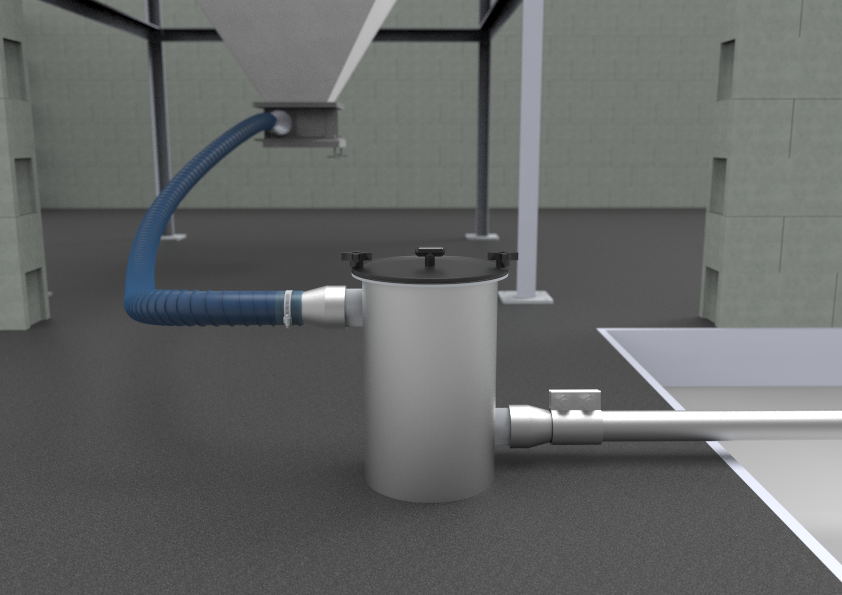
Seven standard line-size codes cover common central-conveying and bulk-transfer piping.
The 10-inch vessel covers 1.5 through 3-inch lines. The 18-inch vessel covers 4 through 6-inch lines.
Choose from access, structure, pipe-load, maintenance, and diagnostic-mobility requirements.
Male camlock, female camlock, and tube-stub combinations support retrofit and new-system layouts.
| Line size | Published ABS model | Vessel diameter | Application note |
|---|---|---|---|
1.5 inch | AHT-A-10 | 10 inches | Confirm the actual tube OD, coupling standard, conveying rate, and cleanout access. |
2 inch | AHT-B-10 | 10 inches | Common small central-conveying and machine-feed size. Verify whether the route is vacuum or pressure. |
2.5 inch | AHT-C-10 | 10 inches | Review throughput, material loading, vertical lift, and structural support at the proposed location. |
3 inch | AHT-D-10 | 10 inches | Use the full route data rather than line size alone when estimating conveying performance. |
4 inch | AHT-F-18 | 18 inches | Larger bulk-transfer and central lines need adequate floor space, headroom, support, and safe cleanout access. |
5 inch | AHT-G-18 | 18 inches | Confirm the expected material rate and pressure or vacuum duty with ABS before final selection. |
6 inch | AHT-X-18 | 18 inches | Large-line projects should include mechanical layout, nozzle orientation, pipe support, and maintenance review. |
Published connection choices
Why choose the ABS unit when several angel hair traps exist
Inline traps generally let pellets continue while retaining long stringers. The ABS advantage is not a unique screen principle. It is the standard configuration range and the ability to connect capture with source prevention and the broader material-handling system.
| Architecture | Best fit | Strengths | Important tradeoff |
|---|---|---|---|
Low-profile drawer or silo-base trap Gravity source | One known stringer source at a silo or bin discharge with limited vertical clearance. | Compact and source-focused. It may be the better answer when contamination begins at one gravity outlet. | Less useful for diagnosing several pneumatic routes and does not protect stringers generated downstream. |
Compact fixed inline trap One known route | A small number of permanent conveying lines with a defined source and accessible cleanout point. | Simple installation and direct protection of one destination. | Limited line-size, connection, mounting, or system-integration options can increase custom work on a mixed plant network. |
Full-size inline vessel trap Central conveying | Central routes, bulk transfer, or meaningful stringer loads. | Larger collection volume and good diagnostic visibility. | Requires space, pipe support, and planned maintenance access. |
Receiver screen or filter only No separate trap | Very light contamination that existing separation handles without downstream tangling. | No added vessel in the material line. | The receiver or filter becomes the collection device, increasing cleaning and carryover risk. |
ABS Angel Hair Trap plus Velocity Control Capture and prevent | Plants that need immediate downstream protection and also want to reduce the operating condition that creates the stringers. | 1.5 to 6-inch published line range, two vessel sizes, six connection patterns, floor or line mounting, diagnostic relocation, patented velocity control, and integration with ABS pumps, receivers, filters, SMART routing, and controls. | It is a system project, not a one-part shortcut. Pickup velocity, route condition, pump capacity, receiver separation, and controls still require application review. |
Build a preliminary ABS angel hair control path
This tool identifies a practical starting architecture and a preliminary published trap code. It is not a final equipment selection, pressure-drop calculation, installation drawing, or performance guarantee.
The best angel hair project often includes more than the trap
Each ABS component should address a specific failure mode: prevent formation, separate pellets and air, protect the pump, route resin correctly, and keep the process supplied. This is a system review, not an excuse to turn one stringer problem into a full line card.

Tranquility pump and patented Velocity Control
ABS controls vacuum-pump speed from pump-inlet pressure so material can be conveyed at a programmed velocity. ABS states that the system can reduce and often eliminate angel hair while improving conveying efficiency.[3]
- Different speeds for different materials and routes
- VFD-driven pump operation rather than one fixed maximum speed
- Manufacturer-published energy, noise, filter-life, and maintenance benefits are application-dependent

Dust Collection Units and differential-pressure monitoring
Long stringers and fine dust are different separation problems. ABS Dust Collection Units filter conveying air before it enters the vacuum pump and can monitor pressure difference when paired with ABS pump systems.[6]
- Three body sizes with mild or stainless construction options
- Large access door and quick-release filter clamps
- Alarm and cleaning-cycle logic based on filter condition

SMART material distribution and Simplicity controls
SMART reduces piping and verifies that material connections match the recipe. ABS controls can coordinate vacuum sequencing, route logic, pump speed, receiver demand, silo levels, and reporting.[8][9]
- Route-specific conveying recipes
- Fewer wrong-resin and wrong-destination events
- Central visibility for alarms and maintenance trends
Receiver inlet design, separation, flapper or knifegate sealing, and specialty geometry for difficult regrind affect carryover and bridging. ABS offers standard 1/8 to 6 ft³ receivers and specialty designs.[7]
If stringers appear immediately after bulk delivery, review unloading air, hose length, bends, silo fill piping, temperature, and receiver or venting before blaming the plant machine route. The railcar resin weighing guide explains the broader transfer architecture.
Protecting the final blender or dryer is valuable because stringers can tangle around shafts, bridge hopper outlets, or interrupt feed. The downstream equipment still needs correct material conditioning, discharge geometry, and recipe control.
Estimate the annual burden of angel hair cleanouts and interruptions
Use the plant’s own frequency, labor, downtime, and resin-loss assumptions. The result is a screening value for prioritizing the project, not a savings guarantee for an Angel Hair Trap or Velocity Control.
Included: direct labor, optional lost-production contribution, and discarded resin. Excluded: equipment price, installation, maintenance, energy, product-quality escapes, filter replacement, pipe wear, customer claims, and value from improved consistency. Avoid double counting. If the lost-production value already includes labor or resin, enter zero for those separate fields. Use the broader Resin Handling and Conveying ROI Calculator for a complete system case.
Place the trap where it can protect the process and be maintained safely
A good trap in an inaccessible or poorly supported location becomes another maintenance problem. Treat placement, support, isolation, cleanout, and data collection as part of the equipment specification.
Place the unit after the route segment being evaluated so collected stringers represent that section. Move or duplicate traps when the source is not yet isolated.
Protect the receiver, dryer, blender, surge hopper, machine throat, or silo before strands can tangle, bridge, or load another separator.
Allow operators to see the clear window, remove the cover or screen, collect a sample, and clean the vessel without unsafe reaching or improvised platforms.
Do not ask flexible hose or thin conveying tube to carry an unsupported vessel. Review floor mounting, line mounting, nozzle loads, vibration, and thermal movement.
Use the trap as a measurement point
Instead of recording only “trap cleaned,” weigh or estimate the stringers, record resin mass conveyed, route, pump speed, vacuum, cycle time, filter differential pressure, and material temperature. A simple normalized metric, such as grams of stringers per 1,000 kg conveyed, can show whether a velocity or piping change actually improved the system. The Plastics Engineering guidance recommends similar normalized dust and differential-pressure trending for PCR conveying.[10]
Common angel hair trap specification mistakes
Installing the trap on the clean-air side of the receiver
The trap is designed for the pellet stream. Air-side dust collection and pump protection are separate functions. Map material and air flow before choosing the location.
Calling every fine contaminant angel hair
Long flexible stringers, dust, pellet chips, labels, film, metal, and moisture clumps need different separation methods. Submit samples or clear photographs before selecting the screen and equipment path.
Adding a trap while continuing to run every route at full pump speed
The trap may protect the process while continually filling with preventable stringers. Evaluate pickup velocity and route-specific VFD control so the plant does not turn cleanout into the permanent operating strategy.
Selecting from line diameter alone
Line size identifies a preliminary ABS vessel code, not the complete application. Material rate, resin, vacuum or pressure, route, support, temperature, stringer load, and connections still matter.
Putting the unit where operators cannot safely clean it
Clearance and access are part of the design. A trap above a ceiling, behind hot equipment, or supported by hose can increase maintenance risk and discourage routine inspection.
Using the receiver filter as the primary material separator
Filters should not be forced to carry the entire stringer and fines load. Rapid differential-pressure rise, poor pulse cleaning, and re-entrainment are signs that upstream separation and conveying conditions need attention.
Ignoring the shortest routes
A pump sized for a long route can create excessive velocity on a short draw. Route-specific speed recipes are often more useful than one plant-wide setting.
Assuming virgin and PCR resin can share one conveying recipe
Pellet morphology, roughness, contaminants, bulk density, and friability can change with PCR and regrind. Validate each material family rather than carrying forward the virgin-resin air setting.
Counting the entire operating loss as guaranteed equipment savings
The calculator identifies the burden of the current problem. Actual recovery depends on how much is caused by angel hair, how much the selected architecture changes, installation quality, maintenance, and operator use.
Information needed to size the trap and diagnose the conveying system
- Representative contamination samplePhotographs with scale, strand length and thickness, amount collected, and confirmation that the material is polymer.
- Resin and material conditionGrade, supplier, pellet shape, virgin, PCR or regrind percentage, temperature, additives, filler, and material changes.
- Where and when it appearsRailcar unload, silo fill, one route, several routes, receiver, dryer, blender, hopper, or machine throat.
- Complete route layoutPipe size, horizontal and vertical distance, lift, bends and radii, flex hose, valves, pickups, diverters, and receiver entry.
- Pump and control dataPump model and horsepower, VFD, normal speed, vacuum, relief activity, sequence controls, and route-specific recipes.
- Material and air-side performanceConveying rate, cycle time, filter differential pressure, cleaning frequency, dust mass, carryover, and receiver condition.
- Trap configurationLine size, floor or line mount, connection preference, orientation, pipe support, headroom, cleanout access, and mobility needs.
- Operational burdenCleaning frequency, downtime, people involved, discarded resin, filter replacements, quality effects, and current work instructions.
- Existing ABS or other equipmentReceivers, pumps, controls, SMART routing, dust collectors, blenders, dryers, railcar unload, and available I/O.
- Commercial scopeOne trap, diagnostic trial, full retrofit, new central system, desired timing, installation responsibility, and quotation requirements.
Related Gauge Advisor resources
Plastic resin angel hair trap FAQs
What is angel hair in plastic resin conveying
Angel hair is a long polymer filament formed when pellets are smeared or fibrillated during transport. High velocity, friction, impact, heat, route geometry, pipe condition, and material sensitivity can contribute.
Will an Angel Hair Trap eliminate the cause
No. It captures stringers that have already formed and protects downstream equipment. The cause may require lower route-specific velocity, pickup changes, piping correction, receiver improvements, filtration, or material-specific operating recipes.
Where should the trap be installed
Install it in the material stream downstream of the route being evaluated and upstream of the receiver, dryer, blender, hopper, silo, or machine that needs protection. The final location must also provide safe access and mechanical support.
Can the ABS trap be used to find where angel hair forms
Yes. ABS specifically promotes installing several units or moving one through the system to pinpoint problem areas. Record the collected amount by route and resin so the test becomes quantitative.
Does the trap remove dust and fines
It is primarily a long-stringer separator. Fine particles may pass with the pellets or enter the conveying-air stream. Receiver design, dust collection, filter differential-pressure monitoring, and lower material velocity address that part of the problem.
Which ABS trap model fits my line
The published starting codes are AHT-A-10 through AHT-D-10 for 1.5 to 3-inch lines and AHT-F-18 through AHT-X-18 for 4 to 6-inch lines. Final selection also needs material, rate, pressure or vacuum, connections, mounting, and cleanout review.
When should Velocity Control be included
Evaluate it when fixed-speed pumps, different route lengths, short routes running at excessive velocity, multiple resin families, recurring fines, high energy use, or rapid trap filling suggest that the conveying speed is part of the cause.
Is PCR or regrind more likely to create angel hair
It can be more vulnerable because pellet shape, roughness, friability, contamination, and size distribution may differ from virgin resin. The result is material-specific, so compare normalized stringer and fines generation by resin and route.
Why choose ABS instead of a generic inline trap
The core separation principle is common. ABS becomes a stronger choice when the plant values a broad 1.5 to 6-inch standard range, camlock and tube-stub combinations, floor or line mounting, diagnostic relocation, and one supplier for Velocity Control, pumps, receivers, filtration, SMART routing, controls, blending, drying, and railcar transfer.
References and source notes
The references are collapsible to keep the commercial article readable. They open automatically when printing.
Open technical references and source notes13 sources
Gauge Advisor is the authorized Advanced Blending Solutions sales and applications support partner. ABS sources are used for current equipment configuration, published capabilities, and manufacturer claims. Plastics Engineering, INEOS industry guidance, Processing Magazine, and OSHA provide independent process and safety context. Competitive equipment manufacturers were reviewed for market architecture, but are not cited or named in this article.
- Advanced Blending Solutions, Angel Hair Removal. Current product positioning for stringer capture, diagnostic relocation, downstream protection, and the relationship to Velocity Control.
- Advanced Blending Solutions, Angel Hair Traps literature. Published line sizes, vessel diameters, order codes, connection choices, floor or line mounting, clear level view, and cleanout features.
- Advanced Blending Solutions, Velocity Control and Variable Frequency Drives. US Patent 9,731,914 and pump-speed control based on inlet pressure to convey at a programmed velocity.
- Advanced Blending Solutions, Velocity Control literature. Manufacturer-published energy, angel hair, dust, filter-life, noise, alarm, maintenance, and multi-pump claims. Results are application-dependent.
- Advanced Blending Solutions, Tranquility Vacuum Pumps. Current enclosed vacuum-pump architecture and standard VFD context.
- Advanced Blending Solutions, Air Filtration. Dust Collection Unit airflow, access, materials, differential-pressure monitoring, cleaning controls, and filter-protection context.
- Advanced Blending Solutions, Vacuum Receivers. Standard receiver range, flapper and knifegate options, powder receivers, and specialty receivers for difficult-flow regrind.
- Advanced Blending Solutions, SMART Material Distribution. Common-line routing, recipe verification, hose modules, port expanders, and plant-scale material-distribution context.
- Advanced Blending Solutions, Simplicity Controls. Allen-Bradley and Beckhoff options, scalable PC and PLC controls, graphical interfaces, software modules, and vacuum sequence control.
- Vargas, Conveying PCR: Reducing Fines, Angel Hair, and Scrap, Plastics Engineering, 2026. Velocity, bends, pipe condition, route length, receiver separation, differential pressure, and normalized fines monitoring.
- INEOS and industry partners, Safety and Quality Best Practice Guidelines for Unloading Polymers in Bulk. Polymer smearing and streamer formation, conveying variables, route-by-route source investigation, and bulk-unloading quality practices.
- Processing Magazine, Basic Concepts in Pneumatic Conveying. Dilute and dense-phase operating regimes, attrition, velocity, stability, and the limits of low-velocity dense-phase conveying.
- OSHA 29 CFR 1910.147, Control of Hazardous Energy. General-industry requirements for servicing and maintenance where unexpected startup or release of stored energy can injure employees.
Review the stringer sample, conveying route, and complete ABS architecture
Gauge Advisor is the authorized Advanced Blending Solutions sales and applications support partner. I help plastics processors evaluate, select, quote, integrate, and support ABS Angel Hair Traps, Velocity Control, Tranquility vacuum pumps, receivers, dust collection units, SMART material distribution, controls, blending, drying, and railcar transfer equipment.
Gauge Advisor supports equipment selection and integration for the manufacturers represented here; independent process consulting is not offered. Send the material sample, route drawing, line size, pump and control data, photographs, operating impact, and proposed installation location when available. I will respond within one business day, often within a few hours.
- Angel Hair Trap size and connection screening
- Diagnostic placement and cleanout review
- Velocity Control and Tranquility pump evaluation
- Receiver and air-filtration architecture
- SMART routing, controls, blending, and drying integration
- Quotation, factory coordination, and ongoing support