Updated August 21, 2026
Weighing resin during railcar unloading gives a plastics plant an independent record of how much material passed through the receiving system. That record can support receiving reconciliation, silo inventory, unload completion, and material accountability. The useful measurement is not simply a load-cell display. It is a controlled sequence that records each batch, verifies the vessel returns to a valid no-load condition, accumulates the net total, and preserves enough operating data to explain a discrepancy.
What should the railcar weight record accomplish?
The same load cells can support very different decisions. Select the objective that best matches the plant problem. A system intended for internal inventory control may not meet the legal and procedural requirements for settling a commercial dispute.
Verify the amount transferred into the plant
An inline batch totalizer records the net weight of each completed draft and adds those drafts into one unload total. This gives receiving an independent transfer record at the selected measurement boundary.
Place a properly vented load-cell vessel where every intended material path must pass through it, then totalize complete weigh cycles.
Shipping basis, scale status, railcar heel, material retained in piping or filters, bypasses, spills, and the time boundary used by inventory.
A difference by itself does not establish supplier fault, resin identity, contamination, moisture content, or material remaining outside the measured path.
How an inline batch weighing system totals resin during unloading
An automatic bulk weighing system weighs a flowing commodity in successive drafts. For a receiving application, each cycle establishes a no-load reference, fills the load-receiving vessel, records the loaded value, discharges the material, and adds the net draft to a cumulative total. NIST Handbook 44 treats the weighing sequence, recording, venting, environmental protection, support rigidity, loading range, repeatability, and security of calibration parameters as part of the system, not optional details.[7]
The weigh vessel is empty, mechanically free, properly vented, and stable enough to establish its reference value.
Resin enters until the programmed batch target or usable weighing capacity is reached.
Flow is isolated and the control waits for a valid, stable loaded value before accepting the draft.
The no-load reference is removed from the loaded value under the approved weighing sequence.
The outlet opens and the draft moves into the next conveying stage, silo, or pressure line.
Accepted drafts are summed by railcar, material, lot, destination, date, operator, and other required identifiers.
Keep direct measurements separate from calculations and inferences
The load-cell system measures the vessel in its no-load and loaded states and records the net draft under the configured sequence.
The control adds accepted drafts, then software may compare that total with the bill of lading, invoice, purchase order, or expected silo change.
A falling transfer rate, pickup behavior, air-only cycles, sound, sight ports, or a total near expectation may suggest completion. None directly measures every pocket of resin left in the car.
The total does not identify the resin, detect contamination, determine moisture, or count material that bypassed the scale or remains in piping, filters, or another vessel.
Direct pull and pull/push systems place the weighing boundary differently
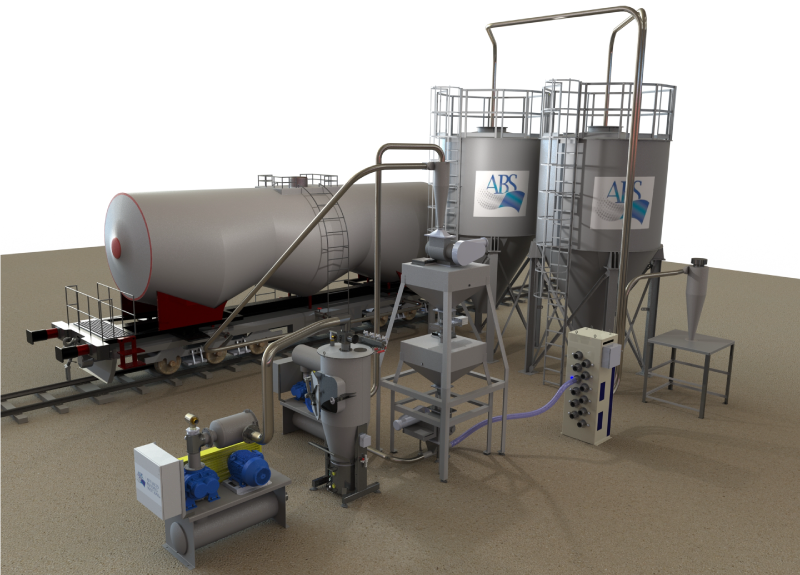
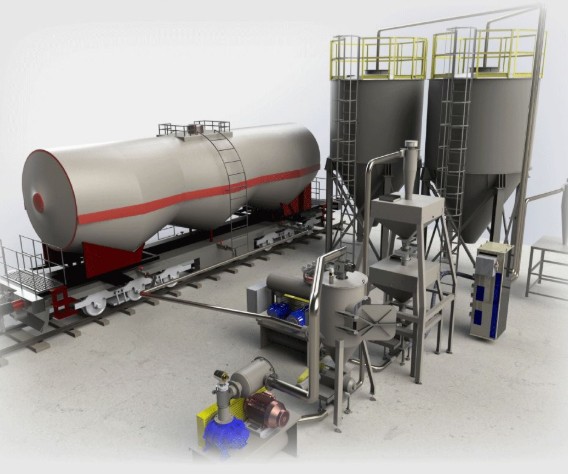
Advanced Blending Solutions publishes two primary railcar unloading architectures. In a direct-pull system, a vacuum pump draws material from the railcar directly to a receiver on the silo. In a pull/push system, material is pulled to a central filter receiver, discharged through a rotary airlock, and then pressure conveyed to one or more silos.[1][2] The best place to weigh depends on which path can be isolated cleanly without compromising transfer rate or routing.
Railcar to receiver on the destination silo
This path can be mechanically simple when one railcar position serves one destination or a small number of clearly selected destinations. The measurement may be integrated near the silo, provided every accepted draft is isolated from external piping loads and the required rate can be maintained.
- Useful where transfer is directly from the railcar to a silo receiver.
- Requires careful review of vessel support, venting, fill isolation, discharge, and silo-top access.
- Long routes, tall lifts, multiple silos, or frequent material changes can shift the design toward a central station.
Railcar to a central receiver, then pressure convey to storage
A central receiving and weighing station can create one controlled measurement boundary before material is routed to several silos. It also separates the vacuum pickup stage from the downstream pressure-convey stage.
- Useful when several destinations share one unloading station.
- Supports centralized filtration, controls, routing, and maintenance access.
- Requires airlock, pressure-pump, venting, routing, and capacity review as one coordinated system.

Inline batch weighing is not the only way to verify bulk resin
Each method establishes a different measurement boundary. The strongest receiving program may use more than one method, such as an external rail scale for commercial settlement and an inline totalizer for plant inventory, process diagnosis, and destination records.
| Measurement method | What it measures well | Important limitations | Best role |
|---|---|---|---|
Inline batch weigh vessel Primary article focus | Every completed draft passing through one controlled plant boundary, cumulative unload total, material and destination records, and cycle-by-cycle diagnostics. | Misses bypassed material and material outside the boundary. Accuracy depends on isolation, venting, clean discharge, calibration, software sequence, installation, and operating range. | Independent plant receiving total, inventory reconciliation, unload history, and integration with Advanced Blending Solutions conveying and controls. |
Rail scale or track scale | Gross, tare, and net mass of the complete railcar under the approved weighing procedure. | Requires suitable rail infrastructure, controlled car positioning, tare basis, regulatory approval when used commercially, and a way to separate material remaining in the car. | Commercial or custody-oriented weighing where the complete car can be weighed before and after unloading. |
Truck scale or certified off-site scale | Vehicle gross, tare, and net for truck-delivered bulk material. | Does not measure a railcar unload unless material is transferred through a truck workflow. Vehicle, driver, fuel, and tare controls matter. | Bulk truck receiving and independent commercial documentation. |
Silo load cells | Change in the supported silo system and ongoing inventory trends. | Structural attachments, wind, piping, ladders, catwalks, roof loads, thermal effects, multiple inlet/outlet flows, aeration, and material bridging can influence the result. | Inventory visibility when the silo can be properly supported and isolated and simultaneous additions or withdrawals are controlled. |
Paperwork and ERP reconciliation | Commercial documents, booked receipts, purchase orders, usage, and accounting history. | It is not an independent physical measurement. Timing differences, manual entries, wrong material codes, scrap, regrind, and unrecorded movements can create apparent variance. | Required business record that should be reconciled with one or more physical measurements. |
Build a preliminary railcar weighing and conveying path
This tool identifies a practical starting architecture. It does not select a final load-cell capacity, pump, line size, airlock, filter, silo, legal-for-trade configuration, or quotation. Final design requires the complete material, throughput, layout, structural, electrical, controls, and regulatory information.
What makes a railcar unload total trustworthy?
The displayed resolution is not the same as verified system accuracy. A strong receiving method controls the mechanical installation, pneumatic forces, weighing sequence, calibration, operating range, material flow, records, and reconciliation process.
Load cells need rigid support and live-part clearance. Piping, hoses, conduits, dust socks, ladders, and platforms must not carry changing external loads into the scale.
Venting and valve sequence must prevent vacuum, pressure, airflow, or filter differential from becoming an apparent weight. NIST specifically requires weighing systems to be vented so pressure does not affect accuracy or operation.[7]
The vessel must empty consistently. Pellet hang-up, stringers, dust, sticky material, a leaking gate, or product trapped on ledges can move the zero between drafts.
Very small drafts relative to capacity reduce effective resolution and increase the influence of noise. For non-grain commodities, Handbook 44 limits normal drafts below 20 percent of capacity except for a final partial draft in covered commercial systems.[7]
Use documented standards, procedures, uncertainty, frequency, security, and post-maintenance checks. NIST emphasizes that traceability belongs to a measurement result and requires a documented calibration chain.[10]
Every intended resin route must pass through the weigh boundary. Bypass lines, manual additions, drain-down, purge material, spills, and maintenance emptying need controlled records.
Compare the unload total with a defined ERP and silo time boundary. Production withdrawals during unloading can make a correct scale appear inconsistent with the silo or inventory change.
Use an escalation procedure that checks documents, calibration, heel, retained material, bypass, spills, data status, and repeatability before a commercial conclusion is reached.
A practical reconciliation sequence
- Verify the commercial basis. Determine whether the shipping quantity is based on a loading scale, rail scale, theoretical volume, standard tare, actual tare, temperature or moisture adjustment, or another contractual method.
- Check the receiving record. Confirm the correct railcar, material, lot, destination, start and end time, accepted draft count, partial final draft, alarms, manual overrides, and any interrupted cycles.
- Inspect the measurement boundary. Look for bypasses, leaks, spills, filter cleanout, resin trapped in hoses or equipment, and material sent to another destination.
- Confirm the railcar condition. Review compartment valves, pickup probes, car slope, unloading method, and whether a heel remains in pockets or around outlets.
- Review calibration and zero behavior. Check recent verification, zero shifts, material buildup, piping contact, pressure effects, and changes made since the last approved test.
- Escalate with evidence. Preserve the raw batch record and supporting documents. A consistent, unexplained difference can then be handled through the plant’s procurement and supplier process.
The weighing system must work with the conveying system around it
The scale is one component in a bulk material transfer system. Advanced Blending Solutions direct-pull systems use vacuum pumps, receivers, and air filtration, while pull/push systems add a central filter receiver, rotary airlock, pressure conveying, and optional SMART material distribution.[1][2]


Advanced Blending Solutions publishes pressure-based VFD control that adjusts vacuum-pump speed to a programmed conveying velocity. This can reduce excessive pellet impact, angel hair, and energy use when correctly applied.[3]
Filtration protects the pump and plant. Differential-pressure monitoring can alarm and control cleaning cycles. Filter condition also matters because pressure and airflow can disturb both transfer capacity and a poorly isolated weighing vessel.[4]
In multi-silo systems, SMART can verify that material connections match the recipe and reduce the possibility of operator routing error.[2]
Advanced Blending Solutions supplies welded and bolted silos configured with level devices, inlets, take-off boxes, gates, airlocks, and vacuum or pressure conveying interfaces.[5]
An inline totalizer does not fix an undersized pump, excessive equivalent distance, plugging, line leaks, bad pickup design, high conveying velocity, poor filtration, dust escape, or an incorrect destination.
OSHA notes that fine combustible dust dispersed in air can create flash-fire, deflagration, and explosion hazards under the right conditions. Resin fines, dust collection, housekeeping, ignition control, venting, and equipment classification need a qualified site review.[11]
Use the Resin Conveying and Vacuum Pump Sizing Calculator for a preliminary airflow, vacuum, equivalent-distance, and pump-range screen. The final railcar system must also consider unloading rate, duty cycle, railcar compartments, pickup arrangement, pipe diameter and material, bends, vertical lift, flex hose, filter loading, material form, destination capacity, and simultaneous plant demand.
Estimate the value represented by a receiving variance
The previous version of this article treated a one-percent difference as money automatically lost to a short shipment. That is too strong. This calculator estimates the financial exposure represented by a difference, then subtracts a user-entered reconciliation allowance. It does not assign fault or guarantee that a weighing project will recover the amount.
Calculation: gross difference mass equals expected load multiplied by observed variance. Difference beyond allowance uses only the percentage points above the entered allowance. The annual value multiplies that mass by material cost and comparable annual loads. The calculation excludes scale uncertainty, contractual tolerances, railcar heel, retained material, production withdrawals, scrap, regrind, installation cost, maintenance, downtime, financing, and benefits from inventory or routing improvements. Use the Resin Handling ROI Calculator for a broader business case.
Information needed to size the unloading, weighing, and control system
The old article said that five inputs were enough. Those inputs are useful, but they are not enough to design a reliable railcar unload and receiving-weight system. The following information reduces rework and helps Advanced Blending Solutions evaluate the complete path.
- Purpose of the weight recordInternal inventory, receiving verification, unload completion, operational diagnosis, supplier discussion, or regulated commercial settlement.
- Shipping and accounting basisBill of lading, invoice, rail-scale ticket, standard or actual tare, purchase order, ERP receipt method, and contractual tolerance or claims procedure.
- Material profileResin family, grade, pellet or powder form, bulk density, particle size, temperature, moisture sensitivity, fines, additives, regrind, flow behavior, and combustible-dust data.
- Railcar and unloading methodCar type, compartment count, outlet arrangement, vacuum or pressure pickup, probe and hose details, slope, switching limitations, unloading schedule, and typical heel.
- Throughput and duty cycleTarget and maximum lb/h or kg/h, total load, number of cars, desired unload time, simultaneous plant demand, breaks, and expected batch cycle.
- Conveying routeHard-pipe and flex-hose distance, vertical lift, line inside diameter, bends, diverters, pipe material, available straight sections, and each destination route.
- Existing equipmentPumps, blowers, receivers, filters, airlocks, valves, silos, level sensors, load cells, rail scale, controls, electrical service, compressed air, and available capacity.
- Weigh-vessel installationIndoor or outdoor location, structure, wind, vibration, access, clearances, venting, flexible connections, cleanout, maintenance lifting, drainage, and calibration access.
- Routing and identificationNumber of silos, materials, connection method, recipe verification, barcode or lot requirements, wrong-material prevention, purge and changeover procedure.
- Data and integrationBatch detail, cumulative total, material and lot IDs, alarms, user permissions, audit trail, printer or report, PLC, SCADA, historian, ERP, and communication protocols.
- Metrology and regulatory needsResolution, accuracy objective, test method, calibration standards, uncertainty, NTEP or legal-for-trade requirement, state authority, service agent, and inspection process.
- Site and project scopeLayout drawings, photos, rail clearances, foundations, structural responsibility, installation scope, controls responsibility, startup plan, timing, budget, and future expansion.
Common railcar resin weighing mistakes
Assuming every difference is a supplier short shipment
A difference is a trigger for reconciliation, not a conclusion. Check the commercial shipping basis, receiving scale, railcar heel, retained resin, spills, bypasses, filter cleanout, inventory timing, and data status before assigning cause.
Calling an internal process scale legal for trade
An internal totalizer can be extremely useful without being a commercial scale. If the result will determine price, payment, or a legally enforceable quantity, involve the state weights-and-measures authority and qualified scale provider early. NTEP certification alone is not final field approval.
Mounting load cells under a vessel that is still tied to rigid piping
A scale cannot distinguish resin weight from changing pipe force. Review every inlet, outlet, vent, conduit, hose, dust connection, platform, ladder, and maintenance attachment across the full motion and temperature range.
Ignoring vacuum, pressure, and airflow during weighing
Pneumatic forces can become apparent weight. The sequence must isolate filling and discharge, provide effective venting, confirm stable conditions, and reject cycles that do not meet the approved state.
Sizing the hopper only from total railcar weight
The vessel is sized around batch rate, cycle time, useful draft size, bulk density, headroom, valve timing, discharge behavior, physical space, load-cell capacity, and the required measurement performance. A larger vessel is not automatically more accurate.
Expecting a weight total to prove the car is empty
The total says how much crossed the measurement boundary. It does not directly see material in each railcar compartment, pocket, hose, filter, receiver, or pipe. Use an unload-completion procedure that addresses the actual car and pickup arrangement.
Comparing the scale with a changing silo level or ERP balance
If production is withdrawing resin while the unload is occurring, the silo change will not equal the receiving total. Define synchronized start and end times and account for every concurrent inlet and outlet.
Using MobiHopper images as proof of a standard load-cell product
MobiHoppers are published as flexible mobile storage. A project may potentially integrate weighing around storage equipment, but the load cells, structure, controls, capacity, accuracy, and approval must be engineered and quoted for the application.
Choosing the pump independently from the weighing cycle
Transfer rate, vacuum or pressure level, fill time, settling time, discharge time, airlock capacity, filter cleaning, route length, and plant demand interact. The full conveying and weighing cycle must meet the unloading target without compromising measurement integrity.
Promising payback from one assumed one-percent error
The financial case should use measured plant variance, the portion that can actually be reduced or recovered, equipment and installation cost, maintenance, operating impact, inventory value, and the plant’s claim process. A generic percentage is an exposure scenario, not guaranteed savings.
Related Gauge Advisor resin handling resources
Railcar resin weighing FAQs
How does a railcar resin weighing system work?
An inline system weighs resin in successive batches. The vessel establishes a no-load reference, fills, isolates and records a loaded value, calculates the net draft, discharges, and adds the accepted draft to a cumulative unload total.
Does the weighing hopper sit on top of the silo?
It can in some direct-pull layouts, but that is not universal. A pull/push system may use a central receiving and weighing station before pressure conveying to one or more silos. Structure, access, rate, routing, isolation, venting, and maintenance determine the location.
Can the system tell me exactly how much resin remains in the railcar?
No. It measures how much crossed the selected boundary. Remaining material is inferred through the total and an unload-completion procedure. Product may remain in railcar pockets, hoses, filters, receivers, or piping.
Can an inline resin scale be used to challenge a supplier invoice?
It can provide supporting evidence, but the commercial use, contract, shipping basis, scale approval, calibration, uncertainty, jurisdiction, and claims procedure matter. Involve the state weights-and-measures authority and procurement or legal team before treating an internal result as the controlling quantity.
What is the difference between NTEP certified and legal for trade?
NTEP certification indicates that a device type has successfully demonstrated capability to meet applicable requirements. NCWM states that an installed scale is not legal for trade until the regulatory authority approves it for the specific use, including suitability, installation, and accuracy.
Is a load cell under a silo enough for accurate receiving weight?
Not automatically. Silo load cells can support inventory and unload-change measurement, but structural attachments, wind, piping, catwalks, ladders, thermal movement, bridging, and simultaneous withdrawals can affect the result. An inline batch vessel creates a different, more discrete boundary.
Why not just weigh one very large batch?
A large vessel may reduce cycle count but increases structure, headroom, load-cell capacity, and discharge requirements. Measurement performance depends on the relationship between draft size and capacity, stable isolation, cycle time, material flow, and the permitted loading range.
Can the system prevent resin from going to the wrong silo?
The scale alone cannot. Destination valves, material identification, recipe control, permissives, and routing verification are required. Advanced Blending Solutions SMART systems are designed to verify that material connections match the recipe in multi-destination systems.
What causes a false railcar weight discrepancy?
Common causes include incorrect shipping basis, standard-versus-actual tare, scale zero shift, piping force, pressure or vacuum, material hang-up, railcar heel, resin retained in filters or lines, bypass, spills, concurrent silo withdrawals, wrong inventory timing, and data-entry errors.
Does the weigh system also detect contamination or moisture?
No. Weight verifies quantity at the measurement boundary. Resin identity, contamination, moisture, color, pellet damage, fines, metal, and material quality require separate controls or inspection.
What information is needed for a preliminary Advanced Blending Solutions quotation?
Send the intended use of the weight record, material and bulk density, railcar and outlet details, throughput and unload target, complete route and elevation, line size, number of silos, existing pumps and filters, site layout, controls and reporting requirements, metrology expectations, and installation scope.
References and source notes
The references are collapsible to keep this focused commercial article easy to scan. They open automatically when printing.
Open technical references and source notes11 sources
Gauge Advisor is the authorized Advanced Blending Solutions sales and applications support partner. Advanced Blending Solutions sources are used for current direct-pull, pull/push, velocity-control, filtration, storage, and pump architecture. NIST, NCWM, and OSHA sources provide independent weighing, commercial-device, traceability, installation, and combustible-dust context. No competitive material-handling equipment manufacturer is cited.
- Advanced Blending Solutions, Direct Pull System. Official description of railcar-to-silo vacuum conveying, pump packages, vacuum receivers, air filtration, and optional pickup-velocity control.
- Advanced Blending Solutions, Pull / Push System. Official description of central filter receivers, rotary airlocks, pumps, pressure conveying, and SMART material distribution.
- Advanced Blending Solutions, Velocity Control and Variable Frequency Drives. Manufacturer information on pressure-based pump-speed control and programmed conveying velocity.
- Advanced Blending Solutions, Air Filtration. Dust-collection and bin-vent equipment, differential-pressure monitoring, cleaning control, and published combustible-material options.
- Advanced Blending Solutions, Welded and Bolted Silos. Resin storage, level and discharge accessories, vacuum and pressure conveying, and railcar-unload integration.
- Advanced Blending Solutions, Tranquility Vacuum Pumps. Current bulk-solids vacuum-pump package architecture and standard component information.
- NIST Handbook 44, 2026, Section 2.22 Automatic Bulk Weighing Systems. Design, sequence, recording, venting, testing, tolerances, installation, environmental protection, loading, and user requirements for covered systems.
- National Council on Weights and Measures, NTEP Frequently Asked Questions. Certificate of Conformance meaning and state requirements for commercial installations.
- NCWM, Buying Commercial Scales Online. Explanation that NTEP certification does not itself make an installed scale legal for trade and that regulatory approval also considers suitability, installation, and accuracy.
- NIST, Metrological Traceability: Frequently Asked Questions and NIST Policy. Definition of traceability through a documented calibration chain and the distinction between traceability and fitness for purpose.
- OSHA Technical Manual, Section IV, Chapter 5. Combustible-dust hazard fundamentals, including flash fire, deflagration, explosion, particle-size, dispersion, confinement, and secondary-dust-event context.
Define the measurement boundary before selecting the railcar system
Gauge Advisor is the authorized Advanced Blending Solutions sales and applications support partner. I help plastics processors evaluate, select, quote, integrate, and support railcar unloading, resin weighing, vacuum and pressure conveying, pumps, receivers, rotary airlocks, filtration, silos, routing, and plant controls.
Gauge Advisor supports equipment selection and integration for the manufacturers represented here; independent process consulting is not offered. Send the material, railcar, unloading rate, conveying route, storage destinations, measurement purpose, current equipment, layout, and reporting requirements. I will respond within one business day, often within a few hours.
- Direct-pull or pull/push architecture review
- Inline batch weighing and receiving records
- Vacuum pump, pressure convey, and airlock review
- Filtration, velocity control, and angel-hair reduction
- Silo routing, SMART controls, and data integration
- Quotation and Advanced Blending Solutions coordination