Updated August 21, 2026
A central resin conveying pump can run for long periods, sit near operators and maintenance staff, and become one of the dominant continuous noise sources in a plastics plant. Advanced Blending Solutions developed the Tranquility Vacuum Pump as an enclosed, VFD-driven pump package that reduces noise at the source while supporting reliable pellet, regrind, and bulk-solids conveying. The EHS case is strong, but the decision should be based on measured worker exposure, the real operating state of the pump, and the performance of the complete conveying system.
Connected process path: A quieter pump package delivers the most value when conveying routes, filtration, controls, bulk unloading, and service access are reviewed as one system.
Related next steps: central resin conveying systems, resin dust collection and air filtration, resin-handling controls and automation, resin-handling service and retrofits, and railcar unloading systems.

85 dBA is an action level, not a magic safe-or-unsafe line
Noise-induced hearing loss depends on how loud the sound is, how long exposure lasts, how often it is repeated, and individual susceptibility. A brief source reading and a full-shift employee dose answer different questions.
General-industry employers must administer a hearing conservation program when employee exposure equals or exceeds 85 dBA as an 8-hour time-weighted average. Monitoring, training, audiometry, protectors, and records may apply.[7]
OSHA uses 90 dBA as an 8-hour TWA PEL with a 5 dB exchange rate. Feasible engineering or administrative controls are required when exposures exceed the limits in Table G-16.[8]
NIOSH recommends 85 dBA over 8 hours and halves recommended exposure duration for every 3 dB increase. This is more protective than the OSHA PEL and is useful for prevention-focused EHS programs.[10]
How to read this: These are NIOSH recommended durations for one steady occupational exposure. They are not a substitute for full-shift dosimetry, do not account for other sources, and do not mean that hearing damage automatically occurs at a specific minute. Most occupational hearing loss develops from accumulated repeated exposure.[11]
85 dBA for 8 hours reaches the NIOSH daily REL
At 85 dBA, a continuous 8-hour exposure reaches 100 percent of the NIOSH recommended daily dose. OSHA also uses 85 dBA as the 8-hour action level for its hearing conservation program, although OSHA calculates dose with different criteria.
Do not call 85 dBA universally safe. It is the point where prevention, monitoring, and exposure management deserve formal attention.
Confirm whether the reading is a momentary sound level, an area average, or a personal 8-hour TWA.
A quieter pump can reduce one source, but the worker dose still includes extruders, grinders, air leaks, relief events, and other equipment.
Important nuance: 85 dBA is a prevention and exposure-management criterion, not a point where injury begins instantly. Repeated or intense noise can damage and eventually destroy the inner ear’s sensory hair cells. In humans those cells do not grow back, so prevention is much more effective than trying to recover hearing later.[16]
Estimate NIOSH noise dose for one steady exposure
Use the measured A-weighted level and the time a worker spends in that sound field. This calculator uses the NIOSH 85 dBA criterion and 3 dB exchange rate. It is an educational screen, not a legal compliance determination or substitute for a calibrated dosimeter.
Excluded: changing sound levels, multiple sources, impulse noise, shift length adjustments, hearing-protector attenuation, room reflections, frequency spectrum, measurement uncertainty, and exposure outside work. For formal EHS decisions, use a qualified noise survey and personal dosimetry.
Why a quieter pump belongs in the EHS hierarchy of controls
NIOSH ranks elimination and substitution above engineering controls, then administrative controls and personal protective equipment. Selecting quieter equipment instead of a louder pump package is a substitution decision. The Tranquility enclosure, silencing, variable-speed operation, isolation, and mechanical package are engineering controls built into that replacement. A well-scoped project can therefore use both higher-priority levels instead of relying only on employee behavior or hearing protection.[12][13]
Remove an unnecessary noise source or process step when practical.
Choose a quieter pump package instead of continuing with a louder source.
Enclose, silence, vary speed, isolate, maintain, and control the source and sound path.
Limit time, rotate tasks, schedule noisy work, and create quiet break areas.
Use properly selected and fitted protection when exposure remains hazardous.
Find which component and operating state creates the dominant sound before specifying the correction.
Industrial rooms are often reverberant, so sound may not fall by the ideal free-field rate as distance increases.[9]
The employee dose is the controlling EHS result, not the catalog value of one machine.
What kind of vacuum-system noise are you hearing?
Select the closest symptom. The first check is different for a continuous blower tone, a relief-valve event, a vibrating base, or pellets striking pipe at excessive speed.
Continuous blower and motor noise: a strong Tranquility use case
A fixed-speed, open-frame pump package that runs for long periods near occupied work areas is the clearest application for a source-control upgrade. The evaluation should still prove that the pump is correctly sized and mechanically healthy.
Record sound at worker locations, pump speed, vacuum, route, filter condition, duty cycle, belt condition, bearing condition, and whether the pump is loaded or idle.
Use the integrated enclosure, blower package, VFD, motor, silencing, and service design to reduce the source while maintaining conveying duty.
One quieter pump will not necessarily move the total plant below 85 dBA if several similar sources or other machines remain.
What the Tranquility Vacuum Pump changes at the source
Tranquility is not only a blower placed inside sheet metal. ABS packages the drive, vacuum controls, service access, safety-oriented features, and velocity-control hardware as one resin-conveying platform.[1][2]
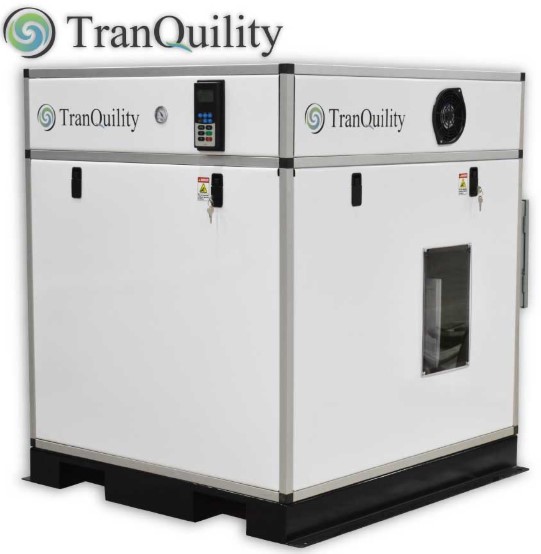
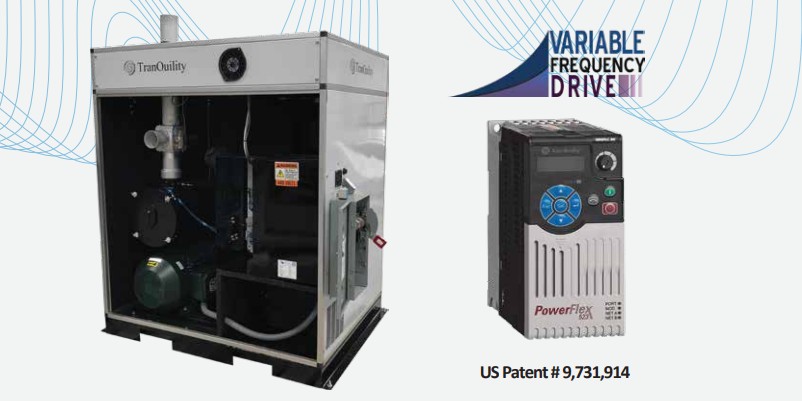
Final selection depends on airflow, vacuum, equivalent distance, line size, material, and simultaneous demand.
The blower package is designed for reliable bulk-solids and resin conveying duty.
ABS uses the VFD to control material pickup velocity and reduce angel hair and material degradation.
Published order options support integration into new or existing conveying architectures.
A specially designed cabinet and silencing approach address blower and airflow noise at the source instead of relying only on hearing protection.
Variable speed allows the system to avoid running every route and resin at full pump speed, which can reduce unnecessary noise, material impact, and energy use.
The enclosed motor package is selected for industrial service and integrated with the pump controls and cooling design.
Positive power transmission and practical belt-tensioning access support maintenance and stable operation.
A liquid-filled vacuum gauge, mechanical relief valve, and integrated vacuum breaker make system condition visible and protect operation.
Exterior access panels and a drain extension with a lockable ball valve are designed to simplify routine service.
Fork pockets support planned relocation and installation handling without treating the blower, motor, and controls as separate loose components.
This is a design feature, not a blanket declaration of facility compliance. Electrical risk assessment, labeling, boundaries, PPE, LOTO, and site procedures still apply.[17]
Avoid a blanket comparison that assigns every open pump a value above 100 dBA and every Tranquility installation a value below 85 dBA. Either condition may occur, but neither automatically applies to every pump size or facility. A technically defensible comparison records the model, operating point, route, filter state, relief state, distance, room, instrument, and employee exposure.
Use the Tranquility upgrade to review the complete ABS conveying architecture
A quieter pump should still move the right material, at the right velocity, through the right filter and receiver, to the right machine. Noise reduction is strongest when the pump is not being forced to compensate for restrictions, leaks, dirty filters, bad routing, or an oversized line.
The material and air streams share equipment but follow different paths. The vacuum receiver separates resin from the conveying air. Filtration protects the pump. The VFD and controls coordinate pressure, velocity, routing, receiver demand, and operating state.
Receiver size, filter design, discharge valve, demand sequence, and air leaks affect how long the pump runs and how deeply it must pull.
Clean, low-restriction filtration protects the blower. Rising differential pressure can increase vacuum demand, relief events, maintenance, and system noise.
The VFD should maintain enough velocity to move resin without needlessly accelerating pellets into elbows and pipe walls.
Recipe-verified routing can reduce dedicated piping and help prevent the wrong material from reaching the wrong machine.
Allen-Bradley or Beckhoff platforms can coordinate pump queues, valve states, vacuum, filter condition, receiver demand, and system history.
The same system review can connect Tranquility to gravimetric blenders, desiccant dryers, bins, silos, railcar transfer, and plant-wide material logistics.
Use the Resin Handling Equipment Selector when the project extends beyond the pump. Use the Vacuum Pump Sizing Calculator to screen line diameter, hard pipe, flex hose, vertical lift, bends, material form, airflow, and vacuum before requesting final ABS selection.
| Project context | Tranquility role | Adjacent ABS equipment to review | First information to collect |
|---|---|---|---|
Single noisy local pump Focused retrofit | Replace an open or aging fixed-speed package with an enclosed VFD-driven pump selected for the existing route. | Receiver, filter, breaker valve, controls, and any worn or leaking line components. | Pump model, HP, blower curve, vacuum, airflow, line size, route, material, duty cycle, sound survey, and electrical service. |
Central multi-machine conveying System upgrade | Serve a coordinated demand queue with VFD velocity control and lower source noise. | Vacuum sequence controls, receivers, SMART routing, manifolds, filtration, and trending. | All sources and destinations, simultaneous demand, longest and shortest routes, materials, changeovers, receiver sizes, and current bottlenecks. |
Railcar direct-pull transfer Bulk transfer | Provide vacuum for the route from railcar pickup to a silo-top receiver when the duty and size range fit. | Direct-pull receiver, air filtration, silo venting, railcar controls, weighing, and routing. | Unload rate, distance, lift, line size, compartments, material, silo height, receiver and filter, sound-sensitive areas, and schedule. |
Pull-and-push or complex bulk routing Engineered architecture | Support the vacuum side of a central station while pressure conveying sends material to selected silos. | Filter receiver, rotary airlock, pressure pump, SMART distribution, valves, controls, and optional weighing. | Full flow diagram, rates, silos, routing logic, airlock capacity, vacuum and pressure sides, filters, dust data, and future expansion. |
How to verify the EHS and conveying result
Do not commission the project with only a statement that the new pump “sounds quieter.” Use the same worker locations, operating conditions, routes, and measurement methods before and after the change.
Identify operators, maintenance technicians, material handlers, quality staff, and pass-through workers. Record where they stand and how long they remain in each area.
Use calibrated sound-level measurements for source mapping and personal dosimetry when workers move or sound varies significantly.
Capture idle, normal convey, longest route, shortest route, clean filter, loaded filter, vacuum breaker, relief event, and maintenance conditions.
Record throughput, cycle time, vacuum, pump speed, filter differential, material damage, plugs, receiver fill, and energy data when available.
Use the same instrument settings, positions, routes, production state, and shift conditions to make the comparison meaningful.
Confirm whether other pumps, grinders, compressed-air leaks, extruders, chillers, pellet impact, or room reflections now dominate the exposure.
A quieter pump does not automatically end hearing conservation, audiometry, training, monitoring, or hearing-protector obligations.
Inspect belts, bearings, enclosure panels, seals, silencers, cooling fans, filters, relief settings, and vibration before gradual deterioration becomes normal.
Direct measurements, calculations, and claims should stay separate
Sound level at a defined point, personal noise dose, pump speed, vacuum, filter differential, conveying time, throughput, and material condition.
8-hour TWA, NIOSH dose, equivalent distance, airflow target, annual energy, and expected material-velocity relationships.
Employee compliance, elimination of hearing risk, universal decibel reduction, guaranteed energy savings, zero angel hair, or a fixed return on investment.
Common Tranquility and plant-noise project mistakes
Treating a pump reading below 85 dBA as proof of employee compliance
The employee dose includes duration, other sources, movement, impulse events, and shift length. Measure the worker exposure. Do not substitute one catalog or demonstration value for a hearing-conservation assessment.
Comparing sound levels taken at different distances or operating states
Distance, walls, reflections, pump load, VFD speed, filter condition, route, and relief-valve state can change the reading. Define the test positions and operating matrix before comparing equipment.
Ignoring several equal noise sources
Decibels do not add arithmetically. Two equal independent sound sources increase the combined level by about 3 dB. Replacing one of several pumps may reduce the local source but leave the room dominated by the remaining equipment.
Replacing a pump before diagnosing relief events, restrictions, or wear
A dirty filter, blocked route, undersized pipe, air leak, worn bearing, loose panel, poor belt alignment, bad isolation, or frequent relief event may be the immediate cause. Correct maintenance and system faults before final sizing.
Oversizing the pump to guarantee capacity
More pump can create excessive pickup velocity, pellet impact, pipe wear, fines, angel hair, unnecessary energy use, and added noise. Size from the complete route, material, simultaneous demand, and control range.
Using the VFD only as an energy device
The VFD is also a material-velocity and system-control tool. Running too fast can damage resin. Running too slowly can cause unstable pickup or plugs. Each route and resin needs an operating window.
Calling an arc-flash-friendly design arc-flash compliant
Equipment layout can improve serviceability, but facility compliance depends on the electrical design, incident-energy analysis, labels, boundaries, disconnects, PPE, maintenance condition, training, and safe work practices.[17]
Failing to repeat the noise survey after a process or equipment change
OSHA requires monitoring to be repeated when process, production, equipment, or controls may increase exposures or make hearing protection inadequate. A major pump or conveying change is a good reason to confirm the new exposure map.
Information needed to size the pump and evaluate the EHS case
- Existing pump packageManufacturer, model, blower, HP, motor, voltage, controls, VFD status, age, maintenance history, and current condition.
- Noise baselineSound-level map, personal dosimetry if available, measurement distance, instrument, work locations, exposure time, and operating state.
- Material detailsResin, bulk density, pellet or regrind form, temperature, moisture, fines, dust, filler, flake, and angel-hair sensitivity.
- Conveying layoutHard-pipe length, flex-hose length, vertical lift, line inside diameter, number and radius of bends, and pickup design.
- Demand and throughputRequired lb/h or kg/h, receiver sizes, cycle time, number of destinations, simultaneous demand, longest and shortest routes.
- Vacuum and restrictionNormal vacuum, peak vacuum, relief setting, breaker operation, filter differential, air leaks, plugging history, and receiver condition.
- Control requirementsAllen-Bradley, Beckhoff, existing PLC, pump queue, recipe control, speed setpoints, alarms, trending, and plant communication.
- Adjacent ABS scopeReceivers, filters, SMART routing, valves, storage, blenders, dryers, railcar unloading, weighing, and future expansion.
- Installation constraintsFootprint, service clearance, forklift access, floor loading, exhaust, ambient temperature, electrical service, and sound-sensitive areas.
- Acceptance criteriaTarget worker exposure, source sound level, throughput, plug rate, material damage, energy, maintenance access, and required documentation.
Related Gauge Advisor resin-handling resources
Tranquility Vacuum Pump and occupational-noise FAQs
Is a vacuum pump below 85 dBA automatically safe?
No. OSHA and NIOSH limits apply to employee exposure over time, not only one source reading. Other equipment, worker movement, shift length, impulse events, room reflections, and measurement method can push the full dose higher.
Does OSHA require hearing protection at 85 dBA?
OSHA’s general-industry standard uses 85 dBA as the 8-hour TWA action level for a hearing conservation program. Hearing protectors must be made available to covered employees, and required use depends on exposure, baseline-audiogram status, standard threshold shifts, the PEL, and the specific standard requirements.
How long does NIOSH recommend at 100 dBA?
For one steady occupational exposure, the NIOSH 3 dB exchange rate reaches a full recommended daily dose in 15 minutes at 100 dBA. That does not mean every 15-minute exposure causes immediate hearing loss. It means the recommended daily dose has been reached.
Will Tranquility eliminate the need for a hearing conservation program?
Not automatically. It can reduce an important source through engineering design, but the employer should repeat the exposure assessment after installation and retain every control still required by the complete noise dose.
What pump sizes are available?
Current ABS literature lists 5, 7.5, 10, 15, and 25 HP Tranquility configurations. Horsepower is not selected from throughput alone. The full route, airflow, vacuum, material, line size, receiver demand, and control range must be reviewed.
Can Tranquility replace an existing pump?
Many applications can be reviewed as retrofits. Confirm footprint, piping, airflow and vacuum duty, electrical service, controls, exhaust, filtration, receiver sequence, service access, and whether the current system has restrictions or leaks that should be corrected at the same time.
How does the VFD help EHS and material quality?
The VFD allows pump speed to match the route and material rather than running at one fixed maximum speed. That can reduce unnecessary blower and airflow noise, excessive pellet impact, angel hair, fines, pipe wear, and energy use. It must still maintain enough conveying velocity to prevent plugs.
What if the loudest event is the vacuum relief valve?
Investigate why relief is opening. A dirty filter, blocked line, bad pickup, undersized pipe, closed valve, excessive pump demand, or incorrect setting may be creating the event. A quieter enclosure does not replace correction of an abnormal system restriction.
What other ABS equipment should be reviewed with the pump?
Common adjacent equipment includes vacuum receivers, air filtration, breaker valves, sequence controls, SMART material distribution, storage, railcar unload, gravimetric blenders, desiccant dryers, and trending. The right scope depends on where the material starts and ends.
What should I send for a Tranquility application review?
Send the existing pump data, sound survey, resin, throughput, line diameter, hard and flex distances, vertical lift, bends, receivers, filters, vacuum, destination count, controls, electrical service, installation photos, and desired EHS and conveying result.
References and source notes
The references remain collapsible so this focused commercial article stays readable. They open automatically when printed.
Open technical references and source notes17 sources
Gauge Advisor is the authorized Advanced Blending Solutions sales and applications support partner. ABS sources are used for current Tranquility construction, available sizes, VFD function, material-conveying architecture, controls, filtration, and SMART routing. OSHA, NIOSH, and NIDCD sources provide independent occupational-noise, hearing-health, measurement, exposure-limit, hierarchy-of-controls, and electrical-work-practice context. No competing resin-handling equipment manufacturer is cited.
- Advanced Blending Solutions, Tranquility Vacuum Pumps. Current standard package features including motor, blower, belt drive, gauge, drain, relief valve, breaker valve, enclosure, access panels, arc-flash-friendly design, internal cooling fan, and VFD.
- Advanced Blending Solutions, Tranquility Vacuum Pumps literature. Published motor sizes, control options, voltage options, fork pockets, product construction, and VFD material-velocity purpose.
- Advanced Blending Solutions, Tranquility launch article. Manufacturer background on controlling noise at the source, enclosure and silencer design, and VFD control of pickup velocity. The older percentage-decibel statements are not used as universal performance claims in this article.
- Advanced Blending Solutions, Velocity Control. VFD control of pump speed based on inlet pressure so material can be conveyed at a programmed velocity.
- Advanced Blending Solutions, Air Filtration. Filter design, airflow restriction, differential-pressure monitoring, cleaning, access, and pump protection.
- Advanced Blending Solutions, SMART Material Distribution, plus Simplicity Controls. Material-connection verification, reduced common piping, scalable Allen-Bradley and Beckhoff controls, and integration context.
- OSHA, 29 CFR 1910.95 Occupational Noise Exposure. Hearing conservation action level, monitoring, personal sampling, calibration, notification, audiometry, training, and hearing-protector requirements.
- OSHA, Occupational Noise Exposure Overview. 85 dBA hearing-conservation action level and engineering or administrative control context above the 90 dBA 8-hour TWA PEL.
- OSHA Technical Manual, Section III, Chapter 5. Sound pressure, distance, free-field and reverberant-field behavior, source measurement, sound power, and industrial-noise evaluation.
- NIOSH, Noise-Induced Hearing Loss. NIOSH 85 dBA 8-hour REL, exposure factors, prevention, and the 3 dB exchange relationship.
- NIOSH, Understanding Noise Exposure Limits. Daily dose durations from 85 to 100 dBA and explanation of accumulated occupational hearing risk.
- NIOSH, Hierarchy of Controls. Preferred order of elimination, substitution, engineering controls, administrative controls, and PPE.
- NIOSH, Implement Engineering Controls. Modifying equipment and the physical environment to reduce noise at the worker’s ear.
- NIOSH Sound Level Meter App. Preliminary workplace-noise screening tool for compatible iOS devices and source-measurement context.
- Advanced Blending Solutions, 5 HP Tranquility Pump Sound Measurement. Manufacturer demonstration of one 5 HP pump and test setup. It should not be treated as a universal sound rating for every size, operating point, distance, or installation.
- National Institute on Deafness and Other Communication Disorders, Noise-Induced Hearing Loss. Inner-ear sensory hair-cell damage, gradual hearing effects, tinnitus, and the fact that human cochlear hair cells do not grow back.
- OSHA, 29 CFR 1910.333 Selection and Use of Work Practices. Deenergization, lockout and tagging, verification, qualified-person, and energized-work requirements that remain separate from an equipment manufacturer’s arc-flash-friendly design description.
Review the noise source and the complete conveying duty
Gauge Advisor is the authorized Advanced Blending Solutions sales and applications support partner. I help plastics processors evaluate, select, quote, integrate, and support Tranquility Vacuum Pumps, velocity control, vacuum receivers, air filtration, SMART material distribution, controls, railcar unloading, storage, blenders, and dryers.
Gauge Advisor supports equipment selection and integration for the manufacturers represented here; independent process consulting is not offered. For formal employee exposure and compliance decisions, use qualified EHS or industrial-hygiene resources. Send the pump data, conveying layout, material, throughput, vacuum, controls, sound measurements, and installation photos when available. I will respond within one business day, often within a few hours.
- Tranquility pump and VFD application screening
- Noise-source and operating-state review
- Vacuum, airflow, line, receiver, and filter sizing
- Central conveying and SMART routing architecture
- Quotation and ABS factory coordination
- Onsite Western U.S. sales and applications support