Updated August 21, 2026
A melt pump can be a powerful upgrade on a PVC extrusion line, but PVC is not a polymer where I would recommend adding pressure equipment first and asking questions later. The compound must be properly fused, thermally stable, and consistently delivered to the pump. The die, sizing, cooling, and haul-off sections still need enough capacity to use the steadier melt flow. When those pieces are in place, a PVC-specific gear pump can separate plasticizing from pressure generation, stabilize flow to the die, and create a more controllable operating window.
Connected process path: For PVC, stable formulation and feed must be carried through controlled fusion, filtration, melt pumping, and final profile or wall control.
For the broader line architecture, including dimensional measurement, resin handling, cooling, and downstream control, review pipe and profile extrusion systems.
Related next steps: extrusion pressure stability, throughput-control weigh hoppers, continuous gravimetric blenders, central resin conveying systems, and pipe, tubing, and profile melt delivery.
Before evaluating a melt pump, verify four process conditions
Rigid PVC has a narrow operating window because the material must fuse sufficiently without accumulating excessive temperature, shear, or residence time. The pump project should begin with the process state, not only the target throughput.
The extruder must deliver a homogeneous, properly fused melt. A gear pump meters what it receives; it does not complete a poorly fused compound or repair inconsistent dry-blend preparation.
Trend actual melt temperature, color, odor, deposits, residence time, and startup or shutdown behavior. PVC degradation can accelerate once dehydrochlorination begins.[6]
Separate feeding, fusion, filtration, pump-inlet, die, sizing, cooling, and haul-off effects. A stable die pressure will not correct a wandering vacuum tank or puller.
Higher usable melt delivery is valuable only when the die, calibrator, vacuum, cooling, haul-off, cut-off, and handling systems can maintain quality at the new rate.
Rigid PVC rheology is strongly influenced by fusion, temperature, filler, and lubrication. Technical work on PVC pipe extrusion emphasizes the need to avoid both under-fusion and over-processing, rather than treating a higher melt temperature as a universal fix.[5] ASTM D2152 is also intentionally limited: it can distinguish inadequate from adequate fusion in a small specimen, but it does not identify thermal degradation or replace the broader product-quality tests.[8]
Where a PVC melt pump fits, and what each stage must do
Click a stage to see its job, the data I would trend, and the failure mode that can be mistaken for a pump problem.
1. Compound and feeding: stabilize what enters the screw
Dry-blend consistency, pellet or powder flow, filler level, regrind, lubricant balance, bulk density, and feed interruptions can change extruder load and melt behavior before the pump ever sees the material.
- Trend feed rate, batch or lot, formulation, regrind percentage, and motor load.
- Check bridging, segregation, inconsistent hot/cool mix preparation, and additive feeding.
- Do not use a melt pump to hide an unstable or incorrectly prepared compound.
What the line is doing matters more than the word “unstable”
Select the closest symptom. The result separates likely causes, first checks, and where a melt pump may or may not fit.
Die pressure and wall thickness pulsate together
A repeating pressure pattern that reaches the product is one of the clearest reasons to evaluate positive-displacement melt metering, but only after locating where the pattern begins.
Feed-cycle variation, fusion instability, screw-output pulsation, changing filter resistance, or a control loop that is hunting.
Feed rate, screw rpm, motor load, melt temperature, pressure before and after filtration, P1, P2, line speed, and wall or weight.
If the pump receives a full, stable melt, it can isolate the die from part of the upstream flow variation and meter a more repeatable volume.
Is a PVC-specific melt pump worth evaluating?
This tool identifies a preliminary path. It is not a final MAAG pump selection, quotation, or process guarantee. Final sizing requires real throughput, pressure, formulation, rheology, temperature, mechanical, and control data.
What is different about the extrex6 EC?
The older version of this article referred generally to an “x6 pump.” The current MAAG designation is extrex6 EC, a gear-pump family developed specifically around PVC processing requirements.
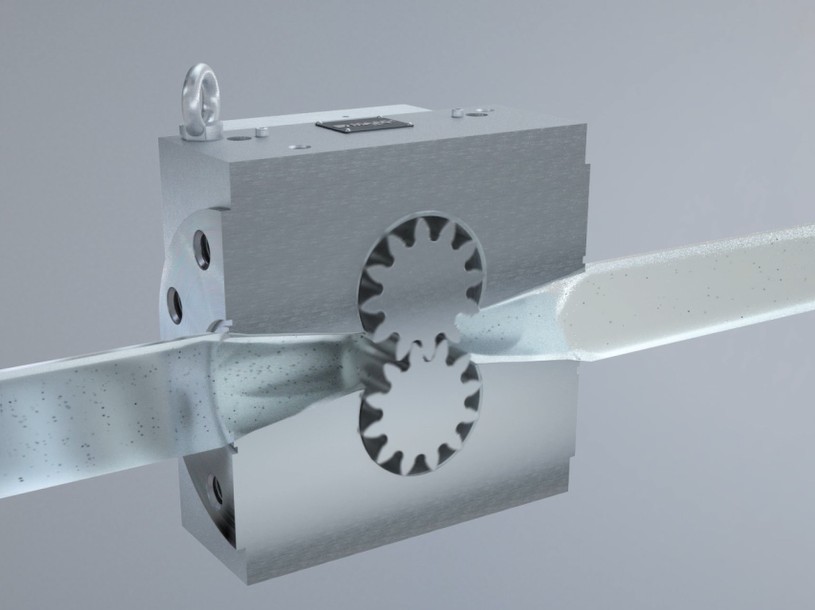
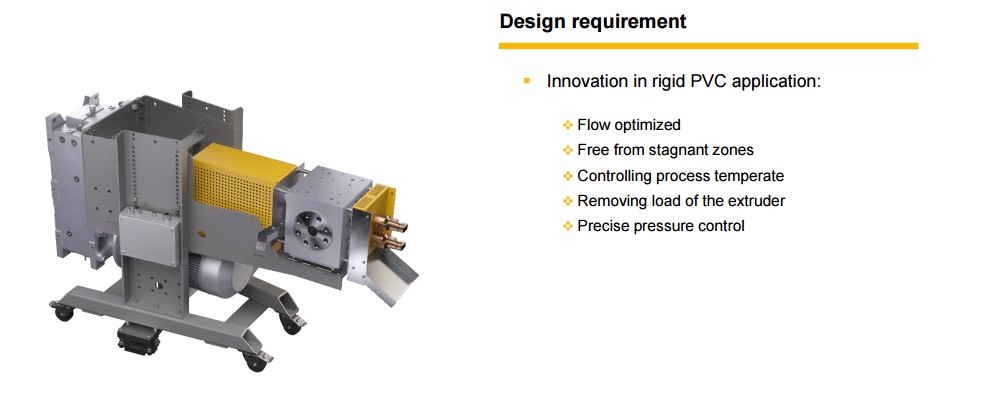
MAAG identifies the EC family as its PVC-specific extrex6 gear-pump design.
Family-level published range. Exact pump size and usable speed window depend on the application.
Do not treat a family maximum as the design point for every size, compound, or duty.
MAAG publishes a flow-optimized ST design and an innovative shaft-cooling solution for temperature control.[1]
MAAG and K 2025 product material position the extrex6 EC as a PVC-specific answer to stagnation and temperature-control challenges in hard-PVC pumping.[2] That is commercially important, but it does not eliminate the need to review the actual formulation, fusion state, inlet condition, drive torque, sealing, heating and cooling utilities, filtration, and shutdown procedure.
What a PVC melt pump can improve, and what it cannot promise
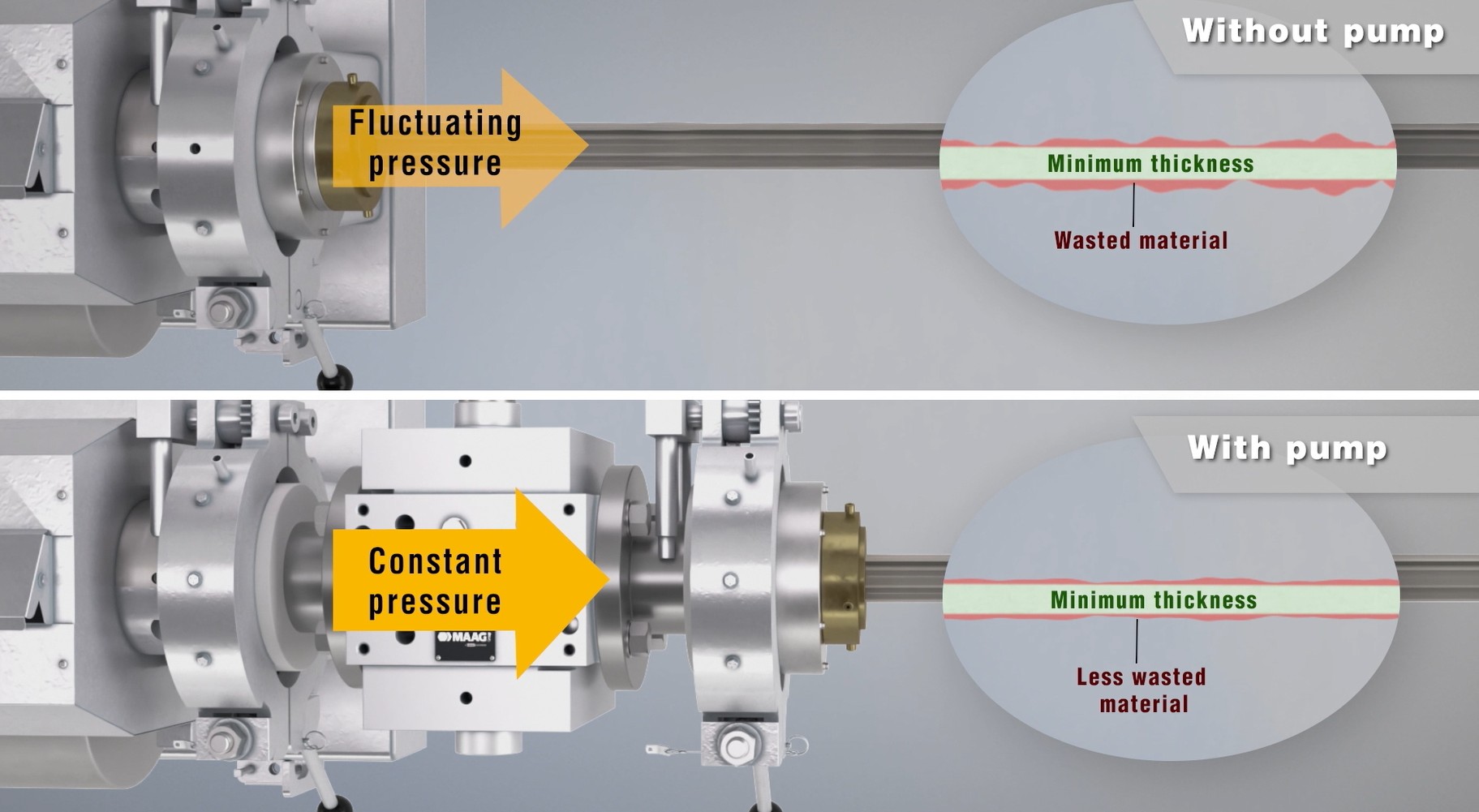
Gear-pump-assisted extrusion has a long technical history. Research supports improvements in flow stability and, in suitable applications, output, energy use, melt temperature, and dimensional consistency. It also shows that the result depends strongly on the polymer, screw design, viscosity, operating point, and completion of melting.[3]
A positive-displacement pump can damp part of the screw-output variation and meter a more repeatable melt volume when it remains full and operates in the intended window.
Reducing the pressure the screw must generate can free operating margin and let the extruder focus more on conveying, fusion, and homogenization.
Less pressure generation in the screw may reduce shear heating, but the pump also adds viscous heat. The net temperature result must be measured, not assumed.
When output variation is reduced, the line may be able to run closer to the controlling product limit instead of carrying extra material as protection against short-term lows.
What a melt pump will not fix
The pump cannot correct under-fused material, variable dry blend, wrong lubricant balance, segregation, or unstable feed.
If PVC is yellowing, burning, depositing, or releasing odor, locate the thermal and residence-time problem before using the pump to push harder.
An overloaded screen pack, poor adapter, dead region, or incompatible filtration system still creates pressure, residence time, and quality risk.
Stable melt flow cannot correct a bad die balance, insufficient vacuum, uneven cooling, undersized tank, or unstable water system.
Pipe wall and profile dimensions can drift even with stable pressure when haul-off speed, belt pressure, line speed, or cutting changes.
One pressure number is not enough. A pump project should define P1, P2, filtration differential, melt temperature, speed, torque, and finished-product data.
Where a PVC melt pump may fit across pipe, profile, sheet, and special compounds
Search by symptom, product, or process. Use the filters to narrow the table. “Evaluate” means the application has a logical path to review, not that a pump is automatically the answer.
| Application or symptom | First diagnosis | Where a pump may fit | Best next Gauge Advisor resource |
|---|---|---|---|
Rigid pressure pipe with repeating wall or weight variation Pipe | Confirm that pressure, output, and pipe wall move together. Separate feed or fusion cycles from sizing, vacuum, cooling, and puller variation. | A strong candidate when the melt is fully fused and P1 can remain stable. The pump can meter a steadier volume to the die. | Pressure fluctuation guide |
Large pipe or restrictive die with high head pressure Pipe | Review screw torque, motor load, melt temperature, fusion, die restriction, adapter, screen pack, and actual output limit. | Evaluate when pressure generation, rather than melting, cooling, or haul-off, is the controlling bottleneck. | Melt Pump Selector |
Rigid profile with dimensional drift or weight giveaway Profile | Trend pressure and output with puller speed, calibrator vacuum, cooling, and profile weight. Confirm the drift originates before the die. | Useful when flow variation reaches multiple profile dimensions and downstream systems are stable. | Pipe, tubing & profile melt delivery |
Rigid PVC sheet or board with thickness variation Sheet & Board | Separate machine-direction flow variation from cross-direction die, roll, cooling, or haul-off effects. | Strongest when average flow to the die is unstable. It will not correct cross-web die balance or roll-gap problems. | Melt pump technical guide |
Flexible or plasticized PVC tubing/profile Flexible PVC | Define plasticizer, viscosity, lubrication, temperature, seals, and whether volatile or condensable components affect the system. | Possible, but requires a formulation-specific MAAG review. Do not assume the rigid-PVC configuration transfers unchanged. | Request formulation review |
CPVC or another special heat-sensitive vinyl Special Compound | Confirm processing window, corrosion, viscosity, thermal stability, temperature-control requirements, and product standard. | Factory review required. The article should not be used to assume extrex6 EC suitability for every chlorinated or specialty formulation. | MAAG application review |
Highly filled rigid PVC compound Filled | Review filler loading, particle size, viscosity, lubricity, fusion, torque, wear, and pressure demand. | Potentially valuable, but materials, clearances, torque, speed, and wear expectations must be selected for the compound. | Melt Pump Selector |
PVC regrind or variable contamination Regrind | Define contaminant size, hardness, concentration, metal risk, degraded material, and filtration strategy. | Do not select the pump separately from filtration and protection. Some high-contamination recycling filters are explicitly not intended for PVC. | Filtration & Screen Changer Selector |
Coextruded PVC skin/core or multiple melt streams Coextrusion | Determine which stream creates the variation and whether each extruder can supply a stable, compatible inlet condition. | One or more independently controlled pumps can improve layer or stream metering, but the entire coextrusion architecture must be reviewed. | Melt pump application guide |
One extruder feeding two dies or outputs Multi-Output | Confirm whether the outputs need independent rate control and whether the extruder can supply the combined melt demand. | A Y-adaptor and independently driven pump streams may be evaluated for balanced or separately controlled outputs. | MAAG melt-pump solutions |
Retrofit on an existing PVC extrusion line Retrofit | Measure available length, centerline, support, flange interfaces, drive orientation, utilities, heaters, cooling, transducer ports, and control I/O. | Often feasible, but the mechanical and control integration must be designed as one system rather than treating the pump as a stand-alone block. | Request retrofit review |
Stable melt pressure but dimensions still drift Downstream | Move downstream to die thermal balance, calibrator vacuum, cooling, internal air, puller speed, belt pressure, cut-off, and measurement. | A pump is unlikely to be the first correction when P2 and output are already stable. | Plastics Extrusion Troubleshooting Guide |
A melt pump is only as stable as its inlet and control strategy
A common arrangement is for pump speed to establish the intended melt flow while extruder screw speed is adjusted to maintain a stable pump-inlet pressure. That allows the pump to remain full without making the screw and pump fight each other.[4]
The selected displacement and rpm define the intended volumetric output, minus internal leakage. Actual mass output still depends on density and operating efficiency.
Extruder speed can be trimmed to hold pump-inlet pressure within a validated window. Low or unstable P1 can indicate starvation, filter restriction, poor fusion, or excessive pump demand.
Outlet pressure, differential pressure, drive torque, temperature, and alarms protect the pump, adapter, die, and product.
Stable melt flow must be synchronized with calibrator, vacuum, cooling, puller, cutter, and product measurement to hold wall, weight, and dimensions.
Estimate the annual value of reducing PVC material giveaway
The old article used one fixed ROI example. This calculator is more useful because it lets you enter the actual line rate, production hours, material cost, and expected change in overage. It is still a screening calculation, not a guaranteed savings result.
Important: This is a material-only screening estimate. It does not include throughput contribution, scrap, energy, downtime, maintenance, capital cost, depreciation, financing, product mix, density, or double-counting between giveaway and scrap. Use the full Melt Pump and Filtration ROI Calculator for a more complete business case.
What to collect before requesting a MAAG pump review
The strongest project begins with a short set of real operating data, not a general statement that the line needs more output.
- Product and compoundRigid PVC, flexible PVC, CPVC, filler, stabilizer and lubricant system, regrind percentage, color, and supplier grade.
- Throughput windowMinimum, normal, and maximum kg/h or lb/h, plus screw rpm and actual line-speed range.
- Fusion and quality baselineFusion assessment, melt temperature, color, deposits, odor, impact or product tests, and current reject modes.
- Pressure mapExtruder head, before and after filtration, proposed P1 and P2, die pressure, range, oscillation, and alarm limits.
- Extruder dataType, screw diameter, L/D, screw design, motor power, gearbox, motor load, torque, venting, and current bottleneck.
- Filtration and flow pathScreen changer, mesh or filtration fineness, adapter, breaker plate, die, pressure loss, screen-change cycle, and contamination.
- Downstream capacityDie, calibrator, vacuum, cooling length and temperature, haul-off, cutter, product measurement, and current rate limit.
- Retrofit constraintsCenterline, available length, flange drawings, structural support, drive access, utilities, controls, I/O, and desired schedule.
Common mistakes in PVC melt-pump projects
Sizing the pump from throughput alone
Throughput defines part of the operating window, but selection also depends on viscosity, temperature, P1, P2, differential pressure, speed, torque, lubricity, filler, contamination, residence time, seals, heating, cooling, and mechanical integration.
Using the pump to compensate for poor fusion
The extruder still has to prepare a homogeneous melt. If fusion or dry-blend consistency is unstable, the pump may deliver a more repeatable volume of an inconsistent material state.
Assuming lower extruder pressure always means lower melt temperature
Relieving screw pressure duty can reduce shear heating, while the gear pump adds viscous heating of its own. The net result depends on the compound, differential pressure, speed, clearances, and temperature control. Measure actual melt temperature before and after the change.
Running with inadequate or unstable P1
The pump must remain full. Low inlet pressure, starvation, filter loading, poor fusion, or excessive pump demand can reduce volumetric efficiency and damage operating margin. Trend P1, not only outlet pressure.
Choosing filtration separately from the pump
PVC filtration affects pressure, residence time, stagnation, quality, and pump protection. Select the screen changer, adapter, transducers, pump, and die interface as one melt-delivery system.
Counting a manufacturer example as the plant ROI
Published examples can show what is possible, but the project case should use the plant’s throughput, material cost, dimensional margin, scrap, energy, downtime, cooling limit, and capital cost. Do not add the same material loss to both giveaway and scrap.
Ignoring the downstream bottleneck
A pump can create stable melt flow and still fail to increase saleable output if the die, vacuum, cooling, haul-off, cutter, or inspection system is already at its limit.
Treating every vinyl formulation as rigid PVC
Plasticized PVC, highly filled compounds, regrind, CPVC, and specialty formulations can change viscosity, lubricity, corrosion, sealing, wear, temperature, and contamination requirements. The final configuration should be reviewed against the exact compound.
Related Gauge Advisor melt-delivery and extrusion resources
These pages connect the PVC-specific decision to pump sizing, filtration, troubleshooting, process capability, throughput, and ROI.
PVC extrusion melt-pump FAQs
Is the MAAG extrex6 EC only for PVC pipe?
MAAG identifies the EC family for PVC extrusion generally. Pipe is a natural application because wall, weight, output, and die pressure matter, but rigid profiles, sheet, board, and other PVC processes may also be reviewed. Final suitability depends on the compound and complete line architecture.
Will a melt pump prevent PVC degradation?
No. It may reduce some extruder pressure duty and create a better temperature-control opportunity, but it cannot correct excessive residence time, dead zones, bad formulation, poor fusion, overheated tooling, contaminated regrind, or an improper startup and shutdown procedure.
Will a melt pump increase PVC throughput?
It can increase usable output when extruder pressure generation is the limiting factor and the downstream line has capacity. It will not create more melting, cooling, vacuum, haul-off, or cut-off capacity. The likely rate increase must be established from the actual bottleneck.
Does the pump replace a screen changer or melt filter?
No. The pump meters the melt; filtration controls contamination and protects product quality or equipment. The filtration location and technology should be selected together with the pump, especially because PVC is sensitive to residence time and stagnant regions.
What pressures should be measured?
At minimum, define the pump inlet pressure P1 and outlet pressure P2. Pressure before and after the filtration system is also valuable. The useful design uses synchronized pressure, speed, torque, temperature, and product trends rather than one HMI number.
Can the extrex6 EC be retrofitted?
Many melt-pump projects are retrofits. Feasibility depends on space, centerline, flanges, support, alignment, drive access, heaters, shaft-cooling requirements, pressure ports, controls, interlocks, startup logic, and the condition of the existing extruder and die.
Can the same pump handle rigid PVC, flexible PVC, CPVC, and filled compounds?
Do not assume so. Formulation changes can alter viscosity, lubricity, corrosion, sealing, wear, thermal stability, and contamination. Each material family should be reviewed against the intended pump materials, clearances, speed, pressure, and temperature-control strategy.
What should I send for a preliminary quotation?
Send the product and compound, minimum and maximum throughput, P1 and P2 if available, melt temperature, current extruder and screw information, filtration and die details, motor load, quality problem, target improvement, retrofit drawings, utilities, and timeline.
References and source notes
The references are collapsible to keep the article readable and open automatically when printing.
Open technical references and source notes9 sources
Gauge Advisor is the authorized MAAG sales and applications partner. MAAG sources are used for current extrex6 EC product information. Independent polymer-processing literature, PVC rheology and thermal-stability research, ASTM standards, SPE guidance, and the PVC Pipe Association are included for broader context. No competing melt-pump or extrusion-equipment manufacturer is cited.
- MAAG Group, extrex6 EC. Official PVC gear-pump application, ST flow-optimized design, shaft cooling, published throughput range, and family differential-pressure information.
- K 2025, MAAG extrex6 EC product information. Trade-fair product description of the hard-PVC-specific design and its attention to dead spaces, temperature control, and pressure duty.
- Pham and Hyun, Gear Pump Assisted Extrusion, Polymer Engineering & Science, 1992. Critical review of flow stability, throughput, energy, melt-temperature, and material-dependent results in gear-pump-assisted extrusion.
- SPE Extrusion Division, Troubleshooting Gear Pump Assisted Single-Screw Extrusion. Practical guidance on pump inlet pressure, starvation, control interaction, and troubleshooting the combined extruder-pump system.
- Vlachopoulos, The Role of Rigid PVC Rheology in Pipe Extrusion. Technical discussion of PVC fusion, wall slip, filler effects, viscous heating, weld lines, and the need to avoid both under-fusion and degradation.
- Jubsilp et al., Effects of Organic Based Heat Stabilizer on Properties of PVC, 2021. Peer-reviewed discussion of PVC thermal degradation, dehydrochlorination, released HCl, stabilizer behavior, and processing sensitivity.
- ASTM D1785-21a. Standard specification covering PVC Schedule 40, 80, and 120 pipe requirements including dimensions, workmanship, extrusion quality, finish, performance, and marking.
- ASTM D2152-23. Test method for adequacy of fusion of extruded rigid PVC pipe and fittings, including the important limits of what the acetone-immersion test can and cannot establish.
- PVC Pipe Association, PVC Pipe: High Quality and Performance Standards. Industry-association overview of dimensional, extrusion-quality, flattening, burst, impact, joint, hydrostatic, traceability, and third-party quality controls.
Review the PVC application before selecting the pump
Gauge Advisor is the authorized MAAG sales and applications partner for melt pumps, screen changers, filtration systems, and related controls. I help PVC pipe, profile, sheet, board, tubing, and specialty-extrusion manufacturers evaluate, select, quote, integrate, and support MAAG equipment.
Gauge Advisor supports equipment selection and integration for the manufacturers represented here; independent process consulting is not offered. Send the compound, product, throughput range, pressure data, melt temperature, current equipment, quality issue, and retrofit drawings when available. I will respond within one business day, often within a few hours.
- PVC compound and process review
- extrex6 EC family and size screening
- P1, P2, filtration, and control architecture
- Retrofit mechanical and utility review
- Quotations and MAAG factory coordination
- Ongoing sales and applications support