Updated August 21, 2026
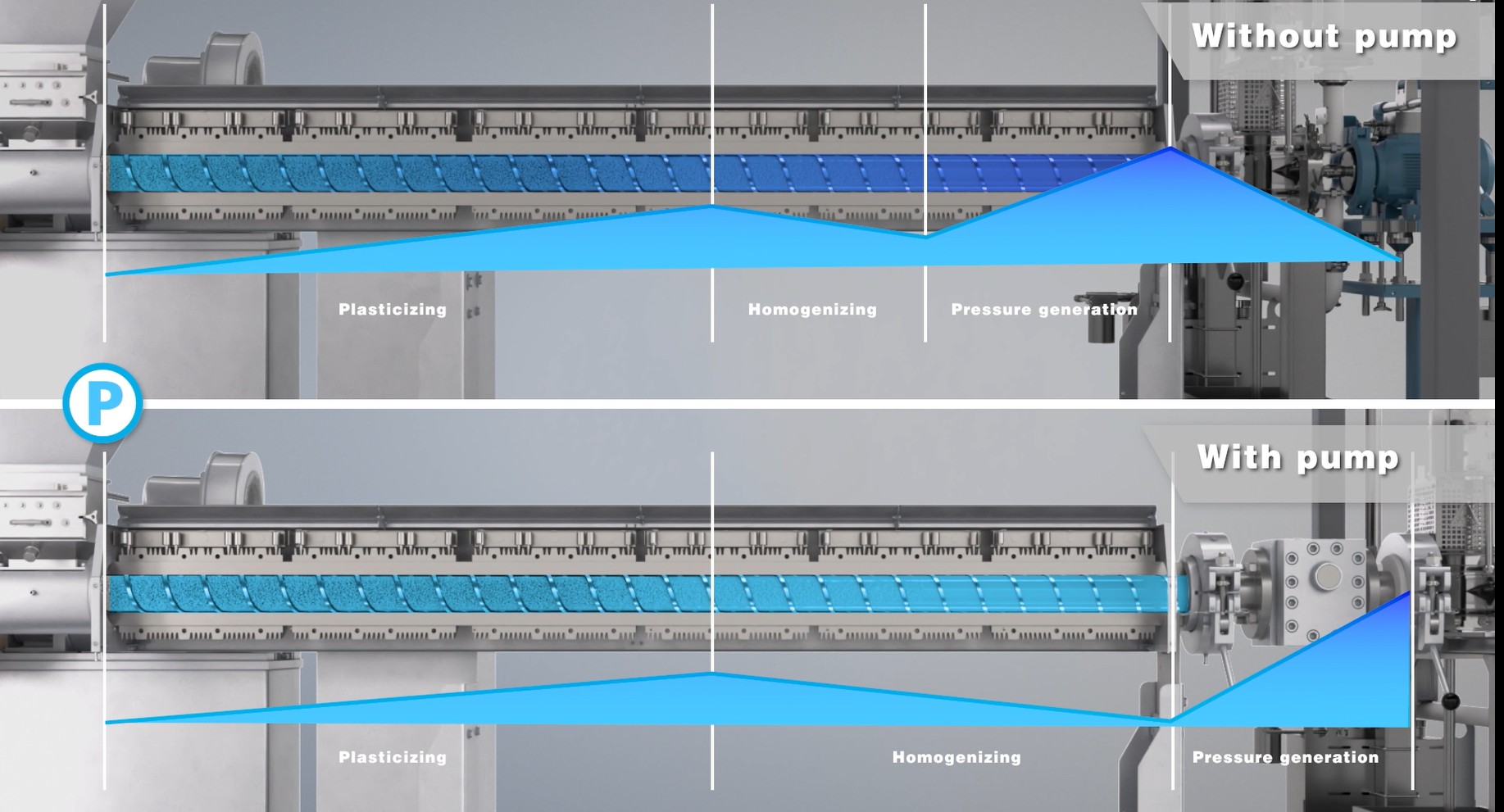
A melt pump is one of the most useful, and most misunderstood, upgrades in polymer extrusion. It does not dry resin, repair a worn screw, correct a poor die, or stabilize a bad haul-off. What it can do is separate two jobs the extruder is often forced to perform at the same time: plasticize and homogenize the polymer, then generate enough pressure to push that melt through the filtration system and die.
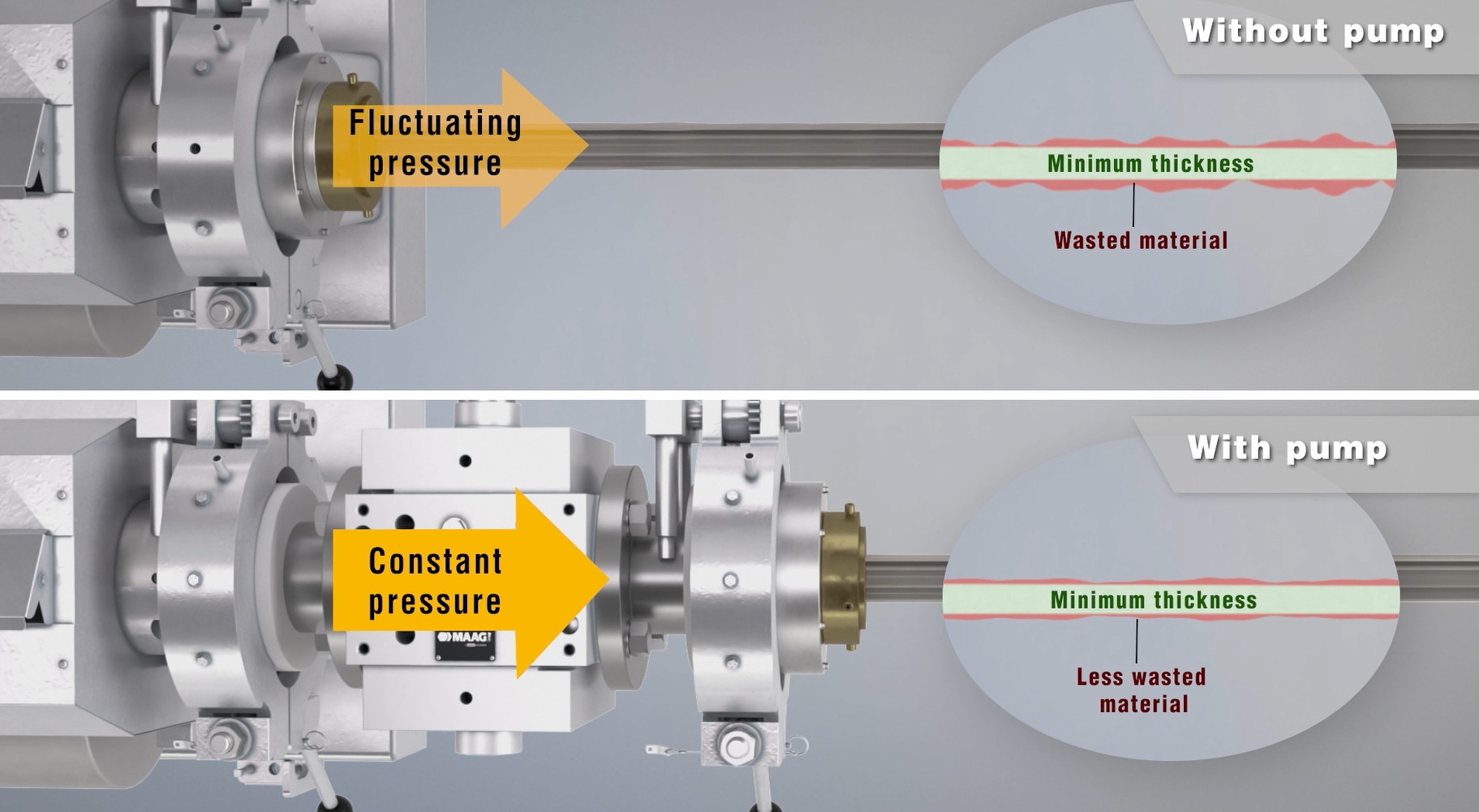
That separation is where the value comes from. A properly selected extrusion melt pump, also called a polymer gear pump, meters a repeatable volume of melt to the die while allowing the extruder to operate with a more manageable discharge pressure. The result can be steadier output, tighter dimensions, less resin giveaway, higher usable throughput, and a more controllable process.
Connected process path: A melt pump works best as part of a connected system that keeps inlet flow stable, manages contamination, and matches downstream line capacity.
Related next steps: extrusion pressure stability, polymer filtration selector, recycling and regrind melt delivery, film and sheet melt delivery, and throughput-control weigh hoppers.
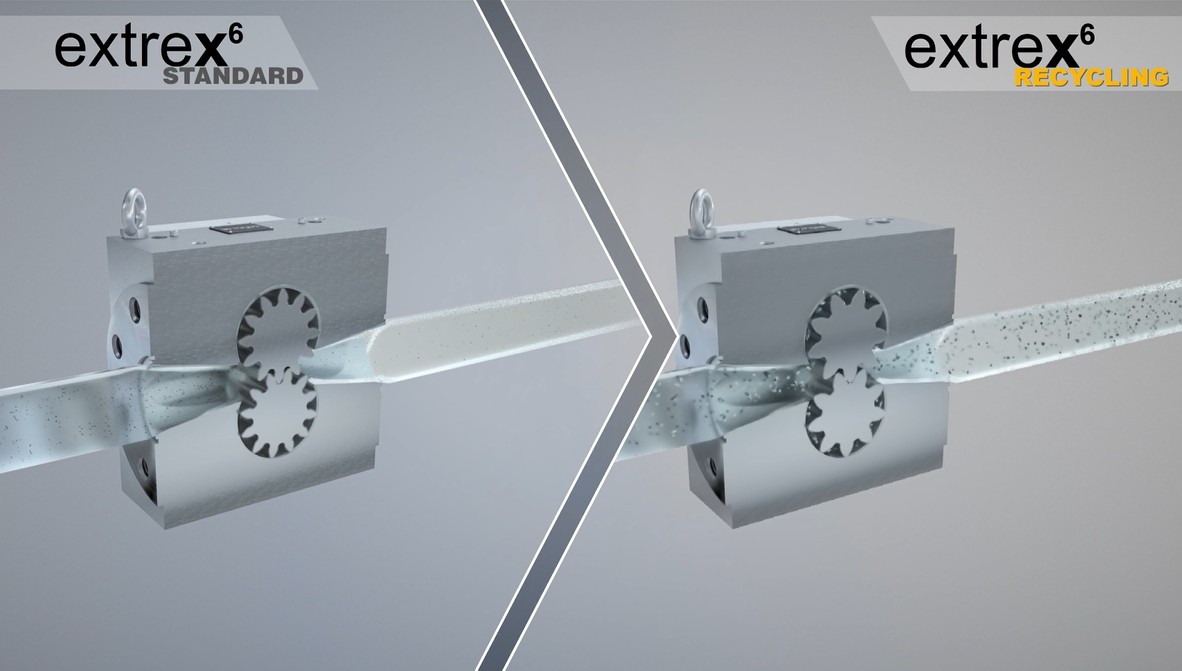
How an extrusion melt pump actually works
An external gear pump uses two closely fitted, intermeshing gears. Polymer is carried around the outside of the gears in the spaces between the teeth and the housing, then displaced toward the outlet as the teeth re-engage. In simplified terms, pump output is the pump displacement multiplied by rotational speed, minus internal leakage.
Pressure is not a fixed quantity that the pump creates by itself. Pressure develops because the downstream die, adapter, screen pack, and other restrictions resist the flow. The pump supplies the torque needed to move a controlled volume against that resistance. Actual volumetric efficiency depends on polymer viscosity, temperature, speed, clearances, wear, inlet condition, and pressure differential. Independent research on polymer gear pumps confirms that these operating variables matter, which is why a pump cannot be selected from throughput alone.[3]
1. Extruder: plasticize and feed the pump
With a gear pump in the line, the extruder can focus more of its work on solids conveying, melting, mixing, and delivering a full, stable melt stream to the pump. It still needs enough discharge pressure to keep the pump inlet filled. A melt pump cannot correct intermittent starvation, poor blending, wet resin, or incomplete melting.
Is a melt pump worth evaluating on your line?
This quick checker is not a pump selection or quotation. It helps separate situations where a gear pump is a strong candidate from problems that should be investigated elsewhere first.
Considering a melt pump for your extrusion line?
Share your polymer, operating throughput, and the pressure or output problem you want to solve. Gauge Advisor will help assess the pump and filtration duty, identify missing sizing data, and coordinate MAAG equipment selection and quotation. Start with the information you have; detailed pressure and process trends can follow during sizing.
What a properly applied melt pump can improve
Gear-pump-assisted extrusion has been studied for decades. The benefits are real, but they are not identical for every polymer or line. A good application review connects the pump to the specific source of variation and confirms that the extruder can supply a fully melted, stable stream.[1]
A high-volumetric-efficiency gear pump can damp much of the flow variation arriving from the extruder. That can tighten thickness, wall, weight, diameter, or profile dimensions when those properties track mass-flow variation.
Shifting pressure generation downstream can reduce the head pressure the screw must overcome. The extruder can then operate closer to its strengths: melting, mixing, and feeding.
Lower extruder back pressure can increase specific output or permit a higher screw speed, provided melting, venting, mixing, motor load, and downstream capacity remain acceptable.
The extruder may add less shear energy when it no longer supplies all of the die pressure. However, the pump also generates viscous heat. The net temperature effect depends on polymer viscosity, pressure differential, speed, and pump clearances.
A pump can support restrictive dies, fine filtration, or other downstream components without forcing the extruder to generate the full pressure by itself.
When the pump reduces real process variation, standard deviation can fall and Cpk or Ppk may improve. NIST notes that capability compares process variability with specification width, so a steadier process is only useful if it is also centered and statistically stable.[4]
What a melt pump will not fix
A pump can isolate the die from some upstream flow variation, but it cannot turn an unstable or poorly designed process into a good one by itself. This distinction matters because a stable outlet pressure can sometimes hide what is happening at the pump inlet.
Bridging, blender variation, conveying interruptions, poor bulk-density control, or refill disturbances still change what reaches the screw. Review the Resin Handling Equipment Selector when the problem begins before the extruder.
A pump does not remove moisture or volatiles. Bubbles, splay, degradation, vent flooding, and unstable viscosity must be addressed through material preparation and process conditions.
Unmelt, solid-bed breakup, poor mixing, or excessive temperature variation can reach the pump and create torque, wear, quality, or inlet-pressure problems.
Contamination type, screen area, change method, pressure rise, and pump location need to be evaluated together. Use the Filtration and Screen Changer Selector and the filtration selection guide.
Stable mass flow does not correct a damaged die, uneven cooling, unstable vacuum sizing, puller variation, air-ring problems, web tension, or winding defects.
If pressure sensors are poorly located, noisy, drifting, or sampled too slowly, the control loop may react to bad information. Stable pressure also does not prove that product dimensions are stable, so the quality measurement still matters.
Where melt pumps create value across extrusion processes
Search or filter the matrix to see why a processor may evaluate a gear pump, what commonly limits the application, and which Gauge Advisor resource is the best next step.
| Application | Why a melt pump may help | Key selection concern | Related Gauge Advisor resource |
|---|---|---|---|
Blown film Film and sheet | Stabilizes melt flow feeding the annular die, which can reduce machine-direction gauge variation and support higher output when the extruder is pressure-limited. | Separate melt-flow variation from air-ring, IBC, cooling, die, resin, and winding effects. Pump stability alone does not correct cross-direction profile. | Blown film bottlenecks guide |
Cast film Film and sheet | Provides steadier flow to a flat die, supporting thickness consistency, reduced edge or center giveaway, and more repeatable automatic die control. | Confirm whether variation is machine-direction flow, cross-direction die profile, chill-roll behavior, or draw and neck-in. | Film and sheet melt-delivery solutions |
Sheet and plate Film and sheet | Can stabilize sheet weight and thickness, relieve extruder pressure, and support restrictive dies or screen packs. | Roll stack, bank control, polishing, cooling, sag, and haul-off can create dimensional variation even with stable flow. | Film and sheet measurement |
Extrusion coating and lamination Film and sheet | Improves coating-weight repeatability when coating add-on tracks polymer mass flow and line speed. | Web speed, draw resonance, neck-in, air gap, substrate tension, and die profile remain separate control variables. | Web gauging technologies guide |
Small and medical tubing Tubing, pipe, profile | Stable mass flow can reduce OD and wall variation caused by output surging and help maintain tighter process capability. | Internal air, puller speed, water temperature, vacuum, tooling alignment, and material residence time can dominate the result. | Medical tube extrusion measurement guide |
Pipe Tubing, pipe, profile | Supports stable wall weight and diameter while handling substantial die pressure or fine filtration demands. | Vacuum sizing, cooling capacity, sag, haul-off, and polymer-specific thermal limits must be checked with pump pressure and throughput. | Pipe, tubing, and profile systems |
Profile extrusion Tubing, pipe, profile | More repeatable output can improve profile weight and reduce dimensional drift caused by flow variation. | Die balance, calibrator design, cooling, puller speed, material swell, and orientation can still distort the shape. | Profile extrusion melt delivery |
Wire and cable coating Wire and coating | Can stabilize insulation or jacket mass flow, particularly on tight-tolerance or high-pressure crossheads. | Conductor speed, centering, crosshead temperature, drawdown, spark-test requirements, and online diameter or wall measurement remain critical. | Wire and cable measurement solutions |
Thin extrusion coatings Wire and coating | Precise metering is valuable when a small change in polymer output creates a large percentage change in coating thickness. | Pump displacement, turndown, residence time, shear heating, and low-flow control accuracy become more important. | Melt Pump Selector |
Compounding and masterbatch Compounding and recycling | Separates pressure generation from mixing, supports downstream filtration or pelletizing, and can increase usable twin-screw capacity. | Filler abrasion, unmelt, dispersion, devolatilization, feed stability, viscosity, and required filtration dictate the pump design. | MAAG melt pumps and filtration |
Recycling and high-regrind extrusion Compounding and recycling | A recycling-specific pump can meter contaminated or highly filled melt and support continuous filtration or pelletizing. | Contaminant size, hardness, shape, concentration, filler loading, wear rate, and whether filtration is upstream or downstream must be defined. | Filtration and Screen Changer Selector |
Rigid PVC and CPVC Special materials | Pressure can be generated with less burden on the extruder, which may support cooler, steadier processing of a shear- and heat-sensitive compound. | Residence time, stagnant zones, shaft cooling, lubrication, compound formulation, and startup or shutdown procedures require a PVC-specific design review. | PVC melt pump selection guide |
Fluoropolymers and low-lubricity melts Special materials | Application-specific materials, clearances, drive arrangements, and cooling can support high-temperature or demanding low-lubricity service. | Chemical compatibility, temperature, bearing lubrication, seals, torque, and surface finish require direct engineering review. | Request an application review |
Elastomer and rubber extrusion Special materials | A low-compression pump design can provide controlled flow at high discharge pressure for dry, sticky, or scorch-sensitive compounds. | Compound temperature, scorch behavior, shaft thermoregulation, inlet condition, viscosity, and cleaning method differ from thermoplastic applications. | MAAG melt pumps and application support |
Two dies or independent melt streams Compounding and recycling | Two independently driven pumps can split one extruder output into separately controlled melt streams for two dies or profiles. | Total extruder capacity, branch balance, independent pressure demand, controls, and changeover behavior must be modeled as one system. | Build a preliminary pump configuration |
Which MAAG melt pump family fits the job?
MAAG’s extrex6 portfolio is not simply a sequence of “small, medium, and large” pumps. The families differ in pressure capability, load design, material handling, and application purpose. The published limits below are useful starting points, not final selection criteria. Maximum temperature, flow, pressure, and viscosity cannot necessarily be combined at the same time or across every pump size.[6]
extrex6 GU
- Published differential pressure
- Up to 250 bar
- Typical starting point
- General thermoplastic extrusion, compounding, and masterbatch
Broad application range where moderate pressure and stable metering are the main goals.
extrex6 EP
- Published differential pressure
- Up to 320 bar
- Typical starting point
- Higher pressure and greater load, including lower-lubricity melts
An intermediate pressure family between general-use and higher-pressure designs.
extrex6 SP
- Published differential pressure
- Up to 400 bar
- Published outlet pressure
- Up to 520 bar
For demanding pressure and load conditions, with flow-optimized and retrofit configurations available.
extrex6 MP
- Published differential pressure
- Up to 500 bar
- Published outlet pressure
- Up to 700 bar
For the most demanding high-pressure thermoplastic extrusion applications.
extrex6 Recycling
- Published differential pressure
- Up to 250 bar
- Published throughput range
- 1,524 to 15,000 kg/h
MAAG publishes capability for contaminants up to 6 mm and filler content up to 80% for this design. Final acceptance depends on the complete contamination profile.[7]
extrex6 EC
- Published differential pressure
- Up to 400 bar
- Published throughput range
- 50 to 2,400 kg/h
Optimized for PVC requirements, including flow-path and shaft-cooling considerations.[9]
extrex6 ER
- Primary media
- Elastomers and silicone rubber
- Design emphasis
- Low compression, low shear, thermoregulated shafts
Designed for dry, sticky, high-viscosity, and scorch-sensitive rubber and elastomer extrusion applications.[10]
Y-Adaptor and dual drives
- Published combined throughput
- Up to 12,000 kg/h, depending on family and size
- Purpose
- Feed two dies from one extruder
Separate speed-controlled drives allow the two branches to run at different output rates and pressure requirements.[6]

The sizing inputs that actually matter
A throughput number and polymer name are not enough to size a melt pump responsibly. The pump, drive, heating, controls, sensors, filtration, and mechanical integration need to be reviewed as one system.
- Polymer and formulationExact grade, carrier resin, additives, filler, reinforcement, regrind, PCR content, color, and known contaminants.
- Operating temperature and viscosityReal melt temperature and an appropriate viscosity estimate at process shear and temperature, not pellet density alone.
- Minimum, normal, and maximum throughputInclude startup, low-rate products, changeovers, and planned future capacity, in kg/h and lb/h where possible.
- Pump inlet pressure, P1Average, minimum, maximum, fluctuation range, sensor location, and whether the extruder can maintain a full inlet across the turndown range.
- Pump outlet and die pressure, P2Normal and maximum pressure at each product condition, including clean and dirty screens.
- Required differential pressureP2 minus P1, plus transient conditions during startup, screen changes, or control upsets.
- Filtration architectureScreen changer or filter type, location, filtration fineness, area, expected pressure rise, and how the device changes or cleans screens.
- Contamination profileSize, hardness, shape, concentration, filler loading, metal risk, and whether contaminants are soft, brittle, abrasive, or fibrous.
- Extruder condition and limitsScrew diameter and L/D, screw design, motor power, maximum screw speed, current output, venting, melt quality, and discharge-pressure capability.
- Die and downstream demandDie type, pressure-flow behavior, number of dies, product dimensions, line speed, cooling, haul-off, and capacity bottlenecks.
- Mechanical installationAvailable space, flange pattern, support, alignment, thermal growth, cart or fixed frame, drive orientation, maintenance access, and lifting needs.
- Controls and communicationsWho controls pump speed, who controls P1, required temperature zones, interlocks, alarms, remote access, PLC interface, and historian data.
Controls, startup, filtration, and pressure protection
A good pump can perform poorly when the control strategy is wrong. The most important variables are typically pump speed, extruder speed, P1 inlet pressure, P2 outlet pressure, differential pressure, torque, melt temperature, and the state of the filtration system.
Bring the pump, adapters, screen changer, and die to the approved thermal condition. Confirm that valves, screens, rupture protection, interlocks, and sensors are ready.
Start the extruder and establish a full, stable melt stream at the pump inlet before demanding substantial pump output.
Increase pump speed while controlling the extruder to maintain the target inlet pressure. Watch P1, P2, torque, temperature, and filter differential.
Once stable, hold the defined control architecture and trend the same variables with product quality and line speed.
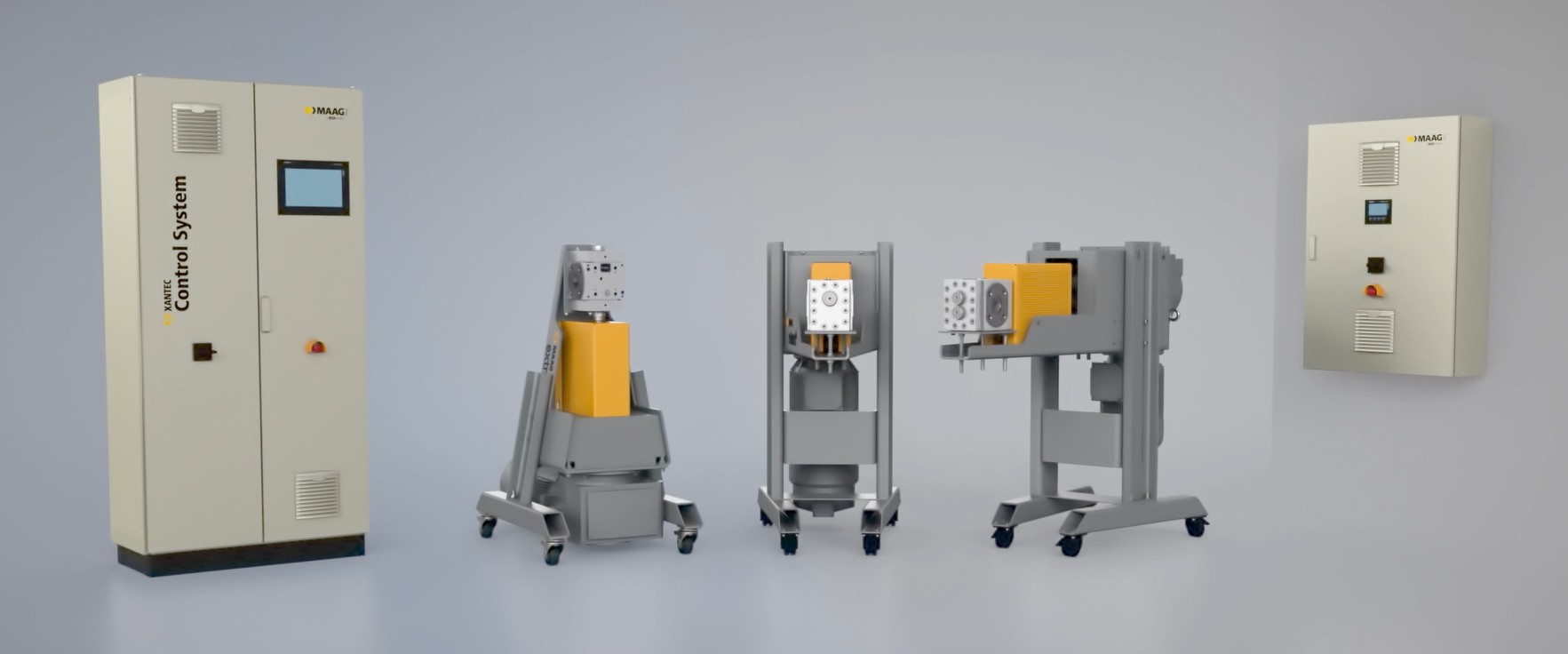
MAAG’s maax PC is designed for standalone or retrofit integration of extrusion pumps. Its published functions include startup and production control, pump-speed control, temperature zones, filter monitoring, and quick control of pump-inlet pressure.[8] The exact sequence and interlocks should follow the approved machine design and MAAG commissioning procedure.
Common melt-pump troubleshooting patterns
The pump outlet can look stable while the extruder, inlet pressure, or melt condition is deteriorating. Trend the whole system and compare the timing of the signals before changing multiple settings.
Outlet pressure looks stable, but pump-inlet pressure oscillates
The pump may be masking upstream surging at the die while P1 reveals the extruder disturbance. Compare P1 with screw speed, feeder output, motor load, melt temperature, refill events, and filter pressure. Confirm that the inlet-pressure loop is tuned correctly and that the sensor is located close enough to the pump inlet.
Read the pressure fluctuation diagnostic guide before assuming the pump is the source.
Pump-inlet pressure falls toward the minimum limit
The pump is demanding more flow than the extruder is supplying, or upstream resistance has increased. Possible causes include low screw speed, feed starvation, screen restriction upstream of the pump, incomplete melting, excessive pump speed, falling viscosity, or a control-loop problem. Reduce demand safely and identify why the inlet is not staying full.
Pump torque or drive load rises over time
Check P1, P2, differential pressure, melt temperature, filter condition, die restriction, viscosity changes, contamination, alignment, bearing condition, and drive data. A rising pressure differential may be process-related, while rising torque at similar pressure and temperature can point toward mechanical or material changes.
Output falls at the same pump speed
Internal slip increases as pressure differential rises, viscosity falls, clearances increase, or wear progresses. Verify the actual pump speed, throughput measurement, P1, P2, temperature, polymer grade, and calibration. The TU/e research on polymer gear pumps shows why volumetric efficiency must be considered as an operating curve rather than assumed to be one constant value.[3]
Melt temperature increases across the pump
Some viscous heating is expected. A larger-than-expected rise can be associated with high differential pressure, high speed, low clearance, high viscosity, poor temperature control, or a pump that is not well matched to the operating point. Do not assume that adding a pump always lowers final melt temperature. The net result is the extruder temperature reduction minus the heat generated in the pump.
Pressure spikes occur during screen changes or backflushing
Screen movement, venting, backflush volume, or a temporary loss of filtration area can disturb the flow. Review the screen changer sequence, pump or extruder compensation strategy, pressure limits, and whether the pump is located before or after the filter. The Filtration and Screen Changer Selector helps compare architectures.
Seal leakage or polymer buildup appears around the shaft
Review seal type, shaft temperature, inlet pressure, material behavior, heating or cooling, alignment, wear, and the approved leakage expectation for the design. Some viscoseal arrangements rely on controlled process conditions and are not evaluated like a conventional mechanical seal.
Pressure is stable, but product thickness or dimensions still vary
Separate mass-flow stability from the rest of the line. Check line speed, drawdown, cooling, sizing, internal air, haul-off, die profile, web tension, winding, and the measurement system. Use the extrusion troubleshooting matrix to follow the defect pattern across the process.
What is a small reduction in material giveaway worth?
This calculator estimates only the gross material value associated with a small percentage reduction in net resin use at the same saleable output. It does not include increased throughput, energy, downtime, labor, maintenance, scrap disposition, financing, or equipment cost.
This is a directional screening calculation, not a savings guarantee. Validate the baseline with production data and distinguish true material reduction from changes in saleable output, product mix, density, or scrap accounting.
Build a defensible baseline for the project
Real line data helps confirm the equipment duty and business case. You can begin an equipment quotation discussion with your polymer, approximate throughput, and project goal. Synchronized pressure, process, and quality trends help complete sizing and evaluate the expected benefit as the project develops.
Capture average, range, periodicity, transients, and the pressure locations. Differential pressure is P2 minus P1.
Trend screw speed, pump speed if installed, motor load, feeder rate, melt temperature, filter pressure, line speed, and quality on the same time base.
Use thickness, weight, wall, OD, width, or profile data to confirm that the pressure or output pattern actually reaches the product.
Separate giveaway, scrap, downtime, reduced rate, energy, maintenance, and customer risk. Avoid counting the same loss twice.
Use the Extrusion Throughput and Line Speed Calculator to verify production assumptions, the Cpk/Ppk and Non-Conformance Simulator to quantify variation, and the Melt Pump and Filtration ROI Calculator to assemble the commercial case.
Extrusion melt pump FAQs
Is a melt pump the same as a gear pump?
In polymer extrusion, the terms are commonly used interchangeably. The device is typically an external gear pump designed to meter a viscous polymer melt at elevated temperature and pressure.
Where is the melt pump installed?
It is installed in the melt stream between the extruder and die. The screen changer or filter may be upstream or downstream depending on contamination, pressure, pump protection, process continuity, and product-quality requirements. The full architecture should be selected together.
Will a melt pump always increase throughput?
No. It can relieve extruder discharge pressure and permit a higher specific output, but the line may still be limited by melting, motor power, feed rate, venting, filtration, die capacity, cooling, haul-off, winding, or product quality. A higher pump rating does not create capacity elsewhere in the line.
Will a melt pump always lower melt temperature?
No. The extruder may generate less shear heat when pressure duty is shifted to the pump, while the pump adds its own viscous heating. The net result depends on polymer rheology, pressure differential, speed, clearance, and temperature control. Early gear-pump-assisted extrusion studies specifically found material-dependent results.[1]
Can a melt pump eliminate extrusion pressure fluctuations?
It can substantially damp many upstream flow disturbances at the outlet when it is full, correctly sized, and controlled. It cannot remove the underlying cause of feed starvation, poor melting, moisture, or other upstream instability. P1 may still fluctuate even when P2 looks stable.
Do I still need a screen changer or melt filter?
Usually, yes. The pump meters the melt; filtration removes contamination and protects product quality or downstream equipment. Some recycling-specific pump designs can pass defined contaminants and may change where prefiltration is required, but that is an application-specific decision, not a reason to ignore filtration.
Can a melt pump process regrind, PCR, or highly filled compounds?
Yes, with the correct pump design and a defined contamination profile. MAAG’s extrex6 Recycling is designed for contaminated and highly filled applications, while dual-drive and application-specific materials can be considered for abrasive service. Final suitability depends on contaminant size, hardness, concentration, filler, viscosity, and wear expectations.
What information is needed for a MAAG melt-pump quotation?
Start with the polymer, approximate operating throughput, and the pressure, output, or quality problem you want to improve. Include the existing pump model, filter arrangement, and available pressure data if known. Gauge Advisor will coordinate MAAG equipment selection and quotation, then confirm temperatures, viscosity, contamination, inlet and outlet pressures, drive, controls, and installation scope before final sizing.
How is a melt pump sized?
Selection considers displacement, speed range, minimum and maximum throughput, viscosity, temperature, P1, P2, differential pressure, material lubricity, contamination, residence time, drive torque, heating, seals, sensors, and mechanical integration. Use the Melt Pump Selector for a preliminary path, then complete an application review.
Can a melt pump be retrofitted to an existing extrusion line?
Often, yes. Retrofit feasibility depends on space, flange interfaces, structural support, alignment, drive orientation, heating, controls, sensors, interlocks, startup logic, and whether the existing extruder can supply the required inlet condition. MAAG offers retrofit flange options, carts, base frames, drives, and controls for many configurations.
How often does a melt pump need service?
There is no universal interval. Wear depends on polymer, filler, contamination, pressure, temperature, speed, clearances, alignment, startup practice, and operating hours. Track throughput per revolution, torque, leakage, temperature, and pressure behavior over time so maintenance is based on condition as well as calendar hours.
Sources and technical references
The reference list is collapsed to keep this long guide easy to scan. Open it to review the independent technical sources and MAAG product data used throughout the article.
Open technical references and source notes11 sources
Commercial disclosure: Gauge Advisor is an authorized MAAG sales and applications partner. MAAG product pages and datasheets below are manufacturer sources and are identified separately from independent technical references.
- Pham, H. T., and Hyun, K. S. “Gear Pump Assisted Extrusion.” Polymer Engineering & Science, Vol. 32, No. 7, 1992. Reviews material-dependent effects on dimensional tolerance, throughput, energy, and melt temperature. View the paper record.
- Spalding, M. A., Huang, W., Smith, D., and Campbell, G. A. “Troubleshooting Gear Pump Assisted Single-Screw Extrusion Processes.” SPE technical paper, 2014. Discusses inlet-pressure control, process interactions, and troubleshooting of pump-assisted lines. Open the SPE paper.
- de Bie, V. G. Performance Analysis of External Gear Pumps in Polymer Extrusion. Eindhoven University of Technology, 2022. Examines volumetric efficiency and operating behavior as functions of fluid and pump conditions. View the university research record.
- National Institute of Standards and Technology. “What Is Process Capability?” Explains the relationship between process variability, specifications, and capability indices. Open the NIST handbook.
- MAAG. extrex6 SP Super Pressure Gear Pump datasheet. Manufacturer-published pressure, throughput, pulsation, energy, temperature, and design comparison data. Open the MAAG datasheet.
- MAAG. extrex6 Y-Adapter datasheet. Provides published GU, EP, SP, and MP pressure and throughput ranges plus the two-stream architecture. Open the MAAG datasheet.
- MAAG. extrex6 Recycling product data. Manufacturer-published information for contaminated and highly filled polymer applications. View the MAAG product page.
- MAAG. maax PC Pump Control System datasheet. Describes retrofit controls, pump speed, temperature zones, filter monitoring, and inlet-pressure control. Open the MAAG control datasheet.
- MAAG. extrex6 EC for PVC extrusion. Current manufacturer information for the PVC-specific design and published application range. View the MAAG product page.
- MAAG. extrex6 ER product data. Manufacturer information on the low-compression, low-shear elastomer pump design and its use with dry, sticky, high-viscosity compounds. View the MAAG product page.
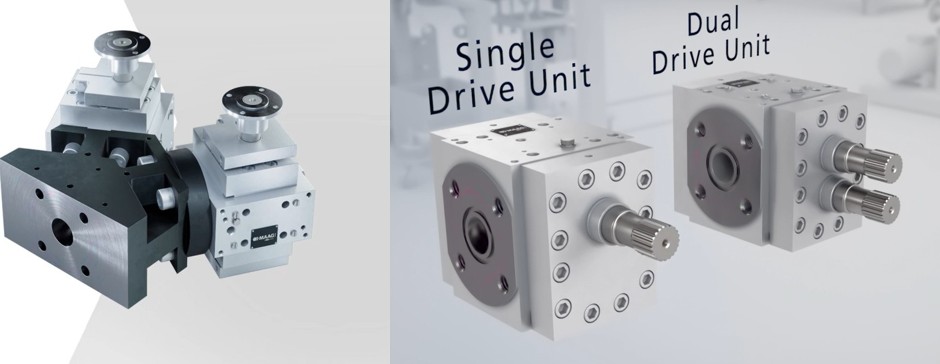
- MAAG. Single and Dual Drive Units for extrusion gear pumps. Manufacturer information on application-specific drives for highly abrasive, recycling, and fluoropolymer service. View the MAAG drive-unit page.
Evaluating a MAAG melt pump or filtration project?
Gauge Advisor is the authorized MAAG sales and applications partner for melt pumps, screen changers, filtration systems, and related controls. I help extrusion processors review the equipment application, select and quote the appropriate MAAG configuration, and coordinate the information needed for integration and factory engineering.
Gauge Advisor supports equipment selection and integration for the manufacturers represented here; independent process consulting is not offered. Send the line information below and I will respond within one business day, often within a few hours.
- Polymer grade, filler, regrind, and contamination
- Minimum, normal, and maximum throughput
- Extruder size, screw speed, and motor load
- P1 inlet and P2 outlet pressure data
- Melt temperature and viscosity information
- Screen changer, filter, and die configuration
- Current quality problem or production bottleneck
- Retrofit space, controls, and target timeline