Updated August 21, 2026
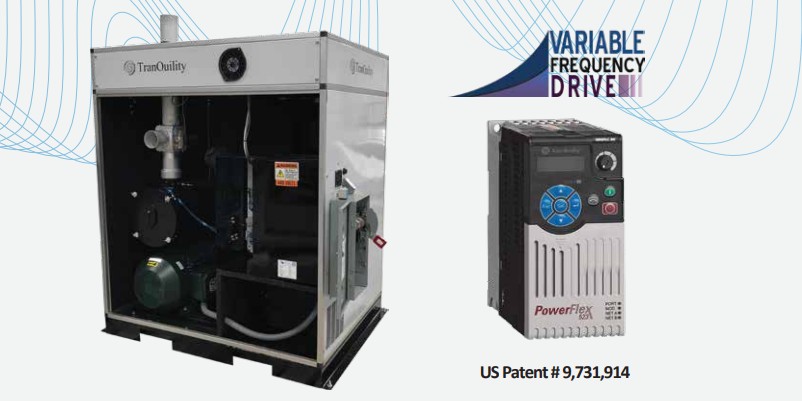
A resin conveying vacuum pump is not just a motor that pulls pellets through pipe. It is the air mover at the center of a connected system that includes the pickup point, conveying line, bends, receiver, filtration, valves, controls, and the dryer, blender, silo, or machine being fed. Advanced Blending Solutions Tranquility Vacuum Pumps package the blower, severe-duty motor, variable-frequency drive, protection devices, sound enclosure, service access, and controls together so those pieces can be applied as one conveying system rather than assembled as unrelated accessories.
Connected process path: Choose the vacuum pump as part of the entire conveying network, including air filtration, route verification, controls, and maintenance access.
Related next steps: central resin conveying systems, resin dust collection and air filtration, resin-handling controls and automation, resin selection stations, resin-handling service and retrofits, and railcar unloading systems.

What the vacuum pump actually does in a plastics plant
In a vacuum conveying system, the pump lowers pressure on the clean-air side of the receiver. Atmospheric air enters at the pickup point, accelerates the resin into the conveying line, and carries it to the receiver. The receiver separates the bulk material from the air. Filters then protect the pump from the dust and fines that remain in the air stream. The pump does not touch the pellets when the system is operating correctly.
The material path and clean-air path answer different maintenance questions. Stringers or wrong-resin events occur on the material side. Filter restriction, air leakage, relief-valve activity, and pump loading occur on the air side. Treating the complete system as one loop makes troubleshooting faster.
1. Pickup point: establish a stable air-to-material ratio
The pickup device admits resin and conveying air at the start of the route. Too little air can overload the line, while too much air can accelerate pellets unnecessarily. Pickup adjustment, material head, air leaks, and line diameter all influence the condition presented to the pump.
- Record the material, transfer rate, line size, pickup style, and air adjustment.
- Check whether the source is a silo, bin, gaylord, dryer hopper, railcar, or regrind device.
- Do not size or tune the pump from distance alone.
AIChE describes the gas mover, material source or feeder, pipeline and bends, and separator as the primary components of a pneumatic conveying system. It also treats pickup velocity and saltation velocity as key design terms.[10] That framework explains why changing only the pump can fail when the actual restriction is a dirty filter, the receiver is undersized, the pickup is poorly adjusted, or several machines are requesting material at the same time.
Resin conveying needs a velocity window, not maximum vacuum
The practical objective is to keep the material moving reliably at the lowest stable velocity appropriate for the resin, pipe, route, and required rate. Below the stable conveying range, pellets can salt out, slide, surge, or plug the line. At unnecessarily high velocity, impact at pipe walls and bends can increase dust, fines, angel hair, wear, noise, and filter loading.
This is a conceptual operating window, not a universal velocity chart. Minimum stable velocity depends on particle size, shape, density, loading, pipe diameter, route geometry, and material behavior. Representative material testing and route data are more reliable than applying one fixed speed to every system.
Technical guidance on pneumatic conveying consistently warns against both extremes. AIChE defines saltation as the condition where particles begin to drop out of suspension in a horizontal line.[11] A recent Plastics Engineering review notes that higher conveying velocity can increase pellet attrition, fines, and polymer stringing, and recommends monitoring pressure differential, filter loading, and collected contaminant mass when optimizing a plastics system.[12]
A fixed-speed package may be perfectly adequate when material, distance, line diameter, and rate remain consistent.
The longest route may need more pump speed than the shortest. Running every route at the longest-route setting can over-convey nearby machines.
Virgin pellets, soft polyolefins, filled compounds, regrind, and powders do not share one ideal pickup condition.
As filters load, system resistance rises. Differential-pressure data helps distinguish normal loading from a pump-capacity problem.
Why each Tranquility design feature matters
The original article listed seven product features but did not explain what problem each one addresses. Select a component below to see its function, why a plastics processor should care, and what it cannot correct by itself.
Twin-lobe positive-displacement blower
The blower is the gas mover. Its rotating lobes move air through the system while the piping, receiver, filter, valves, material loading, and active route create resistance. A positive-displacement architecture is well suited to central resin conveying because it can provide the airflow and vacuum range needed across changing routes when it is correctly sized and protected.
Stable blower speed and a full, clean air path support repeatable conveying cycles and predictable receiver fill.
Vacuum, motor load, belt condition, oil, temperature, filter differential pressure, relief activity, and actual transfer time.
An undersized line, large air leak, plugged filter, bad pickup, blocked receiver, or too many simultaneous demands.
Family-level options. Final size depends on material, rate, route, line diameter, lift, bends, receiver, filtration, and system demand.
ABS publishes these control options for the Tranquility family. The plant standard and integration scope should be defined before quotation.
The literature also notes 380 V at 50 Hz with the 460 V configuration. Confirm plant power, frequency, SCCR, and installation requirements.
Tranquility versus a traditional pump package depends on the application
“Traditional pump” covers many designs. Some are bare open skids with across-the-line starters. Others already have enclosures, silencers, VFDs, gauges, and good controls. The defensible comparison is not old versus new. It is the function included in the proposed package versus the function the plant actually needs.
| Architecture | Where it can fit well | What needs separate attention | Why Tranquility may provide more value |
|---|---|---|---|
Basic fixed-speed open package Simple duty | One stable material and route, modest noise concern, known filtration, and little need for route-specific control. | Starter, sound treatment, breaker and relief logic, gauge access, belt guarding, service access, and central controls. | A packaged VFD, enclosure, service features, protection devices, and controls reduce the number of separate integration decisions. |
Fixed-speed enclosed package Noise-focused | A route with steady demand where source-level noise control is important but speed variation adds little process value. | Internal heat, ventilation, filter restriction, route mismatch, and whether the enclosure remains serviceable. | ABS combines the sound enclosure with internal cooling, removable panels, VFD, and resin-conveying controls. |
Existing pump with VFD retrofit Targeted retrofit | A mechanically sound pump and motor where the plant primarily needs route-specific speed control or a soft start. | Motor compatibility, minimum speed and cooling, blower operating range, controls, pressure sensing, protection, and validation. | A new integrated package can reduce retrofit engineering when several mechanical, acoustic, electrical, and service issues exist together. |
ABS Tranquility package Integrated system | Multiple routes, sensitive resins, central conveying, high utilization, noise reduction, modern controls, or a complete ABS project. | The same system fundamentals still apply: pipe sizing, pickup, receiver, filtration, leaks, demand sequencing, and material behavior. | Blower, high-efficiency TEFC motor, VFD, protection, enclosure, access, gauge, drain, cooling, and control options are designed together. |
What should be reviewed before replacing the pump?
This selector separates a pump-package opportunity from an air-side restriction, material-handling problem, or broader central-system project. It provides a starting architecture, not a final pump size or performance guarantee.
Six conditions to correct or quantify before blaming the pump
A larger or newer pump can temporarily overpower some restrictions, but that may increase velocity, energy use, noise, or wear without solving the actual problem.
Line size, total equivalent length, vertical lift, bend count, bend radius, flex hose, and abrupt restrictions establish the pressure demand and stable conveying range.
Leaking valves, receiver lids, gaskets, flex hose, unused ports, and poor source connections consume airflow and reduce the vacuum available for material transfer.
A restricted filter increases pressure drop, slows transfer, raises pump load, and can trigger relief activity. Trend differential pressure instead of waiting for complete failure.
Powder, light flake, dusty regrind, and bridging scrap may need bag filters, blow-down cleaning, knifegates, or a specialty receiver rather than a standard pellet receiver.
A central pump can serve many destinations only through a valid sequence and receiver-fill strategy. Simultaneous requests can exceed available airflow or starve critical machines.
Bulk density, particle shape, temperature, moisture, fines, electrostatics, softness, filler, regrind percentage, and required transfer rate can change the system response.
Tranquility performs best as part of a complete ABS material-handling architecture
The pump creates airflow. Other ABS equipment determines what enters that airflow, how the resin and air are separated, where the clean air goes, which source is connected, and how the material reaches the production process.

Dust Collection Units and receivers
ABS DCUs collect particles before the air enters the vacuum pump. With ABS pump systems, differential pressure can be monitored for alarms and cleaning control. Standard, powder, and specialty receivers address different material and discharge behaviors.[5][6]
- Clean-air-side filter protection
- Differential-pressure visibility
- Powder and difficult-regrind options

Simplicity controls and sequence logic
ABS offers scalable PC and PLC control platforms with Allen-Bradley and Beckhoff options. Vacuum sequence controls can coordinate existing or new receivers, pump requests, alarms, and integration with blenders, storage, and line supervisory systems.[7]
- Receiver and pump sequencing
- Recipe, alarm, and HMI integration
- Connection to plant supervisory control

SMART material distribution
SMART reduces required common piping in multi-silo, multi-pump plants and verifies that material connections match the recipe. That addresses wrong-resin risk and routing complexity before the pump is asked to convey anything.[8]
- Recipe-verified source connections
- Shared common-line architecture
- Port and hose configurations for plant routing
ABS also supplies direct-pull and pull/push bulk-transfer systems, blending, drying, storage, and material-recovery equipment. In a direct-pull railcar arrangement, for example, the pump, receiver, and air filter operate as one transfer system rather than independent products.[9] The best cross-selling opportunity is therefore not adding unrelated equipment. It is correcting the next limiting function in the same material path.
Compare annual pump energy from actual average kW
Enter measured average input power for the current package and a measured, tested, or quoted average input power for the proposed operating case. The calculation does not infer energy from motor horsepower or a theoretical speed ratio.
Excluded: demand charges, route-by-route duty changes, equipment price, financing, rebates, maintenance, filter condition, increased production, noise reduction, resin quality, downtime, and any capital or installation cost. Use the Resin Conveying and Blending ROI Calculator for a broader project case.
Information needed to size and compare the pump correctly
The most useful quotation request describes the complete conveying duty. “We need a 15 HP pump” is not enough because the same motor size can be attached to very different routes, line sizes, filters, receivers, and material loads.
- MaterialsResin name, pellet or powder form, bulk density, temperature, regrind percentage, fines, softness, filler, and moisture condition.
- Transfer ratesRequired lb/h or kg/h by route, receiver fill volume, cycle time, peak demand, and whether the system must recover from an empty destination.
- Route geometryLine diameter, hard horizontal distance, flex distance, vertical lift, bend count and radius, reducers, valves, and pickup arrangement.
- Sources and destinationsSilos, bins, gaylords, dryers, blenders, machine hoppers, railcars, trucks, and the number of simultaneous or sequenced requests.
- Current pump dataManufacturer and model, blower displacement, motor HP, voltage, starter or VFD, measured kW, vacuum, speed, run hours, and maintenance history.
- Receiver and filtrationReceiver size and type, discharge valve, filter area, cleaning method, differential pressure, dust collected, and relief-valve activity.
- Symptoms and baselineSlow transfer, plugging, angel hair, dust, filter loading, noise, overheating, belt wear, oil issues, leaks, downtime, and affected routes.
- Controls and integrationAllen-Bradley, Beckhoff, or plant standard; HMI; sequence logic; recipes; alarms; networking; remote support; and supervisory I/O.
- Installation conditionsIndoor or outdoor location, ambient temperature, dust classification, available space, service clearances, rigging path, foundation, and exhaust routing.
- Representative testingMaterial samples, difficult routes, current timing data, sound survey, power logging, filter data, and the acceptance criteria for the upgrade.
Common vacuum-pump selection and retrofit mistakes
Sizing from horsepower or straight-line distance alone
Horsepower does not define blower airflow, usable vacuum, line velocity, or transfer rate. Equivalent length, lift, bends, line diameter, material loading, filter resistance, receiver, pickup, and simultaneous demand belong in the sizing review.
Assuming more vacuum always conveys more reliably
More speed can increase available airflow and vacuum, but it can also increase resin impact, dust, angel hair, pipe wear, noise, and filter loading. The objective is sufficient stable velocity for the active route, not the maximum pump setting.
Calling the VFD an energy-saving accessory without a control strategy
A drive creates the ability to change speed. The energy and material-quality value comes from how speed is scheduled or controlled by route, pressure, material, and demand. A VFD left at full speed does not create a useful velocity-control result.
Ignoring filter differential pressure
A dirty filter can make a healthy pump look undersized. It can also increase motor load, extend fill time, trigger relief activity, and reduce available conveying capacity. Measure restriction before changing pump size.
Using a standard pellet receiver for powder or difficult regrind
Powder can require bag filters and compressed-air cleaning. Lightweight or irregular regrind may bridge and require a different vessel or discharge. The receiver is part of the material application, not only a container above the machine.
Enclosing an existing pump without reviewing heat and access
Acoustic treatment can trap motor, blower, belt, and VFD heat. An effective enclosure also needs ventilation or cooling, service clearances, removable panels, and a plan for maintaining sound control after repeated access.
Assuming arc-flash-friendly means no electrical safety work remains
Equipment arrangement can support maintenance, but it does not replace the facility’s electrical assessment, labels, PPE, qualified-person requirements, energy isolation, and work procedures.
Moving or servicing the pump without controlling stored energy
Electrical energy, rotating components, vacuum, pressurized cleaning air, hot surfaces, oil, and connected valves can remain hazardous. OSHA’s lockout standard addresses unexpected energization and release of stored energy during service and maintenance.[14]
Comparing one product sound or energy value with a plant-wide result
Room acoustics, distance, operating state, relief events, other machines, route duty, filter condition, and measured electrical demand change the result. Establish the same measurement conditions before and after the upgrade.
Related Gauge Advisor resin-handling resources
Tranquility vacuum pump FAQs
What does the vacuum pump do in a resin conveying system?
It creates the pressure difference that moves conveying air through the pickup, material line, receiver, filter, and clean-air piping. The moving air entrains the resin. The receiver separates the material before the air reaches filtration and the pump.
Is higher vacuum always better?
No. The system needs enough airflow and vacuum to maintain stable transfer on the controlling route. Excessive speed can increase pellet impact, fines, angel hair, noise, wear, and filter loading. Low speed can allow saltation and plugging.
Why does Tranquility include a VFD as standard?
The drive allows blower speed to be matched to the active route and material. ABS Velocity Control uses inlet-pressure feedback to target a programmed pickup velocity rather than running every route at one fixed maximum speed.
Can a VFD be added to my existing pump?
Sometimes. Review motor and blower compatibility, minimum safe speed, cooling, belt or coupling, pressure sensing, relief protection, breaker-valve logic, controls, and the actual operating range. A retrofit is most attractive when the existing mechanical package is otherwise sound.
What is the difference between the relief valve and breaker valve?
The mechanical relief valve provides a protective vacuum limit. The breaker valve intentionally admits air or unloads the vacuum during the control sequence. They serve different protective and operating functions and should not be treated as interchangeable.
Why is the liquid-filled vacuum gauge useful?
It gives maintenance and operators a local indication of system vacuum, with liquid damping that helps steady the pointer. It is useful for comparing normal and abnormal states, but it is not an airflow meter and does not identify the restriction by itself.
Does the enclosure eliminate the need for a noise survey?
No. The enclosure addresses one source. Employee exposure also depends on distance, duration, relief events, room acoustics, adjacent equipment, shift pattern, and the measurement method. Use the dedicated Tranquility EHS guide for occupational-noise planning.
When should filtration be upgraded with the pump?
Review filtration when the current system has high differential pressure, rapid loading, visible dust carryover, relief activity, frequent cleaning, powder, high fines, or no reliable way to monitor restriction. A pump replacement without clean-air protection can shorten equipment life and preserve the same capacity problem.
What applications need a special receiver?
Powders, dusty blends, light flake, irregular regrind, and bridging scrap may require bag filters, compressed-air cleaning, knifegates, a square outlet, or another specialty receiver. Standard pellet receivers are not universal.
How do I compare energy use fairly?
Log actual electrical input kW, route, transfer rate, vacuum, filter state, and annual duty. Compare the same production demand. Do not estimate savings only from motor HP or assume a universal percentage from VFD speed.
What should I send for a preliminary Tranquility quotation?
Send the materials, rates, line diameters, hard and flex distances, vertical lift, bends, sources, destinations, simultaneous demand, current pump data, receiver and filter information, controls, electrical service, installation photos, and the problem the project must solve.
References and source notes
The references remain collapsible so this focused commercial article stays readable. They open automatically when printed.
Open technical references and source notes15 sources
Gauge Advisor is the authorized Advanced Blending Solutions sales and applications support partner. ABS sources are used for current Tranquility construction, available configurations, Velocity Control, filtration, receivers, SMART routing, controls, and bulk-transfer architecture. AIChE, Plastics Engineering, the U.S. Department of Energy, and OSHA provide noncompetitive process, energy, and safety context. No competing resin-handling equipment manufacturer is cited.
- Advanced Blending Solutions, Tranquility Vacuum Pumps. Current standard-package feature list and resin-conveying positioning.
- Advanced Blending Solutions, Tranquility Pump Packages literature. Published motor sizes, control styles, voltages, standard features, and VFD pickup-velocity purpose.
- Advanced Blending Solutions, Tranquility Vacuum Pumps launch article. Manufacturer background on source-level sound control, enclosure, and silencer design. Published demonstration results are application-dependent.
- Advanced Blending Solutions, Velocity Control and Variable Frequency Drives. Patented pump-speed control based on inlet pressure and manufacturer-published material-quality and energy claims.
- Advanced Blending Solutions, Air Filtration. Dust Collection Unit airflow, access, filter attachment, differential-pressure monitoring, alarms, cleaning control, and hazard-class options.
- Advanced Blending Solutions, Vacuum Receivers. Standard receiver sizes, flapper and knifegate arrangements, powder receivers, and specialty receivers for difficult regrind.
- Advanced Blending Solutions, Simplicity Controls. PC and PLC architecture, Allen-Bradley and Beckhoff options, vacuum sequence control, graphical interfaces, and plant integration.
- Advanced Blending Solutions, SMART Material Distribution. Common-line reduction, recipe verification, hose modules, base units, and port expanders.
- Advanced Blending Solutions, Direct Pull System. Relationship among pump packages, vacuum receivers, air filters, and railcar-to-silo transfer.
- AIChE, Introduction to Pneumatic Conveying of Solids. System components, pickup velocity, saltation velocity, pressure drop, gas behavior, and design context.
- AIChE Chemical Engineering Progress, Dilute or Dense Phase Pneumatic Conveying. Saltation definition and conveying-mode context.
- Plastics Engineering, Conveying PCR: Reducing Fines, Angel Hair, and Scrap, 2026. Plastics-specific discussion of velocity, route geometry, pipe condition, filtration, fines, and stringing.
- U.S. Department of Energy, Improving Motor and Drive System Performance. Motor-system optimization and variable-frequency-drive fundamentals.
- OSHA 29 CFR 1910.147, Control of Hazardous Energy. Minimum requirements for controlling unexpected energization or stored-energy release during service and maintenance.
- U.S. Department of Energy, Premium Efficiency Motor Selection and Application Guide. Motor application, loading, cooling, and variable-speed operating considerations.
Review the entire conveying route before choosing the pump
Gauge Advisor is the authorized Advanced Blending Solutions sales and applications support partner. I help plastics processors evaluate, select, quote, integrate, and support Tranquility vacuum pumps, Velocity Control, vacuum receivers, Dust Collection Units, SMART material distribution, Simplicity controls, railcar unloading, blending, drying, storage, and related ABS systems.
Gauge Advisor supports equipment selection and integration for the manufacturers represented here; independent process consulting is not offered. Send the material, transfer rate, route geometry, current equipment, filters, receivers, controls, power data, symptoms, and installation photos when available. I will respond within one business day, often within a few hours.
- Tranquility pump and blower-size screening
- Velocity Control and route review
- Receiver and filtration selection
- SMART routing and control architecture
- Retrofit mechanical and electrical review
- Quotation and ongoing applications support