Updated August 21, 2026
Film edge trim recycling works best when the plant preserves material identity, chooses the right feed method, converts lightweight scrap into a stable feed form, and controls how much reclaim returns to the extrusion recipe. For clean post-industrial edge trim and off-spec rolls, an in-plant direct-extrusion repelletizer can create a practical closed loop without sending every pound through a separate grinder, a large centralized recycling line, or an outside recycler.
Connected process path: Close the loop from clean film trim through repelletizing, controlled reclaim blending, conveying, and downstream melt filtration.
Related next steps: film-scrap repelletizing, continuous gravimetric blenders, central resin conveying systems, resin-handling controls and automation, and recycling and regrind melt delivery.

Which film scrap stream are you trying to recover?
Two scrap piles that look similar can require different equipment. Select the closest stream to see what should be checked before deciding whether to granulate, repelletize, preprocess, or keep the material out of the internal loop.
Continuous edge trim: the strongest direct-recovery case
Narrow trim generated continuously at a slitter, winder, cast-film line, or blown-film process is often the easiest stream to keep clean and identified. When the trim rate is stable and the polymer construction is compatible with the product recipe, direct collection and repelletizing can return the material before it becomes mixed warehouse scrap.
Trim width, thickness, line speed, number of trim streams, transport distance, static, interruptions, polymer construction, and actual pounds per hour.
Strong starting application for an inline trim-feed configuration, with the model selected from the material-dependent rate and plant layout.
Continuous trim is not automatically reusable in the same product. Confirm additives, print, coatings, barrier layers, heat history, and approved reclaim percentage.
Film scrap is valuable resin in a difficult physical form
Clean post-industrial film can have a known formulation and relatively low contamination risk. The challenge is that thin film has very low and variable bulk density, traps air, bridges, wraps, carries static, and feeds very differently from regular pellets.
Loose film occupies a large volume for little mass. Research on regrind processing shows that lower bulk density and irregular shape can reduce solids-conveying performance compared with virgin pellets.[8][9]
Film can span a feed opening, surge after a bridge releases, or pull unevenly from a roll. Stable feeding is one reason the feed entry and collection interface matter.
Once PE, PP, barrier film, print, adhesive, purge, floor sweepings, and wet scrap enter one gaylord, the plant may no longer have a controlled internal ingredient.
Repelletizing remelts the polymer. Multiple reprocessing cycles can change melt flow, tensile response, impact, color, odor, gels, and other product properties in a material-dependent way.[10]
Printed, coated, wet, dusty, metal-contaminated, or post-consumer film may require stronger filtration, degassing, washing, separation, or a different recycling architecture.
Mechanical recycling becomes more difficult when layers contain incompatible polymers or functional materials. A homogeneous appearance does not prove the blend will process or perform acceptably.[12]
A stable pellet form can be conveyed, stored, weighed, and introduced through a gravimetric blender more predictably than a fluctuating stream of fluff or irregular regrind.
Source reduction remains preferable to creating scrap and then recycling it. First reduce avoidable trim, startup loss, profile variation, and roll defects, then recover the clean residual stream.[15]
What a controlled film-scrap loop actually includes
A closed loop is more than placing a recycling machine beside the film line. The plant must control the scrap before, during, and after repelletizing.
From eligible film scrap to a qualified reclaim ingredient
The most important controls are material identity, feed stability, melt condition, pellet quality, reclaim percentage, and finished-product validation. A failure at any one stage can turn a valuable closed loop into an uncontrolled source of variation.
Flexible-film recycling literature identifies collection, sorting, contamination, filtration, and material-property preservation as recurring barriers.[11] The in-plant advantage is that production scrap can be intercepted before it becomes mixed post-consumer waste. That advantage is lost when the plant combines incompatible streams or allows floor contamination, water, metal, labels, tape, cores, or unknown film into the feed.
Inline edge trim and offline roll feeding solve different operating problems
The strongest Sasquatch applications often use one or both of these feed strategies. The final collection, unwind, rate-control, and machine-sequencing design should be confirmed for the actual film and line.
The scrap is captured immediately, usually has known identity, avoids handling and storage, and can be sized around a rate that repeats whenever the line runs.
An off-spec roll contains a large, concentrated mass of resin. Controlled roll feeding can recover it without manually chopping an entire roll into a separate grinder or centralized system.
Continuous trim and intermittent roll scrap create different peaks. Size the machine, staging, labor, controls, and storage around the combined operating schedule rather than one average number.
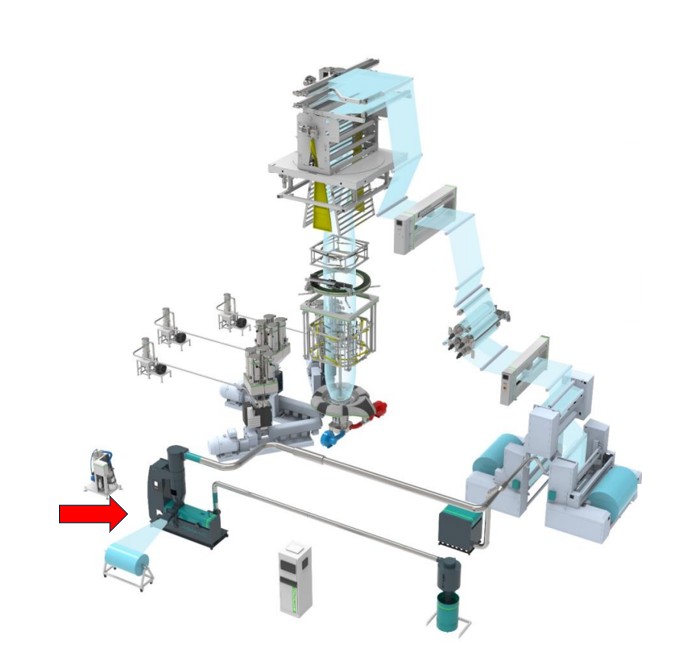
Why Sasquatch is a strong in-plant film repelletizing platform
ABS identifies Sasquatch as a direct-extrusion system for converting trim scrap back into production. The current 2026 platform is broader than the older 110 lb/h description in this article and now includes Alpha and Omega series models with estimated material-dependent rates from 110 to 551 lb/h.[1][2]
For eligible trim and roll scrap, the recovery route can avoid a separate grinder as the first step.
Eight Alpha and Omega models. ABS states that actual rate varies by material type.
The brochure links the enlarged feed entry to reduced bridging risk.
Final controls, pelletizing, utilities, and integration are selected for the project.
The feed entry and collector architecture address the physical problems that make film difficult to feed as a loose bulk solid.
Pellets can be collected, conveyed, stored, weighed, and introduced through a gravimetric blender as a defined reclaim component.
ABS describes material-based temperature control, process visibility, data collection, and integration with the production recipe.[3]
ABS offers customer-material trials at its facility, which is especially valuable for printed, multilayer, tacky, thin, or otherwise uncertain scrap.[3]
ABS can remotely access enrolled systems to diagnose and resolve software or control issues and publishes a 24-hour remote-support phone line.[4]
The ABS after-sales group covers spare parts, maintenance, repairs, technical support, and operator training.[5]
ABS also provides blenders, receivers, pumps, dust collection, routing, storage, controls, drying, and bulk-material equipment.
Sasquatch is not a washing plant, polymer separator, de-inking system, universal devolatilizer, or automatic authorization for every printed, barrier, contaminated, or regulated film.
Lower to mid-range film recovery
Mid-range to larger recovery loads
*ABS brochure estimates. Rates vary with polymer, thickness, construction, feed form, temperature, contamination, pelletizing configuration, cooling, and the complete operating window. Model selection should use normal rate, peak rate, turndown, scrap schedule, and representative trials.
Repelletizing is not the only way to reuse film scrap
Current film-scrap recovery approaches range from simple inline granulation through large shredder-extruder recycling systems. The defensible question is not which machine is universally best. It is which physical feed form and quality requirement match the plant’s scrap.
| Recovery method | Best-fit scrap | Why it can be attractive | Important tradeoff and Sasquatch position |
|---|---|---|---|
Direct refeed as fluff or granulate Simplest loop | Clean, homogeneous edge trim that can be cut consistently and fed immediately into a compatible line. | Avoids another complete melt history and may have lower capital and energy demand when the existing blender or feed system can meter the low-density material reliably. | Irregular regrind can have lower bulk density, unstable feed, segregation, bridging, dust, and inconsistent ingredient flow. Sasquatch is stronger when the plant needs a pellet that can be conveyed, stored, and gravimetrically metered. |
Direct-extrusion film repelletizing Sasquatch focus | Known, clean post-industrial edge trim and off-spec film rolls that need a stable pellet form. | Can remove a separate grinding stage from the eligible route, supports inline and roll-feed strategies, and creates a conventional pellet for the connected resin system. | Adds heat history and requires material qualification. It is not the first choice for dirty, wet, highly volatile, mixed, or incompatible scrap without trials and additional processing. |
Cutter-compactor or agglomerator plus extrusion Broader feed form | Loose film, bags, raffia, nonwoven, printed film, and irregular low-density scrap that benefits from cutting, densifying, preheating, or degassing. | The preconditioning stage can stabilize a wider range of bulky or inconsistent feed forms before extrusion. | More mechanical processing, wear parts, power, footprint, thermal history, maintenance, and controls may be justified only when the scrap requires them. Sasquatch can be the cleaner, simpler path for well-controlled trim and rolls. |
Shredder, washing, separation, and multi-stage extrusion Difficult recycling | Dirty post-consumer film, agricultural film, mixed rigid and flexible scrap, heavy contamination, labels, metal risk, moisture, or broad external feedstock. | Provides the preparation, cleaning, separation, degassing, and filtration needed for a difficult waste stream. | This is a larger recycling plant, not merely a film-line accessory. Sasquatch should not be presented as a substitute when washing, separation, or intensive decontamination is the real requirement. |
Offsite tolling or scrap sale Avoid plant capital | Low, intermittent, mixed, restricted, or non-reusable scrap without enough volume to justify in-house equipment. | Avoids internal capital, staffing, maintenance, utility, storage, and process-development requirements. | The plant gives up some value, timing, traceability, and control while adding freight and inventory. In-house Sasquatch recovery becomes more compelling when clean scrap volume is steady and reuse is already technically approved. |
Does the film-scrap application fit Sasquatch?
This tool identifies a practical starting architecture and a preliminary Alpha or Omega rate family. It does not replace material trials, detailed feed-system design, utility review, quality validation, or an ABS quotation.
Sasquatch is more valuable when the rest of the resin system controls the reclaim
The repelletizer creates the pellet. The surrounding system determines whether that pellet arrives at the right line, at the right percentage, in the right condition, with enough data to troubleshoot the result. Gauge Advisor’s complete resin-handling systems page and Resin Handling System Selector help organize these connected decisions.
Design collection air, trim routing, roll handling, static control, staging, and interlocks around the actual source and rate.
Convert the eligible film stream into a pellet with the selected Alpha or Omega machine, cooling configuration, recipe, and controls.
Use a suitable collector, receiver, intermediate bin, level control, and segregation plan so reclaim does not become a mixed unidentified material.
Move pellets through a correctly sized pump, receiver, filtration, and velocity-control system without creating avoidable fines or stringers.
Meter reclaim by weight rather than relying on an uncontrolled hand blend or a fluctuating fluff stream. Track actual percentage by recipe and production order.
Verify the source-to-destination path, coordinate recipes and alarms, retain trends, and keep the wrong reclaim from reaching the wrong film line.
PE and PP edge trim may not need desiccant drying, but hygroscopic layers, washed scrap, moisture exposure, or other polymers can change the requirement. Dry the material because the resin and process require it, not because every reclaim stream needs a dryer.
Receiver filters and dust collection protect the conveying-air side. Melt filtration, if required, addresses contaminants in the molten polymer. Confirm both architectures separately.
ABS provides after-sales parts, repairs, training, direct technical support, and a remote-support program. That can be more useful than buying isolated machines from several suppliers and diagnosing the interfaces alone.
How to prove the recovered pellet is suitable for the film
The validation plan should follow the product risk. A trash-bag application, an agricultural film, a printed conversion web, a food-contact package, and a regulated medical film do not have the same reclaim limits or testing requirements.
Confirm resin family, grade, layer structure, color, additives, treatment, print, adhesive, and the reason the film became scrap.
Inspect size distribution, tails, agglomerates, fines, color, odor, moisture, metal, black specks, gels, and flow through the selected receiver and feeder.
Use melt flow or a more appropriate rheology method to compare virgin, one-pass reclaim, blended material, and repeated-loop material. ASTM D1238 cautions that melt-flow rate does not predict every other property without valid correlation.[16]
Run a designed series such as zero, low, normal, and upper reclaim percentage instead of jumping from laboratory pellets to an uncontrolled full-production blend.
Trend melt pressure, screen loading, output, motor load, melt temperature, die buildup, bubble stability, gauge profile, gels, odor, and startup behavior.
Depending on the product, review thickness, tensile, dart impact, tear, seal strength, coefficient of friction, haze, shrink, barrier, print, and customer-specific properties.[17][18]
Food-contact recycled plastic requires a chemistry and process assessment. FDA evaluates proposed recycled-plastic food-contact uses case by case and identifies contaminant migration as a major concern.[13]
Removing a separate grinder may remove one dust-generating step, but plastic dust and additives remain within OSHA’s combustible-dust program. The plant still needs housekeeping, hazard assessment, and suitable collection and protection.[14]
Estimate the annual value of qualified film-scrap reuse
This calculator values only the pounds that are captured, converted into usable pellets, and approved to displace virgin resin. It subtracts the existing scrap value and the entered variable processing cost from the virgin-resin value. It does not apply a universal payback claim.
Excluded: equipment price, installation, financing, depreciation, tax treatment, fixed labor, floor space, scrap-storage reduction, freight, avoided outages, product claims, throughput effects, and any value already counted elsewhere. Use the Resin Handling ROI Calculator for a broader plant model and keep each recovered pound in only one savings category.
Common film-scrap repelletizing mistakes
Combining incompatible polymers because they all look like clear film
PE, PP, PA, EVOH, PET, tie layers, coatings, adhesives, and additives do not become compatible merely because the scrap is transparent. Keep identity by recipe and validate every multilayer or mixed stream.
Counting every pound of plant scrap as recoverable
Some scrap is wet, dirty, mixed, degraded, printed, customer-restricted, food-contact restricted, or otherwise unsuitable. Base the machine and ROI on the eligible stream, not the plant’s total dumpster weight.
Sizing from average trim rate and ignoring peaks
Roll recovery, line startup, web breaks, trim-width changes, and several simultaneous sources can create peaks well above the average. Review normal, maximum, minimum, and scheduled batch demand.
Assuming pellet form restores virgin properties
Repelletizing improves feed form. It does not reverse thermal oxidation, contamination, incompatible layers, additive loss, print, odor, or repeated heat history. Finished-film tests control release.
Returning reclaim without gravimetric control
A fluctuating reclaim percentage can create more variation than the recovered material saves. Meter reclaim as a defined ingredient and trend actual consumption by recipe and production order.
Ignoring screens, gels, volatiles, and contamination
Printed, coated, dusty, wet, or aged scrap can change screen loading, odor, die buildup, gels, and bubble stability. Review filtration, venting, material trials, and the plant’s acceptable defect level before finalizing the system.
Calling the process dust-free or automatically OSHA compliant
Eliminating a separate grinder can remove one source of noise, dust, and maintenance, but the facility still handles polymer fines and hot equipment. Combustible-dust, ventilation, guarding, lockout, housekeeping, and fire-protection requirements remain site-specific.
Buying the repelletizer without the material-handling interfaces
Trim collection, roll presentation, pellet cooling, receiver capacity, conveying air, storage, level control, blender feed, recipe logic, and alarms determine whether the complete loop runs reliably.
Skipping a trial on the most difficult approved scrap
Do not test only a clean easy roll. Include the thinnest, tackiest, most printed, highest-slip, most variable, longest-stored, or otherwise difficult material that will be included in the production scope.
Film-scrap and system information that speeds up selection
- Film constructionPolymer grades, number of layers, layer percentages, tie layers, barrier resin, color, additives, print, coating, adhesive, and treatment.
- Scrap sourcesEdge trim, bleed trim, off-spec rolls, startup film, bubble collapse, web breaks, loose scrap, regrind, purge, or external scrap.
- Feed form and dimensionsTrim width and count, film thickness, roll width, roll diameter, core, loose-film size, winding condition, tack, static, and storage age.
- Rate profileMinimum, normal, and peak lb/h by source; line speed; trim percentage; roll batches per week; and whether several sources run together.
- Contamination and restrictionsWater, oil, dust, metal, tape, labels, cores, floor contact, ink, odor, gels, food-contact status, and customer reclaim limits.
- Current dispositionScrap sale value, disposal cost, freight, labor, storage, baling, granulation, tolling, and actual annual eligible pounds.
- Reuse objectiveSame product, another internal product, approved reclaim percentage, required pellet condition, quarantine, traceability, and release testing.
- Plant layout and utilitiesCollection points, convey distance, floor space, elevation, power, compressed air, cooling water, ventilation, access, guarding, and maintenance clearance.
- Connected ABS equipmentExisting blenders, pumps, receivers, bins, silos, SMART routing, dryers, dust collectors, controls, and available PLC communication.
- Representative trial materialClean normal scrap, worst approved scrap, printed or multilayer samples, known problem material, and enough mass for a realistic ABS trial.
Related Gauge Advisor film and resin-handling resources
Film edge trim and roll-scrap repelletizing FAQs
What is the difference between regrinding and repelletizing film scrap?
Regrinding cuts film into irregular pieces or fluff that may be returned directly if the feed system can meter it reliably. Repelletizing remelts the scrap and forms pellets, creating a denser and more conventional feed form for conveying, storage, and gravimetric blending. Repelletizing also adds another thermal history.
Can one Sasquatch process both inline edge trim and off-spec rolls?
Sasquatch is positioned for direct film-scrap extrusion and is used in inline trim and roll-feed recovery architectures. The final collection, roll-feed, simultaneous or scheduled operation, peak-rate capacity, and controls should be confirmed for the quoted system.
Which materials are the best candidates?
Clean, known post-industrial PE or PP film and qualified compatible structures are the strongest starting candidates. Printed, coated, adhesive-bearing, barrier, mixed, wet, dusty, metal-contaminated, or unknown scrap requires more testing and may need a different architecture.
Does Sasquatch eliminate the need for a grinder?
For eligible continuous trim and roll film, the direct-extrusion route can remove a separate grinder from that recovery path. It does not mean every plant scrap stream can bypass size reduction, preparation, washing, separation, or contamination control.
How much throughput can Sasquatch handle?
The 2026 ABS brochure lists Alpha and Omega model estimates from 110 to 551 lb/h. ABS states that rates vary by material. Final selection should include normal and peak scrap rate, material construction, thickness, feed form, cooling, operating schedule, and trials.
Can the pellets go directly back into the same film?
Only after the material construction, heat history, contamination, reclaim percentage, and finished-film performance are qualified. Many plants use a gravimetric blender to meter reclaim at a controlled percentage rather than treating the pellet as an unrestricted virgin substitute.
What tests should be run on recovered film?
Typical checks can include pellet appearance, moisture, melt flow or rheology, screen loading, extrusion stability, thickness profile, tensile, dart impact, tear, seal strength, coefficient of friction, haze, shrink, print, barrier, odor, and customer-specific tests. Select the test plan from the product specification and risk.
Is a pelletizer always better than an inline granulator?
No. A granulator can be simpler when clean trim can be metered directly and pellet form adds little value. Sasquatch is stronger when the plant needs a stable pellet for storage, conveying, gravimetric dosing, multiple destinations, or scheduled roll recovery.
Does avoiding a grinder make the plant OSHA compliant?
No. It can remove one source of noise, dust, and maintenance, but the plant still must evaluate combustible dust, guarding, hot surfaces, ventilation, housekeeping, lockout, electrical classification, and fire protection for the full installation.
What support does ABS provide after installation?
ABS publishes after-sales support for spare parts, maintenance, repairs, technical support, and training. Its remote-support program allows enrolled systems to be accessed for control and software diagnostics and provides a 24-hour support phone line. Commercial terms should be confirmed at the time of service.
Can ABS test my film before I buy?
ABS states that customer-material trials are available at its facility. A useful trial should include normal and difficult approved scrap, enough material to reach stable operation, the intended feed form, and the pellet and film tests that will control acceptance.
References and source notes
The references remain collapsible so the article stays readable. They open automatically when printing.
Open technical references and source notes18 sources
Gauge Advisor is the authorized Advanced Blending Solutions sales and applications support partner. ABS sources are used for current Sasquatch models, capabilities, controls, material trials, and support. Peer-reviewed papers, FDA, OSHA, EPA, and ASTM sources provide noncompetitive context for film recycling, repeated processing, bulk-density effects, contamination, dust, and validation. Competitive recycling-equipment manufacturers were researched for architecture comparison but are not named or cited.
- Advanced Blending Solutions, Repelletization. Current Sasquatch product positioning as a direct-extrusion film-scrap system.
- Advanced Blending Solutions, Sasquatch 2026 brochure. Current Alpha and Omega model rates, melt-temperature control, enlarged feed entry, collector chamber, Allen-Bradley controls, and air- or water-cooled configurations. All published rates are estimates and material-dependent.
- Advanced Blending Solutions, The Smarter Beast. Recipe integration, material-based temperature control, process visibility, data, remote access, and customer-material trials.
- Advanced Blending Solutions, Remote Support. Remote software and controls diagnostics, support process, and 24-hour remote-service phone line.
- Advanced Blending Solutions, After Sales. Spare parts, maintenance, repair, technical support, and training services.
- Gauge Advisor, Complete Plastics Resin Handling Systems. Connected conveying, blending, drying, routing, storage, controls, contamination control, and film-trim recovery context.
- Gauge Advisor, Film Extrusion Equipment Upgrades. Process-first prioritization and avoidance of double counting in film-equipment ROI.
- Thieleke and Bonten, Enhanced Processing of Regrind as Recycling Material in Single-Screw Extruders, Polymers, 2021. Irregular regrind shape, lower bulk density, feed-zone behavior, throughput, and process-window effects.
- Johann, Reißing, and Bonten, Comparative Analysis of the Solid Conveying of Regrind, Virgin and Powdery Polyolefins, Journal of Manufacturing and Materials Processing, 2022. Solid-conveying differences among regrind, pellets, and powder.
- Ballestar de las Heras et al., Comparative Analysis of Post-Industrial Recycled LLDPE in Film, Polymers, 2024. Effects of recycled LLDPE and multiple reprocessing cycles on material and film properties.
- Langwieser et al., Impact of Single and Double Filtration Systems on Recycled Flexible Packaging, Polymers, 2024. Technical barriers in flexible-film recycling and the relationship between filtration and recycled-material quality.
- Kaiser, Schmid, and Schlummer, Recycling of Polymer-Based Multilayer Packaging, Recycling, 2018. Multilayer packaging structures, compatibility challenges, and recycling pathways.
- U.S. FDA, Use of Recycled Plastics in Food Packaging: Chemistry Considerations. Case-by-case evaluation and contaminant-migration considerations for recycled food-contact plastic.
- OSHA, Combustible Dust National Emphasis Program, CPL 03-00-008. Plastic dust and additives within combustible-dust inspection and hazard context.
- U.S. EPA, Non-Hazardous Materials and Waste Management Hierarchy. Source reduction and reuse are preferred before recycling, energy recovery, and disposal.
- ASTM D1238-23a, Melt Flow Rates of Thermoplastics by Extrusion Plastometer. Quality-control use and the important limit that melt-flow rate does not establish uniformity of other properties without valid correlation.
- ASTM Plastics Standards. Current film-test references including D882-26 tensile, D1709-24 dart impact, D1894-24 coefficient of friction, D6988-21 thickness, and related methods.
- ASTM F88/F88M-23, Seal Strength of Flexible Barrier Materials. Seal-strength measurement for process validation, capability, and control.
Review the scrap stream, feed method, and reuse specification together
Gauge Advisor is the authorized Advanced Blending Solutions sales and applications support partner. I help blown-film, cast-film, converting, sheet, and extrusion plants evaluate, select, quote, integrate, and support Sasquatch repelletizers and the connected ABS conveying, storage, blending, routing, filtration, drying, and controls equipment.
Gauge Advisor supports equipment selection and integration for the manufacturers represented here; independent process consulting is not offered. Send the film construction, trim and roll dimensions, normal and peak rate, contamination condition, current scrap disposition, reuse target, layout, utilities, and representative material when available. I will respond within one business day, often within a few hours.
- Inline edge-trim collection review
- Offline roll-feed and batch-recovery review
- Alpha or Omega family screening
- ABS material-trial coordination
- Conveying, storage, blender, and controls integration
- Quotation, startup planning, and ongoing support