What does a film repelletizer do?
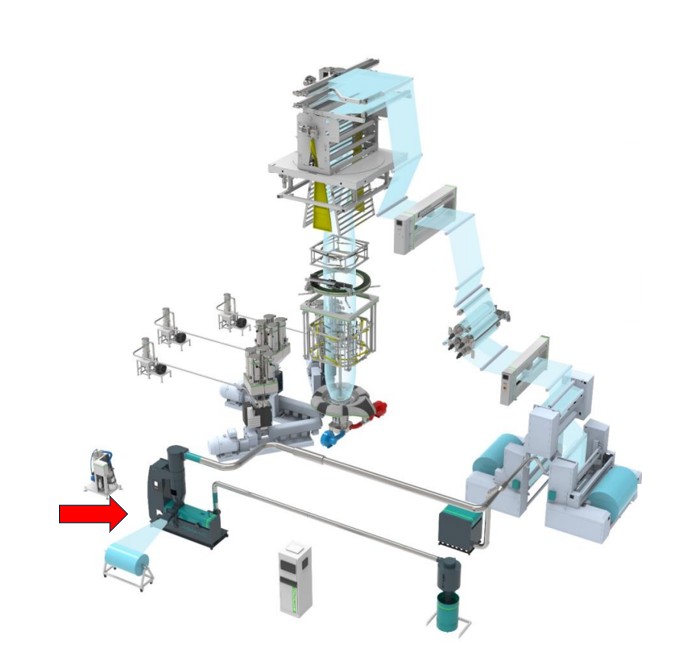
A film repelletizer converts eligible plastic film process scrap into pellets that are easier to convey, store, and meter. The Sasquatch is a direct-extrusion system for compatible film scrap. A complete production loop also needs a defined feed method, pellet collection and cooling, material transfer, buffer or receiver, gravimetric return, recipe controls, and a quality plan.
How is repelletizing different from granulating film scrap?
Granulation mechanically cuts scrap into irregular pieces. Direct-extrusion repelletizing melts compatible scrap and forms it into pellets. Pellets are generally easier to convey and gravimetrically meter, but extrusion adds heat history and requires review of polymer compatibility, filtration, degradation, volatiles, moisture, pellet condition, and downstream product requirements.
Can Sasquatch run inline with a blown-film, cast-film, or sheet line?
Sasquatch is designed to support inline film-scrap recovery. Blown-film and cast-film edge trim are strong starting applications. Selected thin-sheet or web scrap can also be reviewed. The actual trim geometry, rate, construction, speed, static, feed method, peak demand, line stops, and finished-product requirements determine whether the application and configuration are suitable.
Can one system process edge trim and off-spec rolls?
A project can be reviewed for continuous trim plus scheduled roll recovery, but the operating sequence matters. Continuous trim creates a base load while roll processing creates intermittent demand. Record whether those loads overlap, how rolls are presented, and how controls prioritize, stop, or isolate each source before selecting a model and feed arrangement.
Which materials are the strongest candidates?
The strongest starting candidates are clean, dry, known, segregated post-industrial film scrap with a stable feed form and an approved reuse destination. Printed, coated, adhesive, tacky, multilayer, barrier, moisture-exposed, dusty, or inconsistent scrap requires representative trials. Dirty post-consumer film, mixed polymers, unknown structures, or material needing washing and intensive separation generally requires a different recycling system.
Does direct extrusion eliminate the need for a grinder?
For eligible clean and controlled trim or roll scrap, direct extrusion may remove a separate grinder as the first step. That is not a universal claim. Some scrap forms, rigid or thick material, tangled webs, inconsistent feed, mixed waste, or contaminated material may require preparation, size reduction, densification, separation, or a different system.
What are the current Alpha and Omega throughput ranges?
The August 2026 cut sheet publishes eight estimated rates: Alpha XS 110 lb/h, Alpha S+ 198 lb/h, Alpha M 265 lb/h, Alpha L 375 lb/h, Omega Compact 220 lb/h, Omega S 331 lb/h, Omega M 441 lb/h, and Omega L 551 lb/h. Every rate is an estimate that varies by material type. Final performance and configuration require representative material testing and written quotation.
How do air-cooled and water-cooled configurations differ?
The 2026 cut sheet depicts Alpha air-cooled and Alpha water-cooled configurations, but it does not publish a universal cooling-method map for every model. Cooling choice affects utilities, heat rejection, layout, pellet handling, maintenance, and integration. Confirm the actual polymer, rate, ambient conditions, available cooling water, pellet-quality target, and quoted model before choosing.
Can recovered pellets return directly to the same film recipe?
They can return only after the material and product are qualified for that use. Establish the permitted reclaim percentage through trials and finished-product testing. Review polymer and layer compatibility, heat history, melt flow, filtration and screen loading, gels, moisture, pellet condition, color, odor, mechanical properties, regulatory or customer limits, and line stability. Pellet form alone does not approve unrestricted reuse.
What connected equipment is normally required?
The connected scope may include trim collection or roll feed, pellet collection and cooling, a vacuum receiver or surge hopper, central conveying pump and filtration, intermediate storage, a continuous gravimetric blender with a reclaim feeder, a weigh hopper, verified routing, and plant controls. Drying, magnetic separation, or additional filtration is included only when the polymer, contamination risk, or material path requires it.
Can Advanced Blending Solutions test customer film scrap?
Yes. Advanced Blending Solutions maintains an R&D lab for customer-material and equipment trials. A useful trial includes representative normal material and the worst approved production variation, along with construction, scrap form, rate, intended reclaim percentage, pellet acceptance criteria, finished-product requirements, and samples or data from the existing process.
What information is needed to size and quote a Sasquatch?
Send the film construction and polymer grades; scrap source and physical form; trim count and width; roll dimensions and weights; minimum, normal, and peak lb/h; shifts and hours; print, coating, additives, tack, static, moisture, and contamination; intended reclaim percentage and destination; available power, compressed air, cooling water, space, access, and conveying route; existing receiver, pump, storage, blender, dryer, and controls; site photos and layout; and representative trial material.
How should a plant calculate repelletizing return on investment?
Start with eligible captured scrap, not total plant scrap. Multiply annual eligible pounds by usable pellet yield, the approved virgin-resin displacement, and the difference between virgin-resin value and current scrap value. Subtract electricity, cooling, labor, filtration, wear parts, maintenance, testing, and handling. Add avoided baling, storage, hauling, disposal, or outside-processing costs only once and validate the assumptions with production data.
What controls and remote support are available?
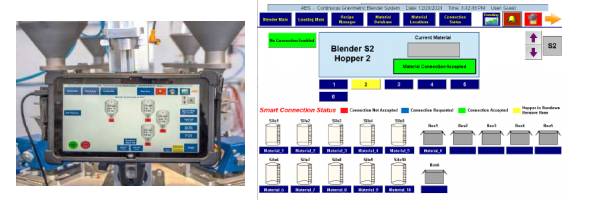
Advanced Blending Solutions supports scalable PC- and PLC-based controls, including Allen-Bradley and Beckhoff systems, custom software, recipe integration, temperature control, process visibility, alarms, trends, and interfaces to connected material-handling equipment. Optional remote support is subject to the quoted platform, enrollment, plant network access, and cybersecurity approval. Final I/O, historian, interfaces, support scope, and commissioning are project-specific.